
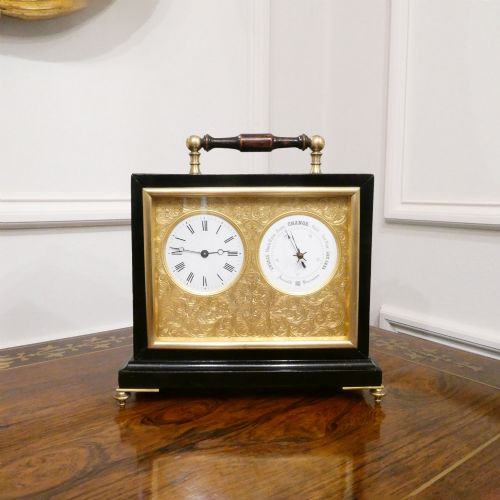
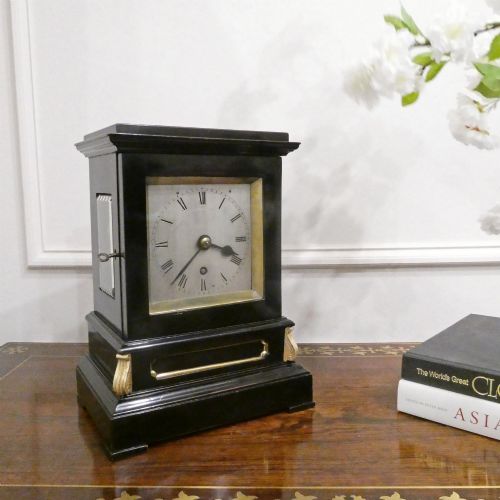
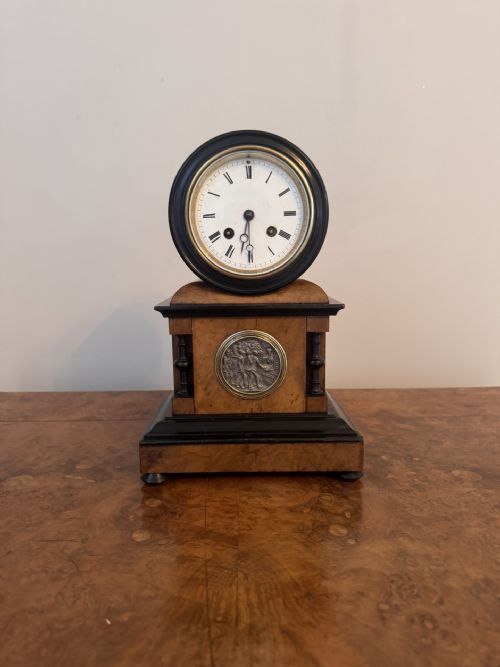


Ebonised Wood Mantel Clock
An ebonised wood mantel clock brings dark timber and striking brass movement to a shelf, offering the weight of Victorian or Regency design.
Ebonised Wood Mantel Clock
An ebonised wood mantel clock is a timepiece designed for domestic interiors, typically constructed from timber treated to resemble ebony. The examples on this page span the eighteenth century through the Edwardian period, with Victorian pieces appearing most frequently.
The forms range from traditional bell-top bracket clocks and library clocks to chiming mantel clocks and ormolu-mounted French designs. Alongside standard clock cases, related objects such as display domes and carriage clocks also emerge within this search phrase.
Construction and materials
The primary construction relies on timber finished with an ebonising process to achieve a deep black surface, often paired with secondary woods like burr walnut. Cases frequently incorporate glass viewing panels, brass bezels, and gilt bronze or ormolu mounts.
Dial work typically utilises enamel for chapter rings, while internal movements combine brass gears and plates, driven by mechanisms such as single fusee or striking trains.
Listings for this phrase include pieces from the eighteenth century, the Regency era, and the Victorian period, utilising ebonised wood alongside brass and gilt bronze.
Assessing quality and execution
Quality reveals itself in the crispness of the timber finish, the weight and gilding of the brass mounts, and the complexity of the internal movement, such as chiming mechanisms or verge escapements. The integration of maker signatures on dials or backplates elevates a piece.
The refinement of the case joinery and the preservation of original enamel dials and glass panels distinguish standard production clocks from finer workshop examples.
Des Granges of London·Charles Frodsham and Holingue Frères·John Taylor London·D Robertson of Perth·Baldwin of Loughborough·Henry Marc
The Ebonised Wood Mantel Clock Glossary
- Ebonised
- Timber treated with stain or paint to imitate ebony. This dark finish became particularly popular during the Victorian and Aesthetic Movement periods.
- Fusee
- A conical pulley used in clock movements to maintain even driving force as the mainspring unwinds. It is a hallmark of better quality mechanical timepieces.
- Verge
- An early type of escapement controlling the release of the gear train. It is commonly found in older bracket clocks.
- Ormolu
- Gilt bronze ornamentation applied to clock cases. The technique involves coating bronze with a mercury and gold amalgam.
- Bracket clock
- A portable table clock traditionally placed on a matching wall bracket. Many examples feature bell-top wooden cases.
Ebonised Wood Mantel Clock: Frequently Asked Questions
How do I wind an ebonised mantel clock?
Most mechanical clocks require a key to turn the winding squares on the dial face gently. Care must be taken not to overwind the mainspring.
Striking and chiming models may also need their levers synchronised if the strike falls out of step with the hands.
Where should I place a mantel clock?
These clocks sit best on level surfaces such as mantelpieces, sideboards, or library shelves where vibrations are minimal. A stable base ensures the pendulum beats evenly.
Direct sunlight and damp environments should be avoided to protect the ebonised finish and internal brasswork.
What is a single fusee movement?
A single fusee movement uses a conical drum and cord or chain to equalise the power delivered by the mainspring. This mechanism helps the clock maintain consistent timekeeping as it runs down.
Library clocks and bracket clocks frequently employ this system for improved accuracy.