

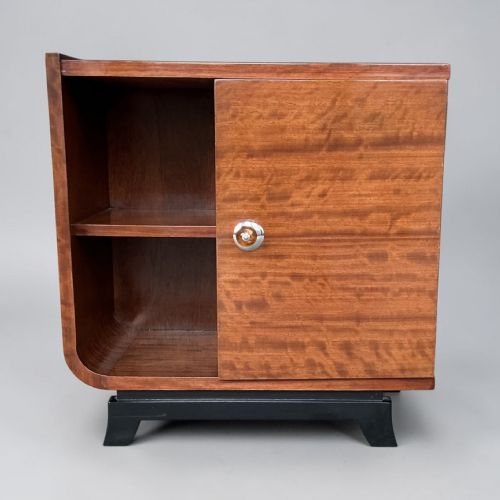
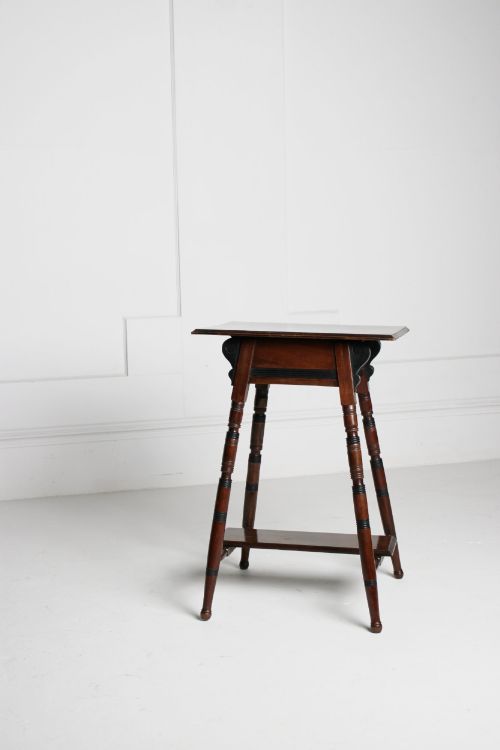
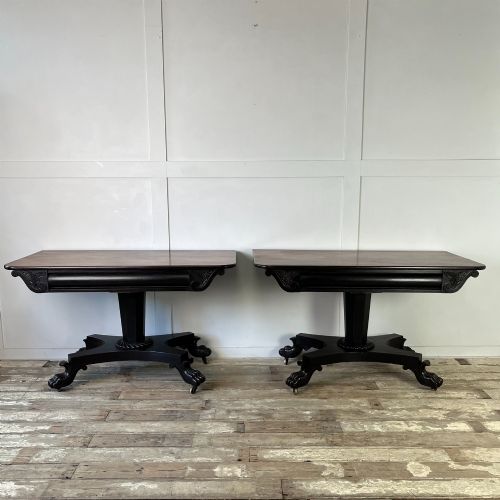


Ebonised Mahogany Side Table
An ebonised mahogany side table brings dark elegance and striking contrast to a room through deep-toned wood and polished timber.
Ebonised Mahogany Side Table
When you search for an ebonised mahogany side table, you encounter pieces designed to serve functional and decorative purposes in period interiors. The records show forms ranging from console tables and occasional tables to canterburys and side cabinets.
You are most likely to meet 19th-century interpretations on this page, alongside Georgian, Regency, William IV, Victorian, Edwardian, and 1930s Art Deco examples. These items utilise traditional timber construction finished with dark ebonisation to mimic ebony.
The styles span French Empire, Aesthetic Movement, and Late Victorian designs. Each piece reflects the decorative priorities of its specific period while maintaining the core characteristics of the form.
Materials and construction methods
The construction relies primarily on mahogany as the base timber, treated with an ebonising process to achieve a uniform black finish. Workshops frequently incorporated brass hardware, marble tops, and parcel gilt highlights to enhance the visual impact of the dark surfaces.
Makers applied specialised finishing techniques to create the deep gloss characteristic of ebonised pieces. Structural joinery adheres to period cabinetry standards, utilising solid timbers and occasional veneer applications.
Ebonised Mahogany Side Table Retail Price Guide 2026
Typical asking prices for ebonised mahogany side table among the pieces listed under this phrase on Sellingantiques today, from the lower quarter to the upper quarter. They describe what is for sale here now, not the wider market.
One recorded Victorian piece multitasks as both a table and a music stand, proving that Victorians loved furniture that worked overtime.
Distinguishing quality across examples
Quality separates standard production items from exceptional commissions through the depth of the ebonising finish and the selection of the underlying mahogany. Superior examples display meticulous surface preparation and refined proportions.
The incorporation of secondary materials such as original brass mounts, marble inserts, or intricate inlay work elevates a piece. Craftsmanship in the joinery and the integrity of the structural frame determine the enduring standard of the object.
Druce & Co London
The Ebonised Mahogany Side Table Glossary
- Ebonised
- Wood finished with a dark stain or paint to imitate ebony. This treatment became popular during the nineteenth century to provide a dramatic contrast in period interiors.
- Console table
- A table designed to stand against a wall, frequently supported by console brackets or legs. These items often feature decorative front legs and simpler rear supports.
- Guéridon
- A small circular table on a central pillar, originating in seventeenth-century France. Later nineteenth-century versions frequently adopt classical revival forms.
- Canterbury
- A low stand featuring partitions for holding sheet music, books, or newspapers. Some variants incorporate table surfaces or cabinet compartments above the rack.
- Parcel gilt
- Woodwork decorated with small areas of gold leaf applied to specific carved details. This technique highlights architectural motifs against a dark background.
Ebonised Mahogany Side Table: Frequently Asked Questions
How were these tables used historically?
Historically, these tables functioned as display surfaces for decorative objects, lamps, or writing materials in reception rooms and parlours. Console variants stood against walls to anchor decorative arrangements.
Smaller formats like Sutherland tables or lamp tables offered movable surface space for tea or reading materials. Their dark finishes suited the heavier interior palettes of the Victorian and Edwardian eras.
How do I style an ebonised mahogany side table today?
You can place these tables in hallways, living rooms, or bedrooms as accent pieces that provide a strong visual anchor. Their dark tones complement both neutral modern backdrops and traditional period spaces.
Pair them with metallic accents or contrasting ceramics to highlight the deep finish of the wood. The compact footprint of many examples allows them to fit easily into smaller alcoves.
How do I identify the period of a table?
Identifying the period involves examining the structural style, decorative motifs, and secondary materials used in the construction. Pieces from the Georgian and Regency eras show classical restraint, while Victorian and Aesthetic Movement examples embrace more elaborate ornamentation.
Documentation or maker stamps, where present, provide definitive dates. Construction techniques also reveal the manufacturing era, shifting from hand-cut joinery to later industrial methods.