
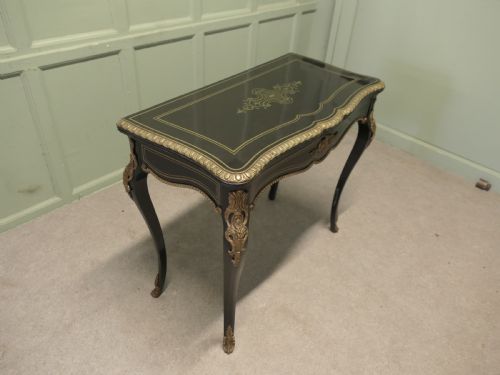


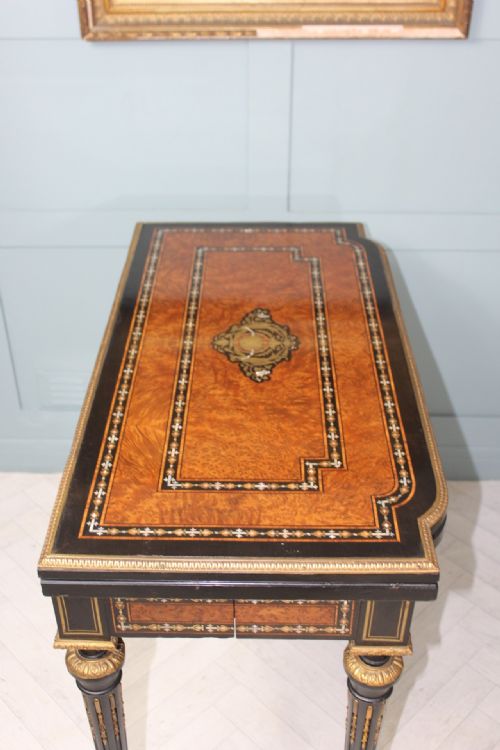

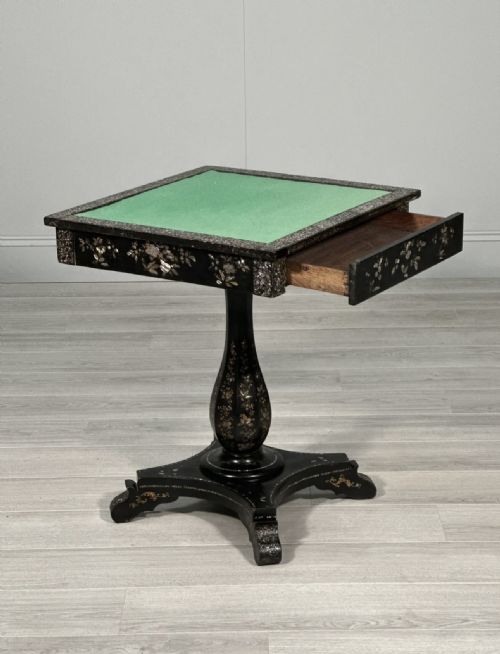
Ebonised Inlaid Gaming Table
An ebonised inlaid gaming table brings dark timber and metallic flash to a drawing room, offering a folding top designed for cards and social play.
Ebonised Inlaid Gaming Table
An ebonised inlaid gaming table combines a darkened dark wood surface with contrasting metallic or shell decoration, built to serve as a functional card surface when unfolded.
The pieces catalogued here span the nineteenth century, including Victorian, Aesthetic Movement, and French Napoleon III or Louis XV style examples.
Forms range from card and games tables to occasional, console, and coffee tables, alongside specialised variations such as handkerchief and sewing tables.
Materials and construction methods
Workshops utilised ebonised wood as a dark ground, often pairing oak, walnut, or burr walnut with contrasting inlays of brass, ormolu, and tortoiseshell.
Detailed marquetry and mother-of-pearl embellishments were meticulously set into the timber surfaces, reflecting French Rococo Revival and Boulle techniques.
The listings show nineteenth century examples incorporating brass, ormolu, tortoiseshell, and mother-of-pearl across Victorian and French styles.
Judging the quality
Excellence rests in the precision of the brass inlay and the depth of the marquetry, separating standard production from exhibition quality output.
The crispness of the ebonisation and the integrity of the folding mechanism dictate the standing of each piece.
Edwards & Roberts
The Ebonised Inlaid Gaming Table Glossary
- Ebonised wood
- Timber treated to imitate costly ebony, providing a dense black finish that highlights metal and shell inlays.
- Boulle marquetry
- A decorative technique employing tortoiseshell and brass cut in opposing patterns, popular in French revival furniture.
- Marquetry
- The art of applying small pieces of veneer to a structure to form decorative patterns and pictorial designs.
- Ormolu
- Gilded bronze mounts applied to furniture edges and corners, common in nineteenth century revival pieces.
Ebonised Inlaid Gaming Table: Frequently Asked Questions
What is an ebonised inlaid gaming table?
These pieces are nineteenth century tables featuring darkened timber surfaces decorated with brass, mother-of-pearl, or tortoiseshell, built with folding or swiveling tops.
They were intended for card games and social gatherings in formal rooms, combining ornamental presence with practical utility.
How were these tables used originally?
Owners unfolded or rotated the tops to reveal baize-lined surfaces for evening card games, chess, or social entertainment.
Between gatherings, the tables stood against walls as console or occasional furniture, displaying their marquetry and metalwork.
How do I distinguish French styles from English Victorian pieces?
French Napoleon III and Louis XV style pieces often feature elaborate Boulle marquetry, ormolu mounts, and mother-of-pearl detail.
English Victorian examples, including Aesthetic Movement designs, tend to rely on simpler ebonised oak or walnut construction with geometric or botanical inlay.
How should I live with an ebonised table?
Position the table away from direct sunlight and strong heat sources to protect the delicate ebonised finish and prevent wood shrinkage.
Use coasters and gentle dusting cloths rather than harsh chemical polishes to preserve the brass and tortoiseshell inlays.