


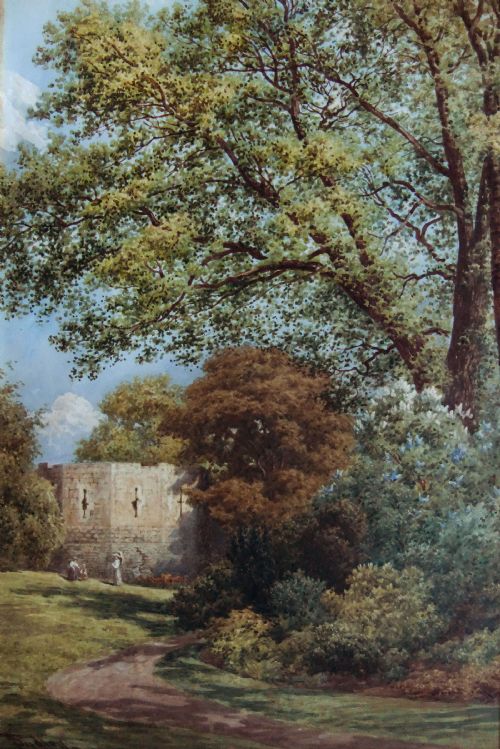


Earthy Green Watercolour Painting
An earthy green watercolour painting captures landscape and still life through muted tones, offering a calm connection to British artistic traditions.
Earthy Green Watercolour Painting
When buyers search for an earthy green watercolour painting, they look at works spanning from the Victorian era through the mid-twentieth century, including pieces by named British artists. These works frequently depict rural landscapes, river scenes, and still life compositions rendered in subtle, natural palettes.
The pieces on this page are predominantly original watercolours on paper, often framed in wood and glass to preserve the delicate pigment. They range from late nineteenth-century depictions of churches and valleys to 1940s wartime studies and modernist views.
Buyers are most likely to encounter framed landscape watercolours from the Victorian period up to the 1940s, featuring characteristic green and earth-toned washes. These items function primarily as wall art, bringing historical British scenery and botanical stillness into modern interiors.
How these watercolours were produced
These works rely on watercolour pigment and paint applied to paper surfaces, occasionally finished with ink detailing to define architectural or botanical outlines. Artists utilised the transparency of the medium to build depth in landscape foliage and pastoral skies.
Framing materials such as wood and glass safeguard the delicate paper supports from environmental moisture and handling damage. Gilt accents sometimes appear on the frames, enhancing the visual weight of the Victorian and Edwardian pieces.
Earthy Green Watercolour Painting Retail Price Guide 2026
Typical asking prices for earthy green watercolour painting among the pieces listed under this phrase on Sellingantiques today, from the lower quarter to the upper quarter. They describe what is for sale here now, not the wider market.
The listings span periods from the Victorian era through to 1940, utilising paper, watercolour pigment, wood, and glass.
What separates the finest works
Quality in these watercolours rests upon the assurance of brushwork and the artist's command of tone, where pigment application creates convincing atmospheric depth. Stronger pieces demonstrate confident control over the green and earthy palette without relying on heavy overworking.
The preservation of the paper and the integrity of the framing contribute significantly to the standing of a piece. Works that retain their original tonal balance without excessive fading represent the higher end of the selection.
James Tower·James Orrock·Alfred Grey RHA·Tom Dudley·Charles Branwhite·Fred Lawson·George Graham
The Earthy Green Watercolour Painting Glossary
- Watercolour paint
- A medium consisting of pigment suspended in a water-soluble vehicle, applied to paper to create translucent washes of colour. It requires careful protection behind glass to prevent light degradation.
- Victorian
- A period spanning the reign of Queen Victoria, characterising the nineteenth-century pieces in this collection. Works from this era often display detailed attention to landscape topography.
- Still life
- An artwork depicting inanimate subject matter, such as flowers in a jug or fruit. This genre allows artists to focus entirely on composition and earthy colour relationships.
- Mid-Century Modern
- A stylistic descriptor covering twentieth-century works that lean towards simplified forms and modern viewpoints. These pieces reflect broader shifts in British art away from strict academic realism.
Earthy Green Watercolour Painting: Frequently Asked Questions
How should I hang an old watercolour?
Watercolours are sensitive to light and should be positioned away from direct sunlight to prevent the green pigments and paper from fading over time.
Ensure the room maintains a stable humidity level and that the frame is securely sealed with glass to protect the paper surface.
Are these paintings original?
The listings comprise original works on paper rather than reproduction prints, bearing the distinct brushwork and pigment texture of the period.
Examining the surface closely under magnification reveals the paper grain and individual pigment particles characteristic of hand-painted art.
What framing is appropriate?
Many pieces retain traditional wooden frames that complement their Victorian or twentieth-century origins, often preserved under glass.
If re-framing, utilise conservation-grade materials and acid-free mounts to ensure the paper remains stable for decades to come.
How do I date a landscape watercolour?
Dating relies on the artist's active period, stylistic movements such as British Impressionism, and the physical evidence of the paper and frame.
Signatures, inscriptions on the reverse, and period framing techniques provide reliable clues to the exact decade of creation.