
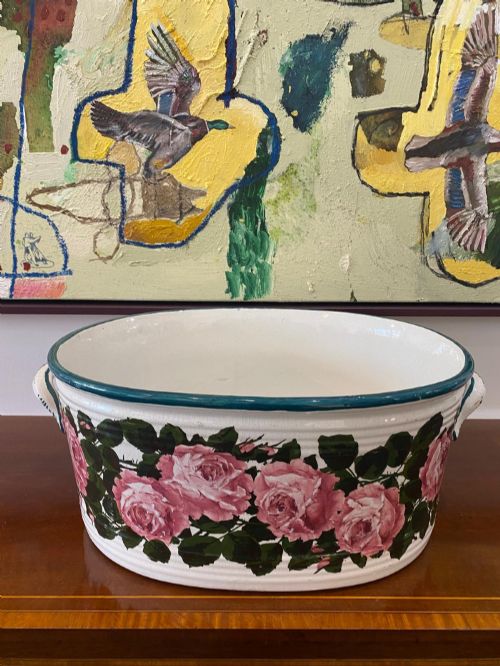
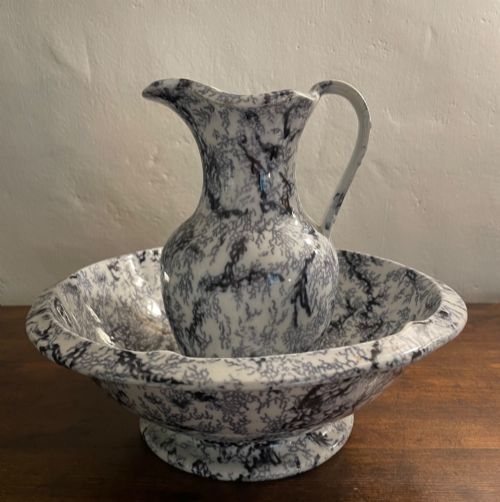
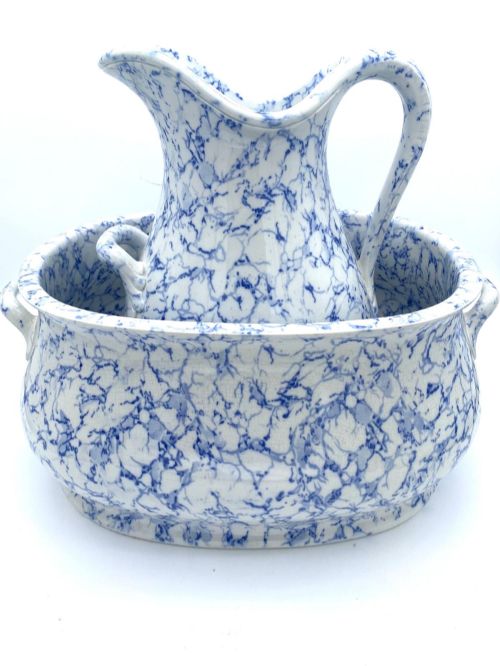
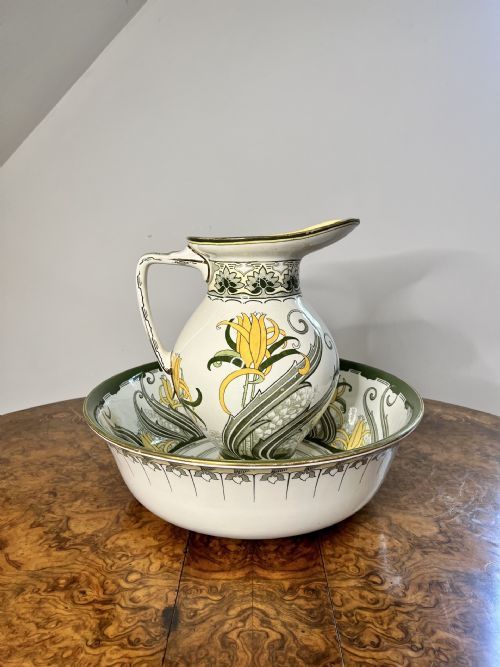

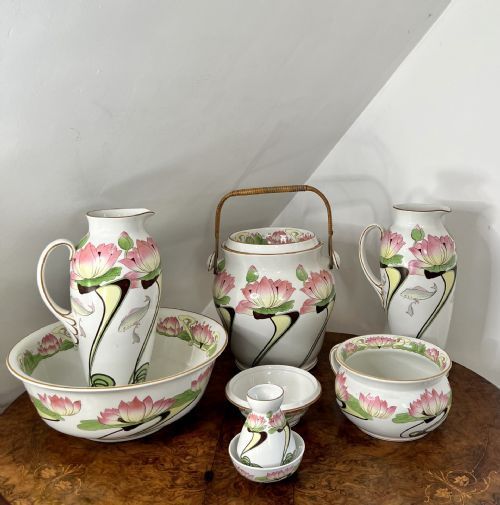

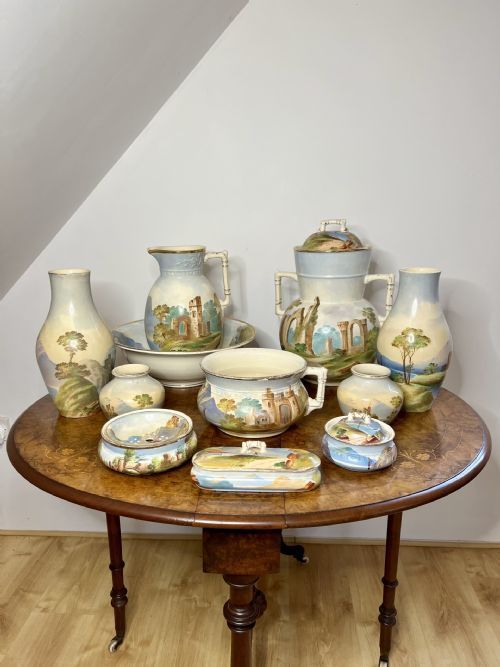


Earthenware Wash Basin
An earthenware wash basin brings utility and period charm to a room, ranging from grand footbaths to complete toilet sets.
Earthenware Wash Basin
An earthenware wash basin covers a practical domestic history spanning the Regency, Victorian, and Edwardian eras. Buyers search for these pieces to find functional ceramic basins, footbaths, and matching jug and bowl sets.
The selections here most commonly present as Edwardian bathroom sets or 19th-century wash sets featuring transfer-printed motifs. Alongside these sit larger utility forms such as footbaths, knee baths, and green-glazed tian bowls originating from the nineteenth century.
How They Were Made
Potters shaped these vessels from earthenware and creamware, applying lead glaze or smooth ceramic finishes to seal the porous clay body. Many examples incorporate blue and white transfer printing or flow blue techniques to apply detailed patterns across the surface.
Makers utilised specialised firing methods to achieve durable glazes suitable for daily washing and bathing routines. Some decorative pieces received hand-painted accents or gold leaf highlights over the established ceramic base.
Some nineteenth-century footbaths were so capacious that buyers now repurpose them to ice champagne at dinner parties.
What Varies in Quality
The distinction between standard domestic ware and superior examples rests in the crispness of the transfer print and the uniformity of the glaze. Master potteries applied intricate patterns with precise alignment, whereas lesser items show blurred transfers or pooled glaze.
Scale and form also separate common basins from exceptional pieces like large footbaths and marked institutional sets. Condition, structural integrity of the ceramic body, and the presence of a matching water jug elevate certain pieces above simple utilitarian bowls.
Wemyss·Minton·Doulon Burslem·Mann Co·Heathcote·Mark Jones And Sons·Copeland·Verwood
The Earthenware Wash Basin Glossary
- Earthenware
- A porous pottery type fired at lower temperatures, requiring a glaze to hold water. It forms the core material for the majority of these historic basins and jugs.
- Flow Blue
- A transfer-printing technique where cobalt blue bled slightly into the surrounding white glaze during firing. This created a soft, hazy outline favored by Victorian potteries.
- Footbath
- A deep, elongated oval vessel designed for soaking feet before the era of plumbed bathrooms. These substantial items frequently double as decorative planters.
- Creamware
- A refined, pale yellow-hued earthenware developed in the 18th century. It provided a smooth surface for painted and printed ceramic designs.
- Spongeware
- Pottery decorated by dabbing pigment onto the biscuit body using a natural sponge. This technique produced mottled, abstract patterns popular on utility bowls.
- Gaudy Welsh
- A style of colourful, hand-painted earthenware featuring cobalt blue, copper lustre, and iron red. It appeared on nineteenth-century toilet basins and domestic tablewares.
Earthenware Wash Basin: Frequently Asked Questions
What is an earthenware wash basin used for?
These basins served personal hygiene routines in bedrooms and dressing rooms before running indoor plumbing became standard.
Today, they find new purpose as decorative planters, umbrella stands, or striking display pieces in modern bathrooms.
How do I date a wash basin?
Dating relies on maker marks stamped into the ceramic base, stylistic clues like Art Nouveau curves or Regency forms, and the specific transfer print techniques used.
Victorian and Edwardian pieces often display registry numbers or factory names that pinpoint their exact decade of production.
What is the difference between a wash set and a footbath?
A wash set typically includes a large basin paired with a matching water jug, soap dish, and chamber pot for daily cleaning.
A footbath is a single, deep, oblong vessel specifically shaped for bathing the feet, often featuring carrying handles at either end.
Are these basins waterproof?
Most pieces retain their original lead glaze or ceramic finish, making them suitable for holding water and displaying cut flowers or plants.
However, hairline cracks acquired over a century of use mean some antique basins are best reserved for dry decorative display.