

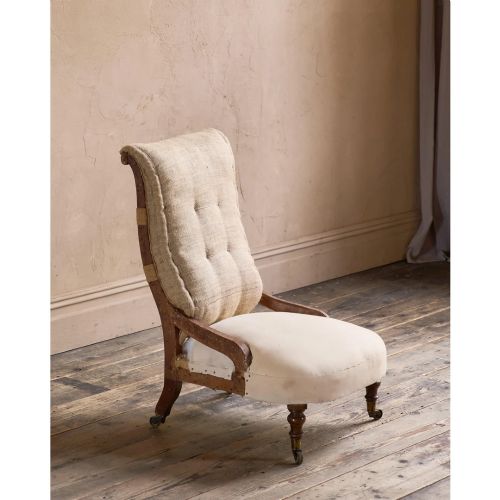
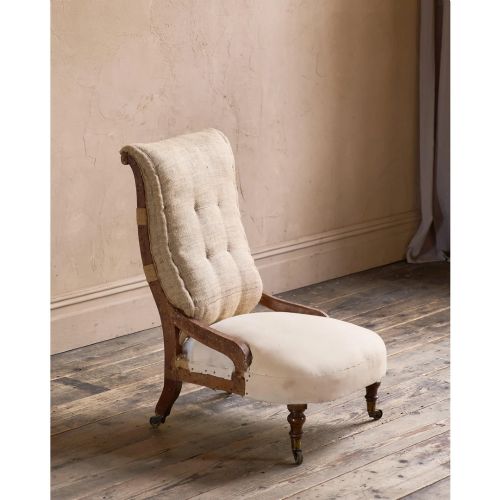


Early Victorian Slipper Chair
An early victorian slipper chair brings low seating and buttoned upholstery to a bedroom or drawing room.
Early Victorian Slipper Chair
An early victorian slipper chair is a low-slung seat designed for bedrooms and drawing rooms during the nineteenth century. These pieces serve as nursing chairs, occasional chairs, and salon chairs, often featuring scroll backs or spoon backs.
Most examples found here date from the mid-nineteenth century, around eighteen-forty to eighteen-sixty, spanning the Victorian, early Victorian, Gothic Revival, and William IV styles. They appear in forms such as open tub chairs, ladies chairs, and side chairs.
How they were made
The frames are constructed from dense timbers like rosewood and walnut, shaped with scroll arms and turned supports. Brass castors frequently facilitate movement beneath the wooden legs.
Upholstery relies on traditional internal foundations covered in hessian and calico, finished with top layers of velvet, damask fabric, leather, or tapestry. Buttoning secures the padding deeply into the backrest.
Early Victorian Slipper Chair Retail Price Guide 2026
Typical asking prices for early victorian slipper chair among the pieces listed under this phrase on Sellingantiques today, from the lower quarter to the upper quarter. They describe what is for sale here now, not the wider market.
Listings feature rosewood, walnut, brass, velvet, leather, and damask across Victorian, William IV, and Gothic Revival styles.
What varies in quality
Quality rests upon the proportion of the timber frame and the crispness of the turning or carving. Denser rosewood and walnut framing indicates higher status than secondary woods.
The sophistication of the upholstery work and the integrity of the surviving textile choice dictate the distinction between standard room furniture and finer salon pieces.
Howard and Sons
The Early Victorian Slipper Chair Glossary
- Slipper chair
- A low-seated upholstered chair originally designed for bedrooms to allow comfortable dressing. These pieces lack arms and stand close to the floor.
- Nursing chair
- A low chair specifically designed for feeding infants in the nineteenth century. They share a similar low stature with slipper chairs.
- Spoon back
- A padded chair back shaped like the bowl of a spoon, curving inward to fit the human spine. This form is typical of mid-nineteenth-century seating.
- Scroll back
- A chair back featuring an outward-curved top rail that resembles a rolled scroll. It appears frequently on Victorian drawing room and bedroom chairs.
- Castor
- A small wheel attached to the base of a furniture leg for ease of rolling. Brass versions are common on nineteenth-century seating.
Early Victorian Slipper Chair: Frequently Asked Questions
What is an early victorian slipper chair?
An early victorian slipper chair is a low-slung, armless seat built during the nineteenth century for domestic dressing rooms and bedrooms. These chairs allowed comfortable seating close to the floor.
Surviving examples often feature exposed rosewood or walnut frames alongside buttoned upholstery in velvet, leather, or damask.
How were these chairs used originally?
These seats served primarily in private chambers for dressing, grooming, and nursing infants. Their low stature made them practical for domestic tasks.
Over time, they moved into drawing rooms and salons as occasional seating for guests.
How do I identify a Victorian period piece?
Identification relies on observing the timber choice, structural form, and upholstery style. Rosewood and walnut frames with scroll or spoon backs point directly to the mid-nineteenth century.
Turned wooden legs fitted with brass castors further support this dating.
How do I live with one today?
Place these compact chairs in bedrooms, dressing rooms, or smaller sitting areas where low seating functions best. Their scale prevents them from overwhelming modern spaces.
Protect the historic fabric or leather by keeping them away from direct sunlight.