



Eagle Wall Sconces
Eagle wall sconces bring fierce neoclassical presence to a room, carved and gilded to hold light against panelled walls.
Eagle Wall Sconces
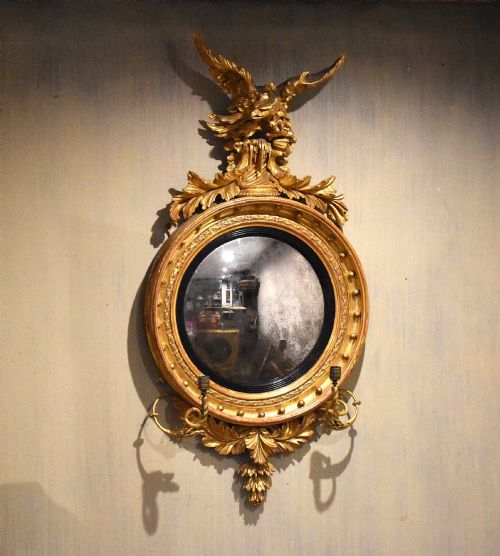
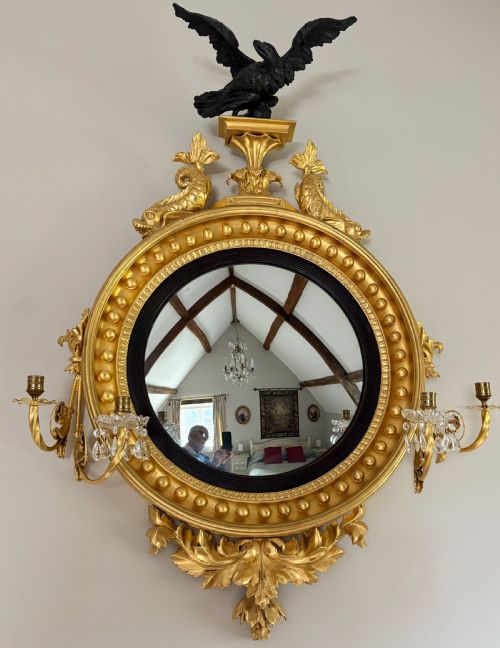
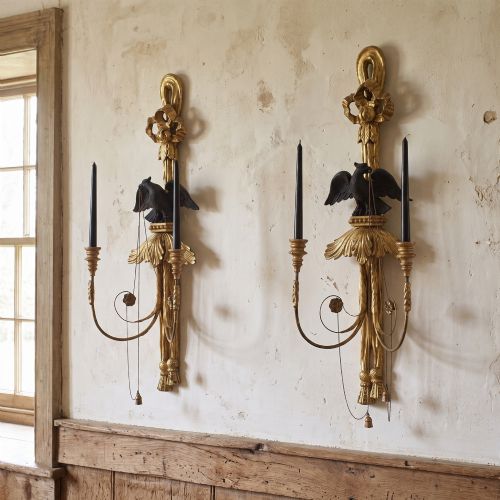
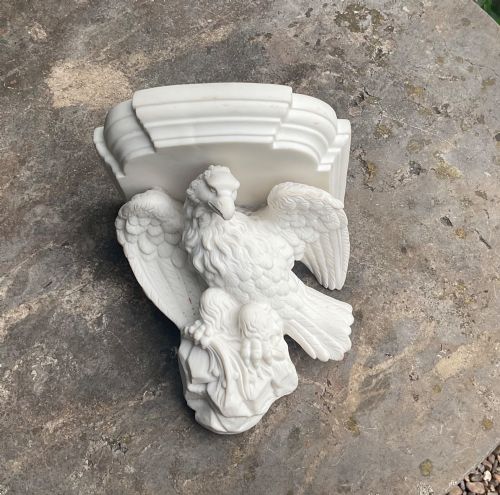
Eagle wall sconces encompass carved wooden brackets, giltwood girandoles, and porcelain shelves featuring the majestic bird as a central motif. These decorative objects merge lighting with sculpture, drawing directly upon Regency, Georgian, and Victorian design traditions.
The versions most commonly met on this page span the Regency period and the early twentieth century, rendered in richly carved giltwood or sturdy oak. Many examples take the form of girandole mirrors with sconces branching outwards, or simple brackets designed to support small ornaments.
Makers drew on Americana folk art alongside British neoclassical idioms, resulting in pieces that range from rustic carved wood to elaborate gilded confections with convex glass. Each piece serves primarily as wall furniture, combining functional illumination or display with strong symbolic carving.
Materials and Construction
Construction relies heavily upon carved timber, predominantly pine or oak, built up with layers of gesso before receiving a rich coat of gold leaf. This traditional giltwood technique creates a luminous surface that catches candlelight or natural daylight.
Makers incorporated brass candle arms and clear glass components, such as convex mirror plates or crystal drops, to amplify the ambient light in a room. Parian porcelain also appears as a moulded medium, offering a matte biscuit finish reminiscent of carved marble for sculptural wall brackets.
Eagle Wall Sconces Retail Price Guide 2026
Typical asking prices for eagle wall sconces among the pieces listed under this phrase on Sellingantiques today, from the lower quarter to the upper quarter. They describe what is for sale here now, not the wider market.
Materials represented across the inventory include traditional giltwood, brass, ebonised wood, and Parian porcelain.
Judging Quality
The integrity of the gilding further separates standard examples from exceptional ones, particularly where burnished gold leaf contrasts with matte grounds. Original glass plates and intact brass candle arms significantly elevate the standing of a piece.
The Eagle Wall Sconces Glossary
- Giltwood
- Wood that has been coated with thin sheets of gold leaf over a prepared gesso ground. This finish provides a durable, reflective surface characteristic of formal antique mirrors and sconces.
- Girandole
- A branched wall sconce, frequently incorporating a mirror plate to reflect and multiply the light of candles. The mirrored backing enhances illumination in dimly lit historic interiors.
- Gesso
- A plaster-like mixture applied to wood surfaces to create a smooth base for gilding or painting. Skilled artisans carve directly into this layer to achieve fine decorative detail.
- Convex Mirror
- A circular glass mirror with a curved, outward-bulging surface that provides a wide-angle reflection of the room. These are often surmounted by carved eagles in Regency designs.
- Parian Porcelain
- A fine, hard-paste porcelain resembling white marble, developed in the nineteenth century. It is commonly utilised for decorative busts and sculptural wall brackets.
Eagle Wall Sconces: Frequently Asked Questions
What is an eagle wall sconce?
An eagle wall sconce is a decorative wall-mounted fixture featuring carved or moulded representations of an eagle, often designed to hold candles or support small objects.
These pieces function as both sculpture and lighting, drawing upon neoclassical and folk art traditions from the Georgian era through to the early twentieth century.
How were eagle sconces used originally?
Historically, these fixtures were mounted on drawing room and parlour walls to provide supplemental illumination from candles.
The reflective glass plates and gilt surfaces helped to bounce and amplify the feeble candlelight available before electric lighting became common.
Where should I place a wall sconce?
Wall sconces suit living rooms, hallways, and dining spaces where they can be mounted at eye level to create a strong visual focal point.
Pairing them with a console table or flanking a larger mirror allows the carved eagle motif to anchor the room's decorative scheme.
How do I distinguish Regency styles?
Regency pieces typically feature bold neoclassical motifs, including convex mirror plates, ebonised details, and deeply carved giltwood eagles with outstretched wings.
They reflect the early nineteenth-century taste for classical antiquity and theatrical interior ornamentation.