
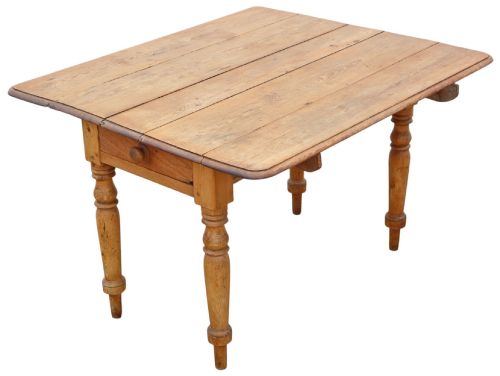
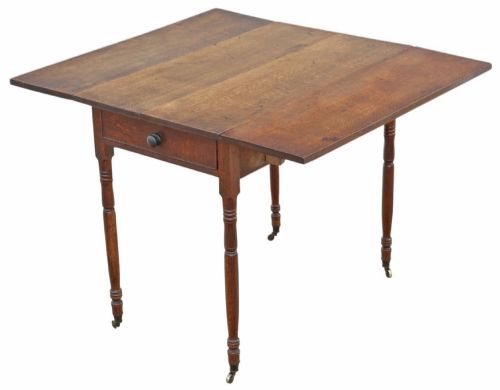
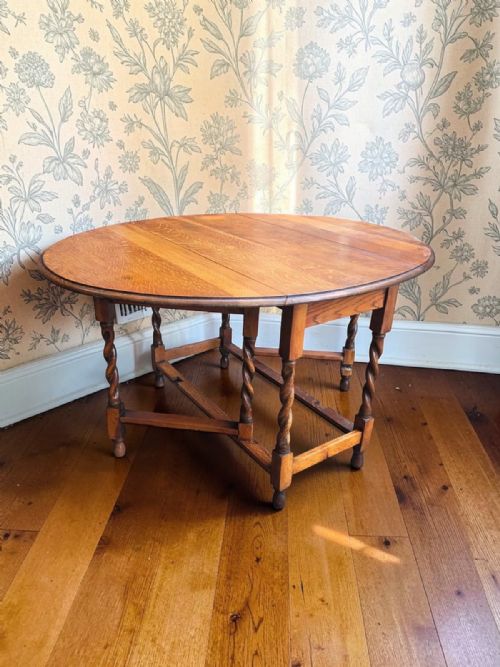
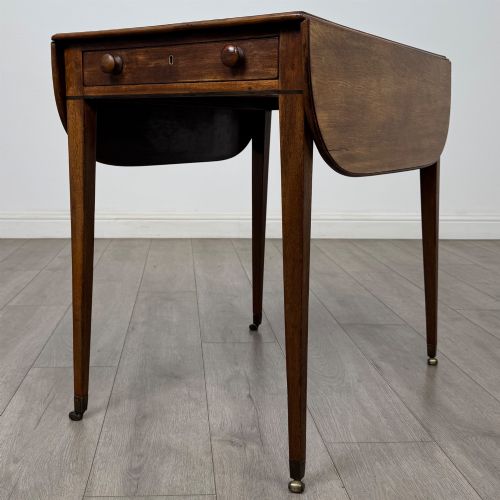
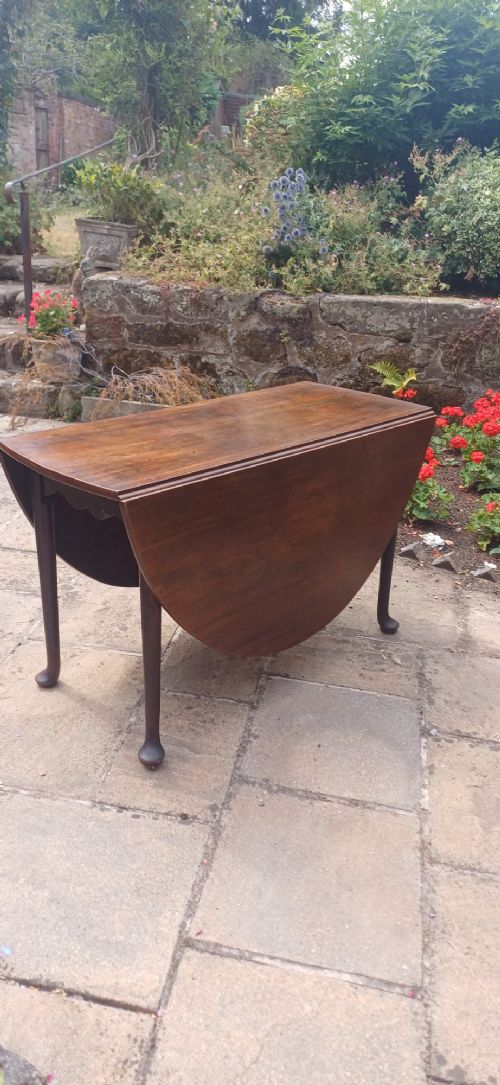
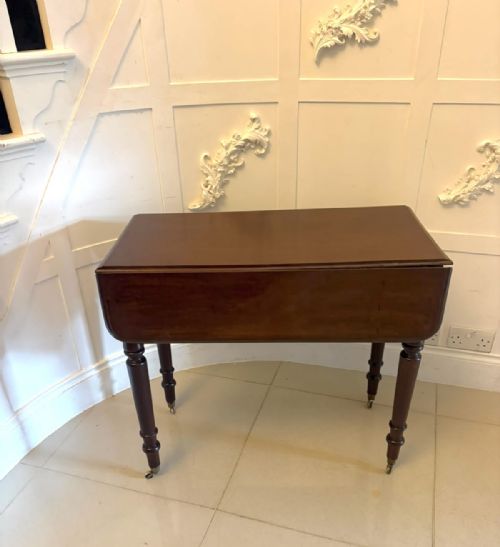
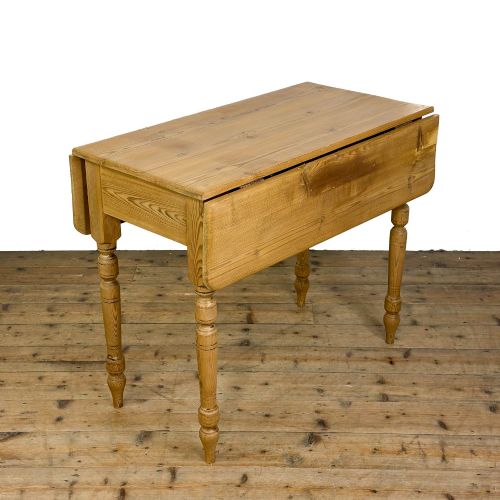
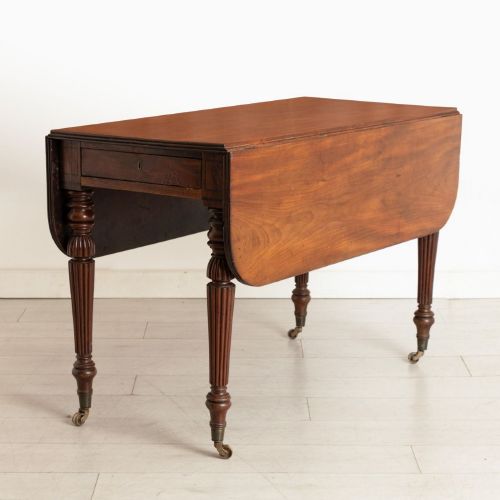
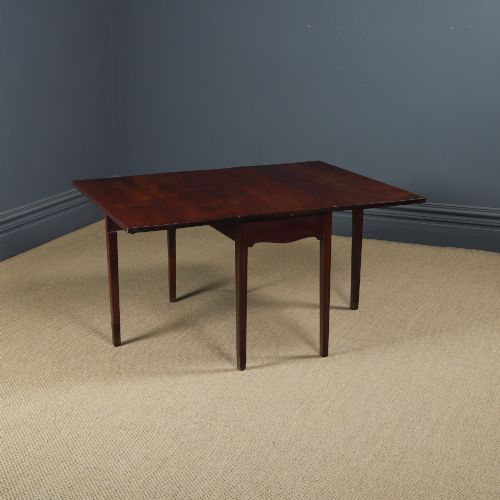
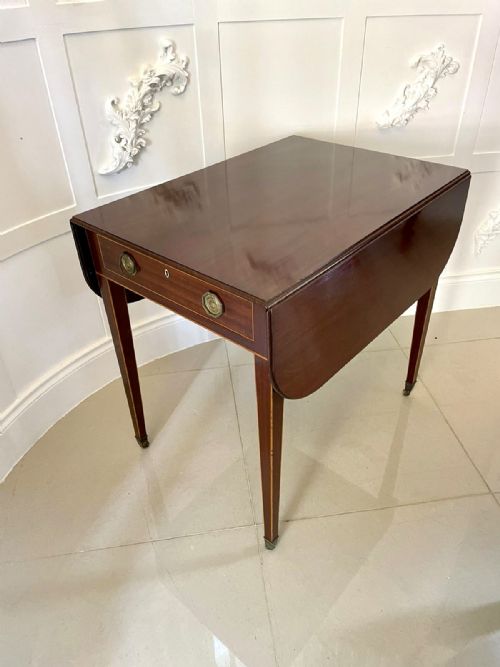


Drop Flap Breakfast Table
A drop flap breakfast table offers a folding surface that expands for dining and tucks away neatly against a wall when not in use.
Drop Flap Breakfast Table
A drop flap breakfast table provides a versatile surface designed to adapt quickly to changing domestic spaces throughout the Georgian, Victorian and Regency periods. These versatile tables appear most frequently as Pembroke tables and larger gateleg or centre dining tables featuring hinged leaves.
Makers constructed these pieces using dense timbers such as mahogany, oak and pine, often incorporating drawers for storage alongside the folding flaps. Buyers encounter everything from compact occasional pieces to large dining tables intended to seat six people comfortably.
Materials and construction methods
Craftsmen built these tables primarily from solid mahogany, oak and pine, frequently selecting Cuban mahogany or adding boxwood and wood inlay for decorative contrast. The hinged drop leaves required sturdy pivot mechanisms and stable gatelegs or drop flaps supported by pivoting brackets.
Joinery techniques included secure framing for drawers and pedestal mounts, ensuring the moving leaves remained level with the fixed centre top during daily use.
Listings feature woods including mahogany, Cuban mahogany, oak, pine, rosewood and satinwood across Georgian, Regency and Victorian periods.
Factors influencing quality
Quality rests upon the selection of timber, such as heavily figured Cuban mahogany or well-chosen satinwood and rosewood cross-banding, rather than plain secondary woods. Finer examples display precise inlay work, carefully fitted drawer boxes and robust hinges that maintain the stability of the drop leaves.
Proportion and proportioned turning on legs, whether barley twist or tapering, distinguish standard utilitarian kitchen pieces from exceptional dining tables commissioned for formal reception rooms.
The Drop Flap Breakfast Table Glossary
- Pembroke table
- A small rectangular table featuring two hinged drop leaves on opposite sides, frequently fitted with a single end drawer. This form became popular during the eighteenth century for breakfast and light writing tasks.
- Gateleg table
- A table with hinged leaves supported by legs that swing outward like a gate to bear the weight of the extended top. This clever mechanism allows a large surface area to fold down into a narrow footprint.
- Cross-banding
- A decorative border of veneer laid around the perimeter of a table top so that the grain runs perpendicular to the central panel. This technique creates a neat framed effect seen on better quality Regency and Georgian furniture.
- Drop flap
- A hinged section of a table top that lowers when not required for use. It provides flexibility in room layout by reducing the overall width of the furniture.
Drop Flap Breakfast Table: Frequently Asked Questions
How do I use a drop flap table daily?
Keep the leaves dropped against the wall for everyday floor space, raising them only when you require extra surface area for dining or working.
Ensure the support brackets or swing legs are securely positioned underneath the leaves before placing heavy items on the extended sections.
What periods do these tables cover?
The pieces span from the early eighteenth century through the Georgian and Regency eras into the Victorian period and later revivals.
Earlier examples often utilise oak or walnut, while mahogany dominates the later Georgian and Regency designs found on the market.
Are these tables suitable for small rooms?
Their folding flaps make them exceptionally practical for compact interiors because you can adjust their footprint to suit the room size.
A Pembroke or occasional drop flap design sits neatly against a wall as a console when fully closed.
How can I tell a Pembroke table apart?
Look for narrow rectangular central leaves flanked by two relatively small drop flaps, often accompanied by a drawer at one or both ends.
They generally feature four slender legs, sometimes connected by cross-stretchers or supported on castors for easy movement.