


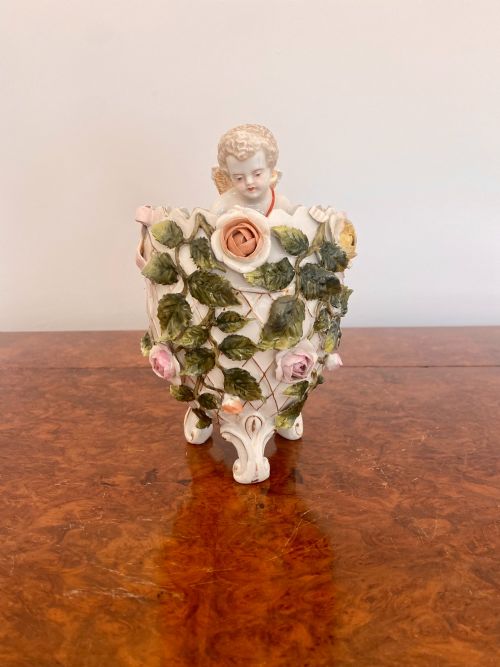
Dresden Style Vases
These dresden style vases bring flamboyant rococo revival forms and intricate painted scenes directly into your interior.
Dresden Style Vases
When you search for dresden style vases, you are looking at ornate ceramic vessels originating primarily from late nineteenth century continental production centres. The pieces appearing here span the eighteen eighties, the nineteenth century broadly, and twentieth century examples from Hungary.
The forms you are most likely to encounter include lidded ginger jars, potpourri urns, gourd vases, and decorative vessels featuring figural elements such as cherubs. These items draw heavily on eighteenth century traditions, translating historical aesthetic codes into Victorian continental taste.
How they were made
The makers formed these objects in porcelain and ceramic, frequently applying detailed enamel decoration and hand painted pictorial scenes depicting figures in landscape settings. Artisans utilised gold leaf and gilt highlights to accentuate the sculptural contours of the porcelain.
Moulding and casting techniques allowed for elaborate three dimensional additions, including applied florals and cherubic figures clambering over the vessels. The finished porcelain bodies received careful glaze firings before final enamelling and gilding.
Dresden Style Vases Retail Price Guide 2026
Typical asking prices for dresden style vases among the pieces listed under this phrase on Sellingantiques today, from the lower quarter to the upper quarter. They describe what is for sale here now, not the wider market.
Listings feature porcelain and ceramic materials decorated with gold leaf, gilt, and enamel across the Victorian and twentieth century periods.
What varies in quality
Quality rests upon the crispness of the porcelain modelling and the dexterity evident in the hand painted Watteau scenes. Finer examples display meticulous brushwork and precise application of gold leaf rather than heavy mechanical transfer printing.
The richness of the ground colours, such as deep blue grounds paired with gilding, alongside the sculptural complexity of lidded forms and applied cherubs, distinguishes exceptional items from standard decorative wares.
Helena Wolfsohn·Sitzendorf Porcelain·Herend
The Dresden Style Vases Glossary
- Rococo Revival
- A nineteenth century design movement reviving the asymmetrical scrolls, shell motifs, and exuberant ornamentation of the eighteenth century French court. This style dictates the curving silhouettes of many vases.
- Gilt
- A thin layer of gold applied to the surface of porcelain to highlight rims, handles, and sculptural details. It catches the light and frames painted panels.
- Potpourri
- A perforated lidded vessel designed to hold dried fragrant plant material. The pierced lid allows scents to diffuse into a room while concealing the contents.
- Ginger Jar
- A high shouldered storage vessel fitted with a matching lid. In nineteenth century production, this traditional shape became a decorative canvas for elaborate painted scenes.
- Enamel
- Opaque vitreous material fused to the porcelain surface through firing. It provides the vibrant, permanent colours seen in figural panels and floral motifs.
Dresden Style Vases: Frequently Asked Questions
What defines dresden style vases?
These pieces are decorative porcelain and ceramic vessels characterised by nineteenth century continental manufacturing methods, elaborate handles, and sculptural lids. They frequently incorporate historical painting styles and gilded ornamentation.
Many examples take specific forms like lidded ginger jars, gourd vases, and urns adorned with cherubs or pastoral scenes. Their aesthetic bridges eighteenth century court taste with Victorian interior display.
How were these vases used?
Historically, these vessels served as prominent decorative centerpieces on mantelpieces, sideboards, and drawing room tables. Lidded versions such as potpourri jars also functioned to perfume domestic spaces with dried botanical mixtures.
Rather than serving utilitarian roles, they functioned as displays of wealth, taste, and refinement in affluent nineteenth century homes. Their intricate painted surfaces invited close inspection by guests.
How do I live with them?
Place these vases on sturdy surfaces where their detailed enamel work and gilding can catch natural light without risking accidental knocks. Because of their delicate applied elements and gold leaf, they require careful placement away from high traffic areas.
Pair them with neutral backgrounds that allow the vibrant blue grounds and pastoral scenes to stand out. Dust them gently with a soft dry brush to preserve the painted surfaces.
How do I date these vases?
Dating relies on examining the porcelain body, the style of the hand painted decoration, and any factory marks present on the base. Pieces from the eighteen eighties often exhibit specific nineteenth century interpretations of earlier eighteenth century motifs.
Stylistic cues such as heavy Victorian continental gilding and specific colour palettes help separate nineteenth century production from later twentieth century examples. Comparing forms with documented factory output aids exact attribution.