


Double Strand Pearl Choker
A double strand pearl choker sits close to the throat, offering a classic neck adornment defined by twin rows of pearls.
Double Strand Pearl Choker
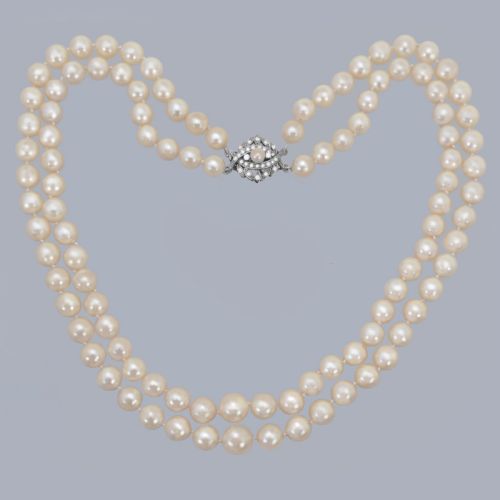
A double strand pearl choker presents a layered formation of pearls, resting higher on the neck than a standard necklace. These pieces appear across multiple eras, ranging from 19th Century and Edwardian designs to Art Deco items and mid-century examples from the 1940s, 1950s, and 1960s.
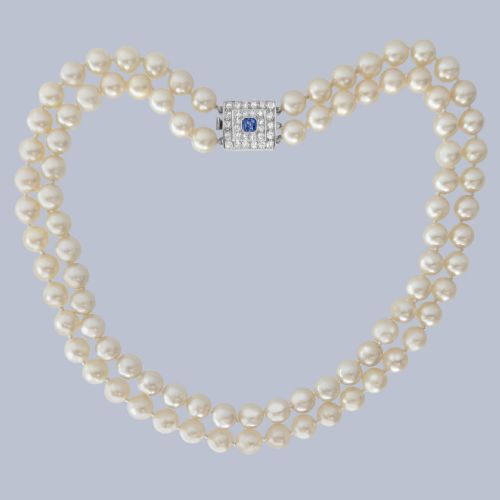
The version most commonly encountered on this page is the mid-century cultured pearl necklace paired with a coloured gemstone clasp. Such pieces utilise either cultured pearls or natural pearls, often secured with 9ct gold or white gold mechanisms.
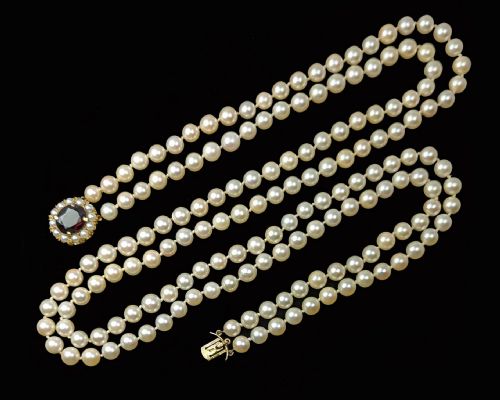
Makers and designers focused heavily on the fastening mechanism, turning the clasp into a focal point set with diamonds, sapphires, garnets, rubies, or tourmalines. Lengths vary, though the choker format specifically remains compact to sit neatly against the collarbone.
Materials and Construction
Construction relies upon stringing pearls into dual parallel strands, a process often updated through professional restringing to ensure structural integrity over time. Pearls are selected for uniformity or graduated sizing, then paired with precious metal clasps.
Metalwork incorporates 9ct gold, 18ct white gold, and silver, fashioned into floral, foliate, or abstract geometric settings. These mountings frequently secure gemstones including diamonds, sapphires, garnets, rubies, and tourmalines directly into the clasp.
Some clasps double as floral bouquets made of gold and garnet, ensuring the necklace looks delightful even when it spins around.
Grading Quality
Quality rests upon the lustre, surface smoothness, and matching of the pearls themselves, alongside the complexity and gemstone content of the clasp. Finer examples feature superior pearl orientation and certified stones within intricate gold mountings.
The craftsmanship of the clasp and the security of the restringing work dictate the overall standard of the piece. Superior items integrate precious gems like diamonds and sapphires into robust gold or silver settings that complement the twin pearl strands.
Mikimoto
The Double Strand Pearl Choker Glossary
- Cultured pearl
- A pearl formed with human intervention, where an irritant is placed inside an oyster to stimulate pearl production. These form the majority of mid-century pieces.
- Clasp
- The fastening mechanism located at the back or side of the necklace, frequently adorned with precious stones and precious metals. It often serves as the decorative centrepiece.
- Foliole
- A decorative motif shaped like a small leaf, commonly seen in gold and silver clasp designs from the Edwardian and mid-century periods.
- Natural pearl
- A pearl formed entirely without human intervention inside a mollusc in the wild. These are typically found in older or period pieces.
- Restrung
- The maintenance process of replacing the silk or thread holding the pearls together. This ensures the necklace remains secure for wear.
Double Strand Pearl Choker: Frequently Asked Questions
How do I wear a double strand pearl choker?
This shorter necklace style sits close to the base of the neck, making it suitable for open necklines and evening wear.
The prominent clasp can be worn at the back or rotated to the front as a decorative pendant feature.
Are these pearls natural or cultured?
The listings include both cultured pearls and natural pearls, depending on the specific period of the piece.
Mid-century items predominantly feature cultured pearls, while certain antique examples incorporate natural specimens backed by gemological certificates.
How should I care for my pearl choker?
Pearls require gentle cleaning with a soft cloth and should be kept away from harsh cosmetics, perfumes, and hairsprays.
Store the necklace flat in a lined box to prevent the silk thread from stretching and to protect the pearls from scratching against other items.
How can I date a pearl necklace?
Dating relies upon the clasp style, the metal purity hallmarks, and the manufacturing techniques used in the mounting.
Edwardian, Art Deco, and 1950s or 1960s mid-century periods each display distinct geometric or floral motifs within their gold and silver clasps.