

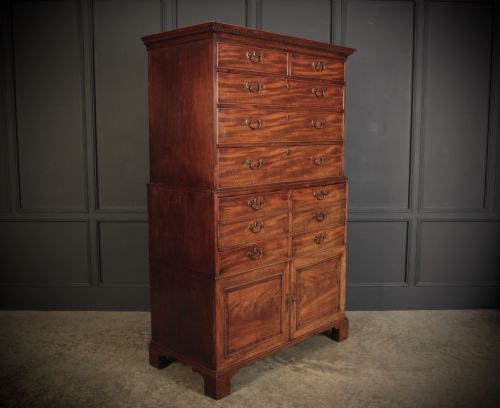


Double Secretaire Desk
Double secretaire desk pieces are substantial storage furniture featuring a fitted writing drawer, and you want one for their architectural presence and hidden compartments.
Double Secretaire Desk
A double secretaire desk combines tall vertical storage with a dedicated writing drawer that drops down to reveal internal pigeonholes and small drawers. These grand items span the Georgian and Victorian eras, taking the form of tallboys, chest on chest configurations, and large bookcase combinations.
Most examples encountered here belong to the eighteenth century, particularly the Georgian and George III periods, constructed with significant height to maximise room utility. Walnut and mahogany dominate the offerings, occasionally finished with paint or paired with glass door upper sections for display purposes.
Forms range from tallboys and chest on chest designs to elaborate bureau bookcases with fitted upper tiers. Buyers encounter pieces from early Georgian through to Victorian times, each showing distinct proportions and drawer arrangements.
How they were made
Cabinet makers utilised dense hardwoods such as mahogany and walnut, selected for durability and rich grain patterns, alongside secondary timbers for internal drawer construction. Brass hardware, including drop handles and escutcheons, secures the structural integrity and operation of the heavy drawers.
Surfaces received careful polishing or painted finishes, while specialised leather inserts often lined the fold-down writing surfaces within the secretaire drawer. Joinery relied on traditional dovetail techniques to withstand the daily weight and stress of stacked drawer compartments.
Double Secretaire Desk Retail Price Guide 2026
Typical asking prices for double secretaire desk among the pieces listed under this phrase on Sellingantiques today, from the lower quarter to the upper quarter. They describe what is for sale here now, not the wider market.
Many secretaire drawers conceal tiny secret compartments designed to hide love letters and small fortunes from prying eyes.
What varies in quality
Design sophistication and timber selection set finer examples apart from standard utility items, particularly where figured veneers and choice walnut or mahogany are employed. The intricacy of the internal fittings within the secretaire drawer, such as secret compartments and shaped pigeonholes, demonstrates the maker's skill.
Proportion and scale dictate the visual weight of the piece, with smaller proportions commanding particular attention from collectors seeking refined elegance. The crispness of carved details on the cornice and the preservation of original brass hardware influence the standing of each piece.
The Double Secretaire Desk Glossary
- Secretaire
- A piece of furniture incorporating a pull-down drawer that serves as a writing desk. It conceals a collection of small drawers and pigeonholes.
- Tallboy
- A tall chest of drawers made in two sections, one stacked on top of the other. They provide large vertical storage capacity while occupying minimal floor space.
- Chest on Chest
- A heavy storage unit featuring a lower chest of drawers surmounted by a slightly smaller upper chest. This form maximises storage through stacked compartments.
- Bureau Bookcase
- A cabinet featuring a sloping or pull-down writing desk combined with enclosed shelving above. Upper doors frequently incorporate glass panels for displaying books.
- Escutcheon
- A protective plate surrounding a keyhole. They prevent the timber around the lock from sustaining wear and tear.
Double Secretaire Desk: Frequently Asked Questions
How do I date a secretaire chest?
Dating involves examining the timber species, construction methods, and hardware styles. Eighteenth-century pieces often utilise walnut or solid mahogany with hand-cut dovetails.
Later Victorian examples display different secondary woods and machine-made elements. The presence of specific period styles like George III or Queen Anne also aids dating.
Where were these desks placed?
These tall pieces stood in principal rooms such as studies, libraries, or master bedrooms of substantial homes. Their imposing height required high ceilings and ample wall space.
They served as private workstations for managing correspondence and household accounts while storing garments or books.
How do I clean mahogany surfaces?
Maintenance requires gentle dusting with a soft cloth and occasional application of traditional beeswax to nourish the timber. Avoid modern silicone sprays that build up residue.
Keep these items away from direct sunlight and heat sources to prevent the wood from drying out or warping.
What distinguishes walnut from mahogany?
Walnut was favoured in earlier periods like the seventeenth and early eighteenth centuries, displaying a rich, dark brown tone with distinctive grain figures. Mahogany gained prominence later in the eighteenth century, offering greater hardness and a reddish-brown hue.
Both timbers were polished to highlight their natural patterns.