
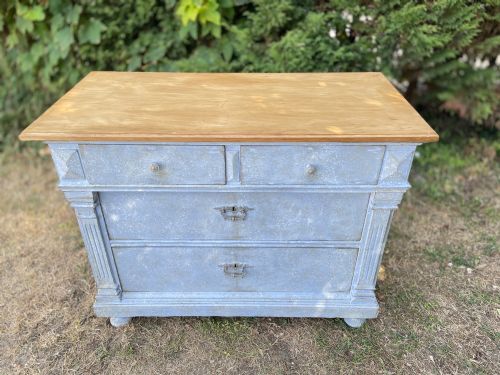
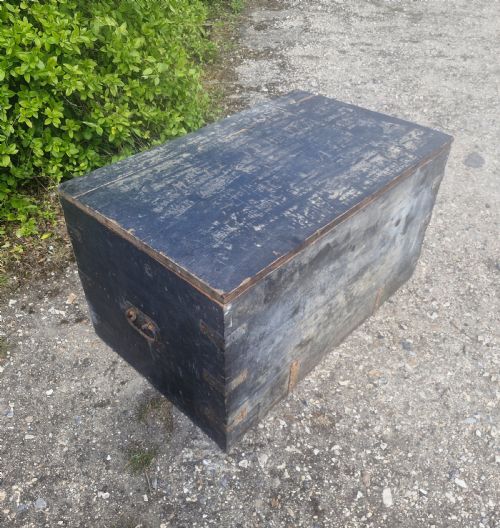


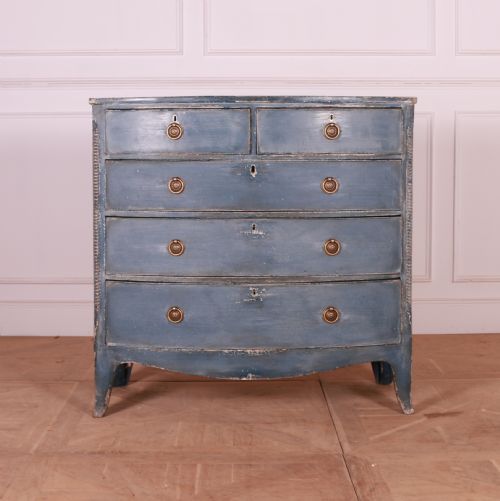
Distressed Blue Storage Chest
These distressed blue storage chest pieces bring character and practical depth into a room through weathered painted surfaces and honest country construction.
Distressed Blue Storage Chest
A distressed blue storage chest serves as a robust container while introducing a distinct, time-worn painted finish to an interior. When searching for a distressed blue storage chest, buyers encounter various forms including blanket boxes, commodes, tall cupboards, and campaign trunks.
The selection ranges widely across European traditions, taking shape as Scandinavian folk pieces, English country drawers, and French Gustavian commodes. Many examples date from the nineteenth century, alongside eighteenth-century Georgian and Baroque items and early twentieth-century trunks.
Pine and oak form the structural backbone of these storage items, often coated in layers of historical blue paint that have weathered through decades of use. Buyers find everything from low log bins to substantial chests of drawers fitted with iron and brass hardware.
How they were made
Carpenters built these storage pieces using solid timbers like pine and oak, relying on traditional joinery to withstand daily household demands. Surfaces received coats of paint, frequently in blue pigments, which have worn down naturally over generations to create the characteristic distressed texture.
Hardware details such as iron hinges, brass drop handles, and campaign mounts were fastened securely to reinforce corners and drawers. Faux marble tops appear on select commodes, demonstrating surface artistry applied over the base wooden construction.
Listings feature pine and oak construction spanning the eighteenth, nineteenth, and early twentieth centuries across British, Scandinavian, and continental European traditions.
What varies in quality
Quality rests in the integrity of the original timber frame and the authenticity of the surface patina. Pieces retaining their early or original blue paintwork carry greater historical weight than later repainted surfaces.
Construction methods distinguish fine cabinetmaking from utilitarian country joinery, visible in drawer dovetailing and the snug fit of doors and lids. Original brass or iron furniture adds distinct character compared to later replacement fixtures.
The Distressed Blue Storage Chest Glossary
- Commode
- A low chest of drawers or cabinet, often decorative in European country traditions. These pieces frequently feature shaped drawer fronts and painted finishes.
- Campaign trunk
- A portable storage chest designed for travel, typically fitted with recessed brass handles and reinforced corners. These trunks use sturdy timber construction to endure journeys.
- Blanket box
- A large chest intended for storing textiles and household linens, hinged at the top for easy access. Early examples often use solid pine or oak planks.
- Baroque revival
- A nineteenth-century style that reinterprets seventeenth-century Baroque ornamentation with dramatic curves and robust proportions. Furniture from this movement employs heavy mouldings and rich painted surfaces.
- Gustavian
- The Swedish interpretation of French neoclassical design, characterised by restrained carving and pale painted finishes. This style balances classical symmetry with rural simplicity.
Distressed Blue Storage Chest: Frequently Asked Questions
How do I clean a painted wooden chest?
Dust the surface gently with a soft, dry cloth to remove everyday particles without disturbing the fragile paint layers.
Avoid commercial chemical sprays or excessive water, which can soften historical finishes and lift the aged blue pigment.
Where should I place a blue storage chest?
These chests suit entryways, bedrooms, or living spaces where they function as coffee tables, end-of-bed storage, or statement sideboards.
Keep them away from direct sunlight and strong heat sources to prevent the old timber and paint from drying out and cracking.
Are these chests practical for everyday storage?
Deep interiors make these pieces well-suited for stowing away bulky blankets, seasonal clothing, or household clutter out of sight.
Drawers and hinged lids operate smoothly when kept in balanced indoor humidity, though older mechanisms require gentle handling.
How can I tell an eighteenth-century chest from a nineteenth-century one?
Eighteenth-century pieces often display heavier oak construction, raised fielded panels, and deeper Baroque or Georgian proportions.
Nineteenth-century examples frequently utilise softer pine timbers, simpler board construction, and regional folk art painting styles.