
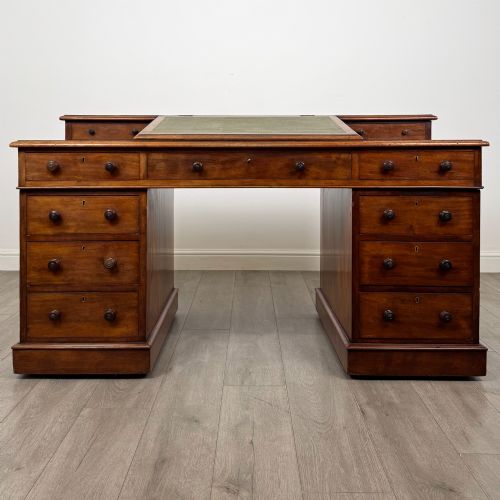


Dickens Writing Desk
A dickens writing desk is a substantial pedestal partner's form designed with tiered upper stationery compartments, offering a commanding workspace for the serious study.
Dickens Writing Desk
The dickens writing desk is a distinct nineteenth century pedestal form, characterised by twin banks of drawers rising above the main writing surface to enclose a central well. Most examples on this page date from the Victorian and Edwardian eras, spanning the decades from eighteen sixty to nineteen hundred.
You will encounter these pedestal desks most frequently in timbers such as mahogany, walnut, and oak, often fitted with leather or baize writing inserts. The upper galleries typically feature pigeonholes and small drawers sheltered beneath a sloping or flat top, creating a secure compartment for correspondence.
The form developed to serve the needs of clerks, writers, and professionals who required extensive filing space close at hand while maintaining a double sided or partner's arrangement. Surviving pieces range from plain utilitarian oak variants to highly decorative burr walnut and satinwood models.
How they were made
Cabinet makers constructed these desks using solid hardwoods like mahogany and oak for structural integrity, often applying veneers of burr walnut, satinwood, or figured walnut to the primary display surfaces. The multi drawer configuration required precise joinery to ensure smooth operation across fifteen or more individual compartments.
Writing surfaces were traditionally inset with panels of tooled leather or baize, bordered by wooden surrounds and occasionally accompanied by brass galleries to the upper tiers. Hardware such as brass drop handles and secure lever locks from makers like Hobbs provided the functional security demanded by nineteenth century offices.
The listings show nineteenth century pieces predominantly executed in mahogany, walnut, and oak, alongside decorative variations in burr walnut and satinwood.
What varies in quality
Quality in a dickens writing desk lies in the selection of timber veneers and the intricacy of the interior compartment layout. Finer examples utilise matched burr walnut or figured satinwood across the entire pedestal and superstructure, whereas simpler pieces rely on plain mahogany or oak.
The density of the drawer arrangement also indicates ambition, with superior desks incorporating fifteen or more fitted drawers alongside original brass hardware and working locks. The transition from standard Victorian mahogany to decorative inlaid walnut marks the progression through the tiers of craftsmanship.
Maple and Co·Lamb Manchester
The Dickens Writing Desk Glossary
- Pedestal desk
- A heavy freestanding writing table built with two supporting banks of drawers that hold up the top. This configuration forms the structural base of the dickens desk.
- Gallery
- A low decorative rail or raised tier fitted to the top back edge of a piece of furniture. On these desks, it often surrounds the upper stationery compartments.
- Burr walnut
- Timber sliced from the gnarled growths of a walnut tree, yielding a swirling and highly decorative grain pattern. Cabinet makers used veneers of this wood on high status Victorian surfaces.
- Baize
- A coarse woolen fabric woven to imitate felt, traditionally used as a flat writing surface on tables and desks before the widespread adoption of leather.
Dickens Writing Desk: Frequently Asked Questions
What is a dickens desk?
A dickens writing desk is a nineteenth century pedestal form featuring two banks of small drawers and pigeonholes elevated above the main writing surface. This layout provides extensive compartmentalised storage for stationery and correspondence.
The design allows a writer to keep reference materials and letters organised directly in front of them while maintaining a deep double sided desk base for everyday use.
How do I date a victorian desk?
Dating relies on examining the timber choices, construction methods, and hardware signatures visible across the piece. Victorian examples span from the eighteen sixties through to the turn of the twentieth century.
Earlier models tend to use solid mahogany or oak with simpler interior fittings, while later Victorian and Edwardian pieces frequently showcase burr walnut veneers and satinwood details.
How were these desks used?
These desks served as private workstations for professionals, managers, and writers who managed large volumes of correspondence. The tiered upper compartments kept active documents sorted and out of sight.
The pedestal drawers below provided deep storage for ledgers and larger reference books, making the form a complete administrative unit for a Victorian study.