
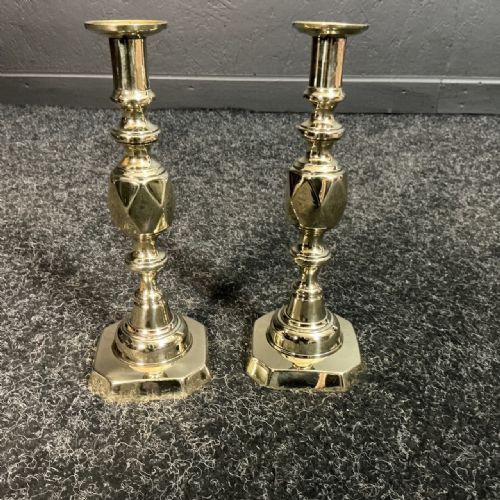


Diamond Knop Brass Candlesticks
Diamond knop brass candlesticks are distinctive Victorian lighting pieces defined by their characteristic stem formations, prized by collectors for their heavy metal presence and period character.
Diamond Knop Brass Candlesticks
Diamond knop brass candlesticks are Victorian lighting pieces that appear in nineteenth century inventories under specific descriptive titles such as King of Diamonds, Queen of Diamonds, and Ace of Diamonds. These items emerge primarily from the Victorian era, spanning the decades from eighteen eighty to eighteen ninety three, with pairs remaining the standard format for domestic display.
The most common variations encountered on this page include tall beehive forms alongside named card suit designs. Makers such as James Clews produced notable examples during this period, often incorporating jubilee dates or proprietary pattern names into the metalwork.
How they were made
Diamond knop brass candlesticks are manufactured from solid brass using period foundry techniques common to nineteenth century metalworkers. Individual components are cast and subsequently turned on lathes before being joined together to form the complete stem and base structure.
Surface finishing involves polishing to achieve a bright metallic lustre, while certain pieces incorporate stamped maker details or registry marks directly into the brass base. Construction weights vary significantly, with larger examples designed to provide substantial stability for tall taper candles.
Listings span the Victorian period from eighteen fifty to eighteen ninety three, utilising solid brass across all recorded items.
What varies in quality
The standard of diamond knop brass candlesticks is determined by the crispness of the cast stem details and the overall gauge of the metal used in production. Heavier castings with sharply defined knop profiles and well executed turning represent the upper tier of nineteenth century manufacturing.
Proportion and scale also dictate quality, as taller pairs with harmonious balance command greater attention than smaller, standard domestic variants. The presence of clear maker stamps, such as those by James Clews, distinguishes ordinary production from finer workshop outputs.
James Clews
The Diamond Knop Brass Candlesticks Glossary
- Knop
- A protruding, decorative knob or rounded projection on the stem of a candlestick. This architectural feature provides both visual interest and a secure grip.
- Beehive
- A rounded, ribbed stem profile resembling a traditional beehive structure. This specific nineteenth century form appears frequently among taller Victorian examples.
- Jubilee
- A commemorative designation often associated with Victorian production dates near eighteen eighty. It marks significant royal anniversaries of the period.
- Foundry
- A workshop where metal is melted and cast into moulds. Nineteenth century brass foundries produced these domestic lighting items through sand casting methods.
Diamond Knop Brass Candlesticks: Frequently Asked Questions
What are diamond knop brass candlesticks?
Diamond knop brass candlesticks are nineteenth century lighting devices featuring prominent geometric stem formations. They date predominantly from the Victorian era.
These items often carry playful nineteenth century trade names like King of Diamonds. They reflect the decorative tastes of the eighteen eighties and nineties.
How were these candlesticks used?
These pieces functioned as domestic lighting aids before the widespread adoption of electricity. Pairs illuminated Victorian dining tables, mantelpieces, and hallways.
Tall variants accommodated substantial wax tapers for prolonged burning. They served both practical illumination and decorative display roles in the home.
How do I identify a Victorian pair?
Victorian examples display characteristic weight, traditional casting methods, and specific stem motifs such as beehives or card suit knops. Dating often relies on stylistic markers and occasional registry stamps.
Many pieces from this era measure up to fourteen inches in height. Construction techniques from the nineteenth century leave distinct lathe marks on the interior components.
How should I clean brass candlesticks?
Cleaning requires mild soapy water and a soft cloth to preserve the historical surface character. Abrasive polishes remove the aged patina that collectors value.
Gentle maintenance prevents damage to stamped maker marks and crisp casting details. Regular dusting is usually sufficient for pieces kept on display.