


Diamond Cut Crystal Glassware
Diamond cut crystal glassware brings weight and brilliance to the table, spanning decanters, bowls, and rummers formed across the Georgian, Victorian, and Edwardian eras.
Diamond Cut Crystal Glassware
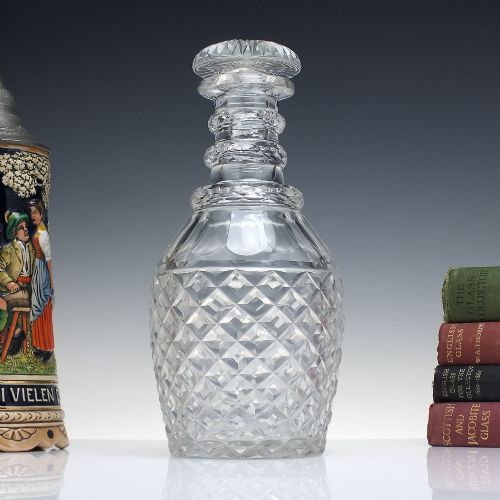
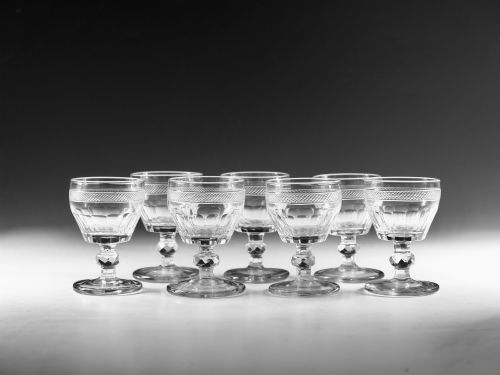
Diamond cut crystal glassware encompasses heavy tableware and serving pieces designed for drinks and fruit, featuring geometric facets wheel-cut into the surface. The selection ranges from early nineteenth-century Georgian Irish port glasses and rummers to Victorian spirit decanters and Edwardian jugs.
The pieces on this page lean heavily towards the nineteenth century and the Edwardian period, alongside robust Georgian examples. Buyers encounter everything from single pedestal bowls and comports to matched sets of whiskey tumblers and ewers.
Decanters and fruit bowls dominate the forms, each demonstrating the deep, light-catching incisions typical of the craft. Whether examining an 1800 tea mixing bowl or a 1910 tumbler, the focus remains on functional vessels dressed in intricate surface pattern.
Materials and manufacture
Makers shaped these items using lead crystal and heavy glass, combining hand-blowing techniques with mechanical or freehand wheel-cutting. The high lead content of the material allows for deep, sharp facets that refract light intensely.
Artisans applied patterns such as hobnail cutting directly to the blank vessels, grinding the surface on stone wheels before polishing the facets to a bright finish. Etched details sometimes complement the cut decoration, particularly on nineteenth-century decanters and stoppers.
Georgian port glasses survived centuries of vigorous toasts, outliving the hearty drinkers who once raised them.
Judging quality and execution
Quality rests on the crispness of the cutting and the weight of the metal. Superior pieces display deep, sharply defined facets with no rounding on the edges, whereas lesser examples feature shallow, soft cuts that lack brilliance.
The thickness and clarity of the crystal also determine the standard of the piece. Heavy, clear lead glass with balanced proportions and original matching stoppers sits at the upper end of the range.
The Diamond Cut Crystal Glassware Glossary
- Hobnail pattern
- A surface design of raised, pyramid-like studs resembling the hobnails on heavy boots. This texture appears frequently on bowls and decanters from the nineteenth century.
- Comport
- A raised dish or bowl on a pedestal, used historically for serving fruit or sweetmeats. These pieces often feature heavy cutting around the rim and stem.
- Rummer
- A large, sturdy drinking glass with a short stem and deep bowl, popular in the Georgian era. They were typically utilised for ale, wine, or punch.
- Lead crystal
- Glass containing a high proportion of lead oxide, which increases weight, refractive index, and working time for cutting. It forms the foundation of the finest glassware.
- Ewer
- A large jug with a wide spout and handled body, designed for water or wine at the table. Antique examples often showcase elaborate diamond cutting.
Diamond Cut Crystal Glassware: Frequently Asked Questions
Are these decanters safe for modern wine?
Most antique decanters function well for serving wine, provided the interior is clean and free from persistent staining. Lead crystal can leach small amounts of lead into liquids stored over long periods, but brief contact during serving poses little concern.
Inspect the inside of the neck and base for residue before use, and avoid storing liquids in them permanently.
How do I date an unhallmarked decanter?
Dating relies on the shape of the body, the profile of the stopper, and the style of the cutting. Georgian decanters often feature three-ring necks and thick, heavy bases, while Edwardian versions tend to display lighter, more uniform facet patterns.
Pontil marks on the base also offer clues, with rough snapped pontils generally indicating earlier Georgian or early Victorian manufacture.
What is the difference between glass and crystal?
True crystal contains a significant percentage of lead oxide, which adds substantial weight and allows the material to be cut deeply without shattering. Standard glass is lighter and harder to work into sharp, complex geometric patterns.
When gently struck, quality lead crystal produces a clear, resonant ring rather than a dull thud.
Why do some decanters have mismatched stoppers?
Stoppers were ground by hand to fit individual decanters during production, meaning they are rarely interchangeable across different vessels. Over the centuries, stoppers were frequently lost or broken and replaced with similar period examples.
A correct-fitting stopper should sit flush and match the weight, glass colour, and cutting style of the body.