


Desk Box Secret Drawer
These desk box secret drawer pieces are ingenious portable writing slopes and boxes housing concealed compartments, offering a tangible link to private correspondence.
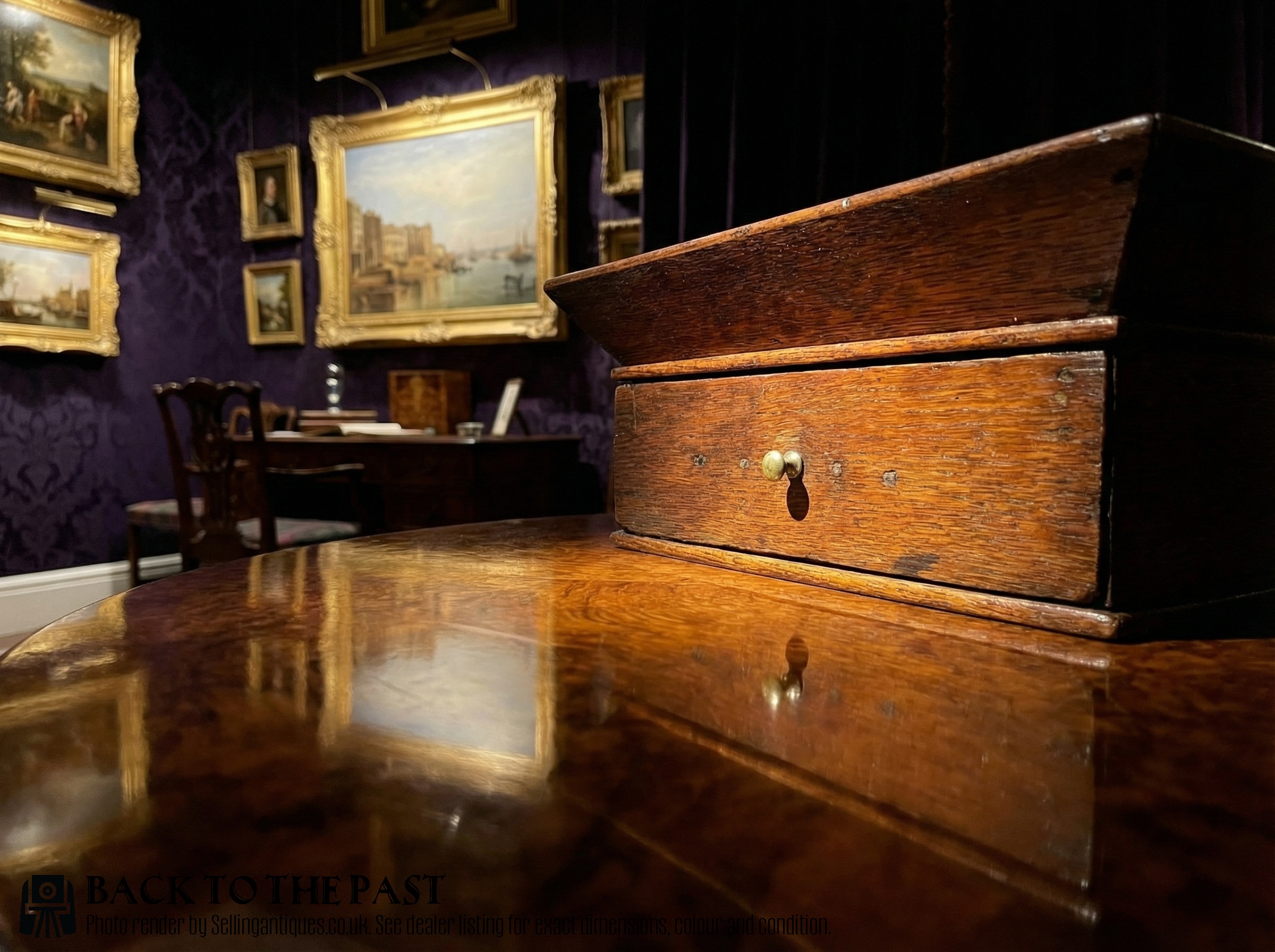
Desk Box Secret Drawer
When you search for a desk box secret drawer, you encounter portable writing slopes and boxes designed for correspondence and safekeeping. The pieces on this page stem from the Georgian and Victorian eras, alongside nineteenth-century interpretations.
Writing slopes dominate the selection, appearing alongside desk tidies and standard boxes. Walnut, figured walnut, burr walnut, rosewood, mahogany, coromandel wood, and oak form the primary bodies of these portable desks.
Victorian examples in walnut or rosewood with brass banding appear most frequently on this page. Georgian pieces in rosewood or oak also feature regularly, offering sturdy construction and classic proportions.
How they were made
Cabinet makers utilised dense hardwoods such as mahogany, rosewood, walnut, and oak to build the primary carcass of each box. Figured and burr walnut veneers were frequently applied to exterior surfaces to create striking grain patterns.
Brass featured heavily in construction, utilised for corner bounds, edge strips, and inlay work to reinforce corners and protect the wood. Bramah locks were often integrated to secure the main compartment and guard the internal mechanism.
Listings feature walnut, rosewood, mahogany, coromandel wood, and oak across Georgian and Victorian periods.
What varies in quality
The choice of exterior timber and veneer selection dictates the visual presence of a desk box secret drawer. Finely figured walnut and richly grained coromandel wood elevate a piece far above standard mahogany or plain oak versions.
The execution of the internal mechanism and the complexity of the concealed compartments reveal the skill of the original maker. High quality examples feature smooth release systems and precise joinery that disguise the hidden storage effectively.
George Austin of Dublin
The Desk Box Secret Drawer Glossary
- Writing slope
- A portable box with a hinged sloping lid designed to provide an angled writing surface. Inside, compartments hold stationery, inkwells, and pens.
- Secret drawer
- A concealed compartment hidden behind removable panels or triggered by a release pin. These compartments were used to store valuables and private papers.
- Bramah lock
- A high security lock patented by Joseph Bramah in the late eighteenth century. These locks were frequently fitted to quality Victorian boxes.
- Campaign style
- A design approach characterised by brass binding and flush handles for portability during travel. These pieces were built to withstand military journeys.
Desk Box Secret Drawer: Frequently Asked Questions
What is a desk box secret drawer?
A desk box secret drawer is a portable writing slope or box fitted with hidden compartments for securing valuables. These wooden boxes fold open to reveal a slanted writing surface and internal storage.
Cabinet makers in the Georgian and Victorian periods constructed these pieces from timbers like rosewood, walnut, and mahogany. The hidden compartments often require operating a small release mechanism to access.
How were these boxes used?
These boxes served as portable writing desks for correspondence before the widespread availability of fitted furniture. Owners stored stationery, ink, nibs, and letters inside the compartments.
The sloping lid provided a firm writing plane when folded down, and the entire box could be latched and locked for travel or storage.
How do I find the secret drawer?
Finding the hidden compartment usually involves removing the small interior pen tray or sliding false partitions. Spring-loaded catches and wooden pins often release the concealed drawers.
Makers designed these spaces to blend seamlessly with the interior woodwork so they remained unnoticed by casual observers.
How do I tell Georgian and Victorian pieces apart?
Georgian pieces often feature mahogany or rosewood with understated brass inlay and simpler joinery. Their proportions tend to reflect earlier, classical furniture designs.
Victorian examples frequently utilise figured walnut with heavier brass binding and corner mounts. Bramah locks appear more commonly on the Victorian boxes in this selection.