
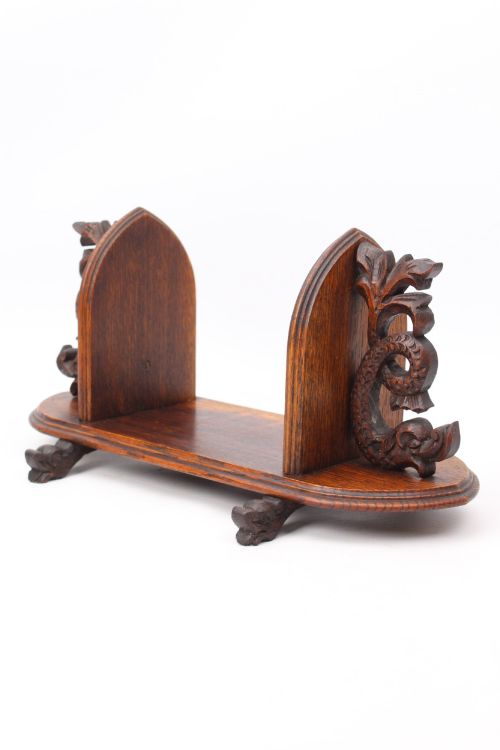
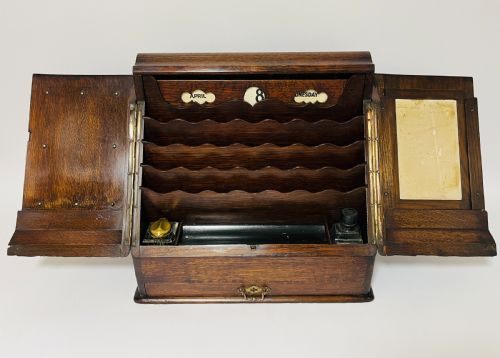


Victorian Oak Desktop Tidy
These Victorian oak desktop tidy pieces are sturdy everyday organisers built to keep correspondence and stationery in order.
Victorian Oak Desktop Tidy
A Victorian oak desktop tidy brings practical workspace organisation to a desk, holding letters, books, and writing equipment in dedicated compartments. When you search for a victorian oak desktop tidy, you encounter forms ranging from simple letter racks and book stands to enclosed stationery cabinets with fitted interiors.
The pieces listed on this page span the Victorian and Edwardian eras, alongside related examples from the Georgian period through to nineteen ten. Common variations include stationery boxes, desk boxes with secret drawers, and letter racks equipped with ink bottles and adjustable dates.
How they were made
These items rely on solid timber construction, utilising oak as the primary material for durability and structural strength. Cabinet makers shaped the wood into sloping boxes, shelved cabinets, and open racks designed for heavy daily use.
Metal components such as brass hinges, handles, and mounts appear alongside fitted glass ink bottles and leather or paper elements. Certain examples incorporate Gothic Revival details or the characteristic simpler lines associated with the Arts and Crafts movement.
Listings on this page span the Victorian, Edwardian, and Georgian periods, utilising oak combined with brass, glass, and leather.
What varies in quality
Quality in a victorian oak desktop tidy depends upon the integration of functional mechanisms and the crispness of any decorative carving. Superior examples feature smoothly operating internal drawers, well-fitted doors, and robust brass hardware that withstands repeated handling.
The choice of timber grain and the precision of the joinery separate standard utility pieces from finer items produced during the Victorian and Edwardian periods. Accessories like matched glass ink bottles and working locks further distinguish the better pieces.
The Victorian Oak Desktop Tidy Glossary
- Stationery cabinet
- A desktop box with doors or a sloping lid enclosing vertical compartments for paper and envelopes. These often include small drawers for stamps and sealing wax.
- Letter rack
- An open wooden frame divided into slots to hold incoming and outgoing mail upright. Examples frequently incorporate integral pen trays or inkwell holders.
- Gothic Revival
- A nineteenth-century design style drawing on medieval architectural motifs such as pointed arches, trefoils, and heavy chamfered edges. It appears on desk accessories of the period.
- Arts and Crafts
- A design movement valuing honest construction, visible joinery, and straightforward materials over excessive machine finish. Pieces in this style often display exposed hinges and simple oak surfaces.
- Secret drawer
- A concealed compartment built into a desk box, accessed by removing a false panel or tripping a hidden wooden catch. This feature offered secure storage for valuables.
Victorian Oak Desktop Tidy: Frequently Asked Questions
What is a desktop tidy?
A desktop tidy is a dedicated wooden container designed to hold correspondence, writing paper, and small desk accessories in an orderly fashion.
These objects kept workspaces organised in homes and offices before the widespread use of modern filing systems.
How do I date an oak desk box?
Dating relies on examining the construction methods, handle styles, locking mechanisms, and overall aesthetic characteristics visible in the piece.
Cabinetry from the Victorian era often displays heavier mouldings, while Edwardian or Arts and Crafts pieces tend toward simpler lines and exposed joinery.
Were these cabinets used in offices?
Yes, stationery cabinets and letter racks served as essential equipment in professional offices, libraries, and home writing desks alike.
They provided a secure and accessible method for sorting daily post and keeping ink bottles from spilling.
What makes an Arts and Crafts tidy different?
Arts and Crafts pieces focus on plain oak surfaces, hand-beaten metal hinges, and structural honesty rather than ornate surface carving.
Such items reflect the late nineteenth and early twentieth-century shift towards handcrafted utility.