





Demilune Foyer Table
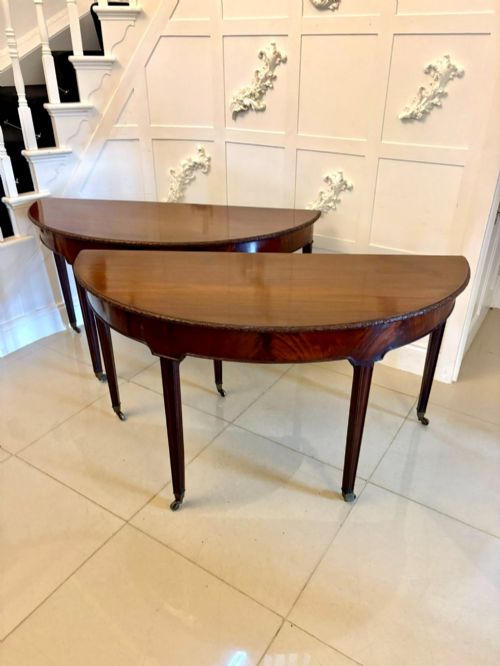
A demilune foyer table stands against the wall with a half-moon top, offering a surface for the hallway that saves valuable floor space.
Demilune Foyer Table
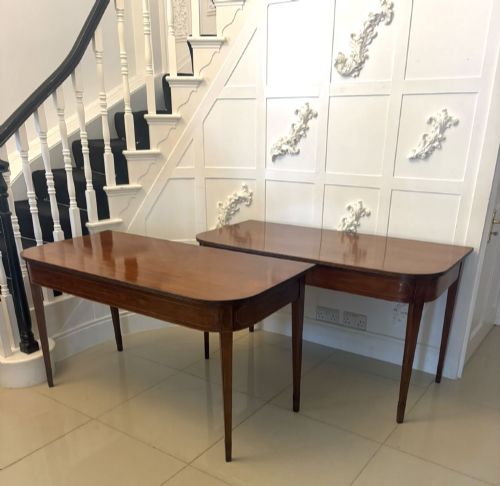
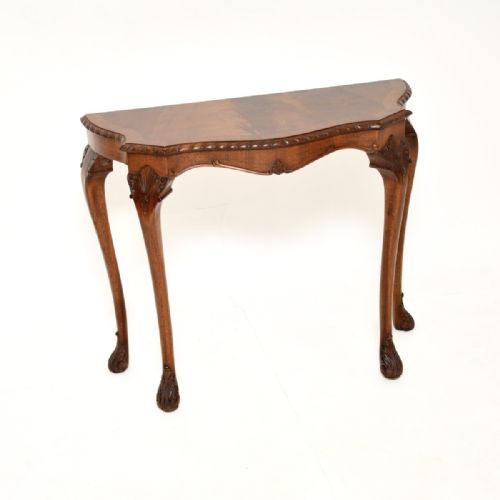
A demilune foyer table is a semicircular console designed to sit flat against a wall in an entrance hall or reception room. These pieces provide a practical landing space for post or decorative items without jutting far into the walkway.
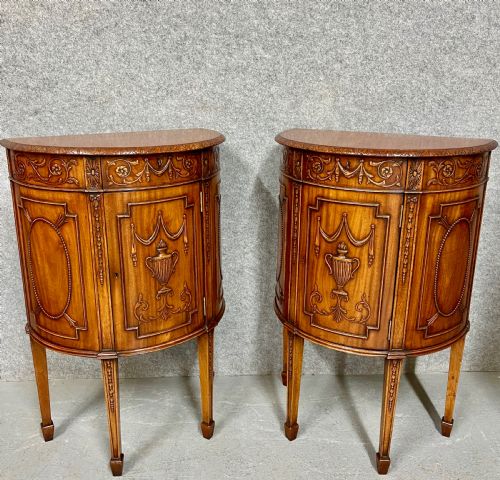
The versions met most often on this page date from the Georgian, Victorian, and Edwardian eras, alongside pieces from the early twentieth century. Console tables and console cabinets dominate the forms, frequently appearing in pairs.
Origin styles range across Georgian, Victorian, Edwardian, and Neoclassical designs, including Louis XVI revivals and Chippendale revivals. Makers occasionally utilised matching wall mirrors to complete the entranceway arrangement.
Construction and materials
Cabinetmakers built these semicircular frames primarily using mahogany, walnut, and satinwood veneers. Boxwood inlay frequently provides fine linear contrast along the borders and friezes.
Surfaces often feature inset marble tops for durability and elegance, while other examples employ polished wood or glass. Giltwood, gilded wood, and brass accents appear across revival pieces from the nineteenth and twentieth centuries.
Demilune Foyer Table Retail Price Guide 2026
Typical asking prices for demilune foyer table among the pieces listed under this phrase on Sellingantiques today, from the lower quarter to the upper quarter. They describe what is for sale here now, not the wider market.
Some past cabinetmakers playfully labelled their half-moon creations with phonetic spellings like 'Demi Loon' in old workshop records.
Judging quality in half-moon tables
Quality rests upon the precision of the cabinetwork, particularly where the curved apron meets the straight back edge. Tight joints and crisp execution of boxwood inlay distinguish superior workshop output from more utilitarian manufacturing.
The choice of timber grain and the depth of the carving on the legs or skirt dictate the visual weight of the piece. Integrated elements like matching marble slabs or well-fitted wall mirrors elevate the overall standing of the furniture.
Edward and Roberts
The Demilune Foyer Table Glossary
- Demilune
- Having the shape of a half-moon or semicircle. This profile allows the furniture to sit flush against a wall.
- Console table
- A table supported by wall brackets or console legs, designed to stand against a vertical surface. They often feature decorative aprons.
- Inlay
- A technique where pieces of contrasting material are inserted into a recessed wooden base to form a pattern. Boxwood and satinwood frequently serve this purpose.
- Neoclassical
- A style drawing inspiration from the classical art and architecture of ancient Greece and Rome. It emphasises symmetry, straight lines, and restrained ornament.
- Marquetry
- The art of applying pieces of veneer to a structure to form decorative designs. Floral motifs and geometric bands frequently appear in this manner.
Demilune Foyer Table: Frequently Asked Questions
What is a demilune table used for?
A demilune table serves as a functional surface in narrow spaces such as hallways, corridors, and entrance foyers. The flat back rests securely against the wall while the curved front softens the geometry of the room.
Historically, homeowners placed them beneath mirrors to display decorative objects, small clocks, or lighting. Their compact footprint makes them useful in modern interiors where floor space is limited.
How do I date a console table?
Dating relies on examining the timber species, construction methods, and decorative styles present on the piece. Georgian and Victorian examples display distinct joinery techniques and proportions compared to early twentieth-century revivals.
Secondary woods used in the interior framework also offer clues to the period and region of manufacture. Comparing the decorative motifs, such as boxwood inlay or neoclassical carving, against known historical styles confirms the era.
Are these tables sturdy enough for daily use?
These tables are generally stable, though their wall-mounted or console design means they benefit from being placed on level floors. Many taller or marble-topped versions were designed to be anchored to the wall for absolute safety.
Daily use is well-suited to holding keys, letters, and decorative ceramics. Avoid placing excessive heavy loads on the outer curved edge unless the legs are braced accordingly.
What is the difference between a console and a side table?
A console table is traditionally designed to stand against a wall and may rely partially on wall brackets for support in historical iterations. A side table is freestanding and finished on all sides for placement anywhere in a room.
Demilune console tables specifically feature the half-moon shape intended exclusively for wall placement. Side tables more commonly take rectangular or circular forms.