
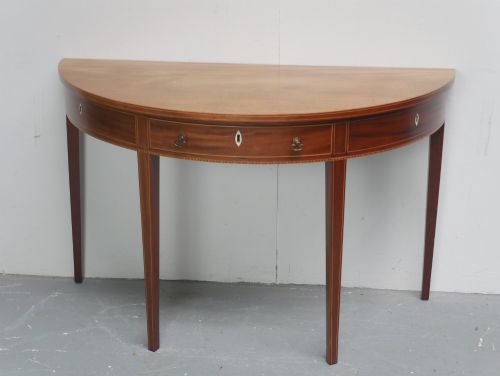
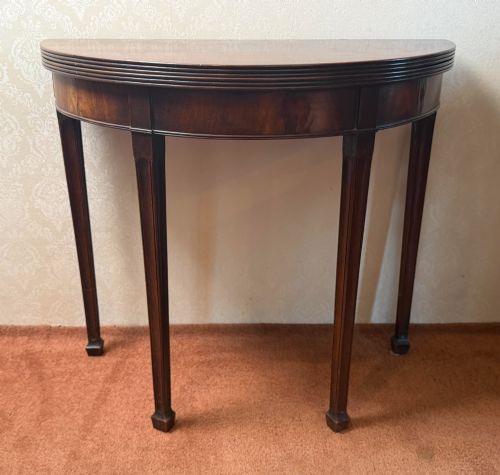
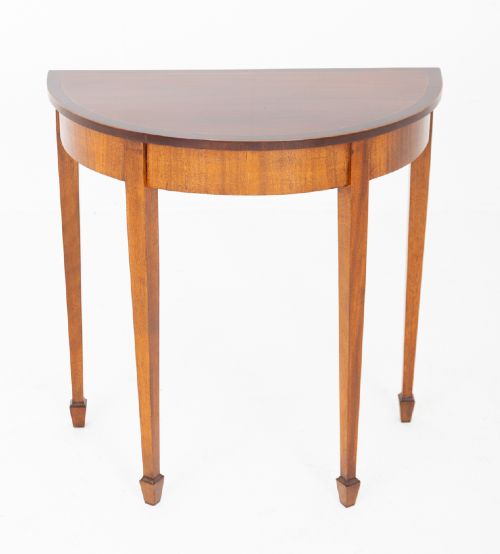
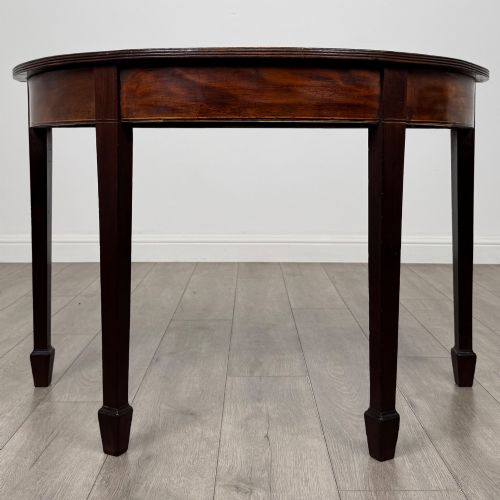

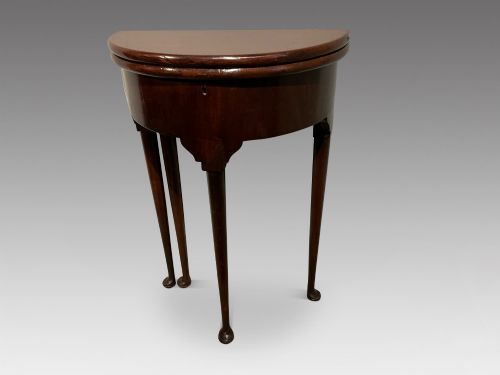
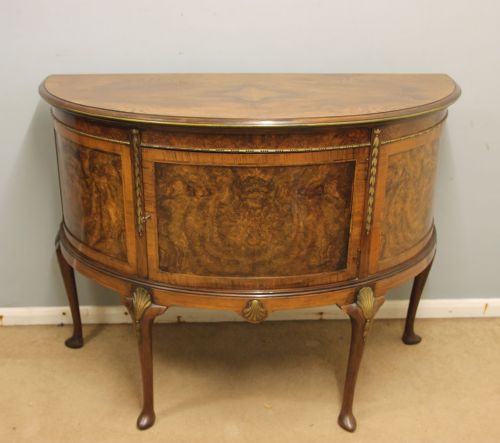
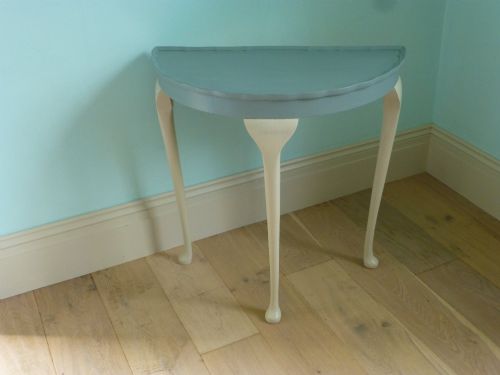

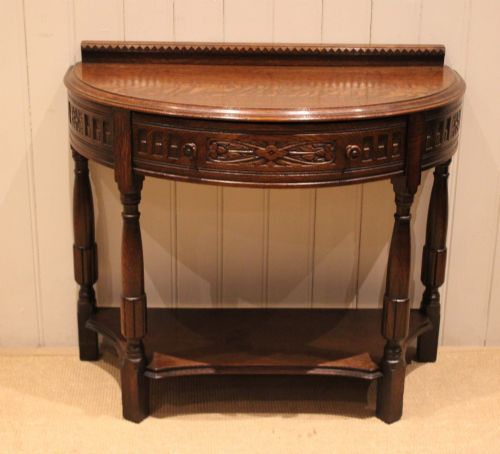
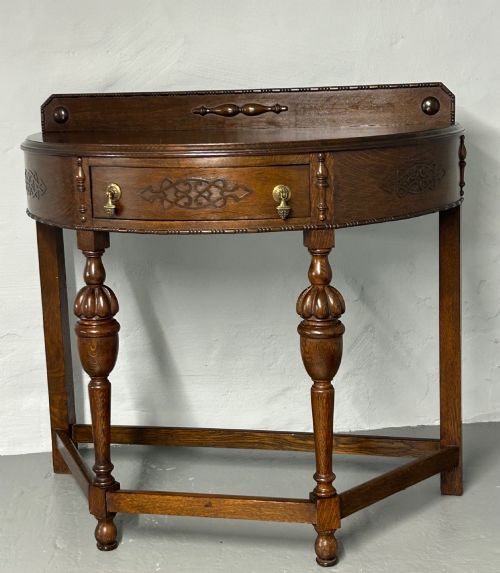
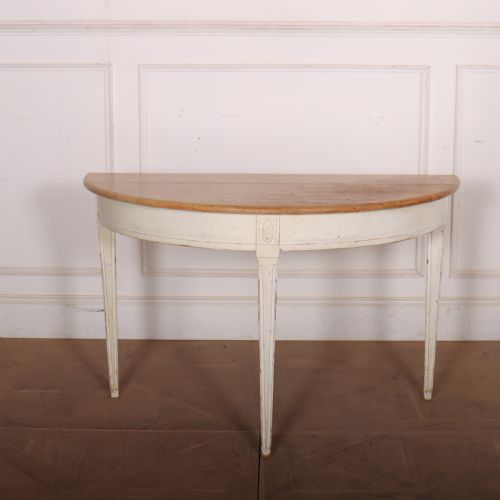


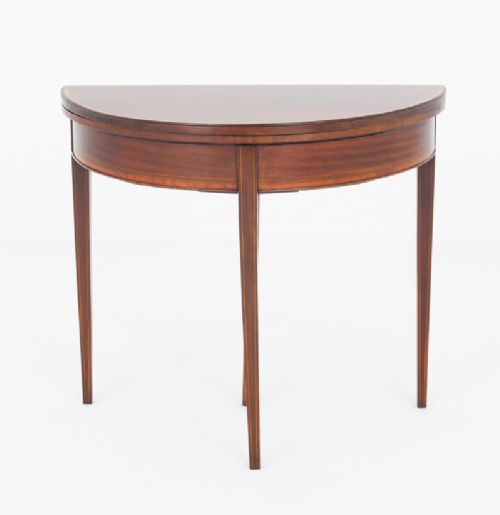
Demi Lune Hallway Table
A demi lune hallway table offers a curved profile designed to hug a wall neatly while bringing distinct period character to an entrance.
Demi Lune Hallway Table
A demi lune hallway table is a half-moon shaped piece designed to stand flush against a wall, making it a practical choice for narrow corridors and entryways. The form appears frequently as console tables, side cabinets, and occasional tables.
Most examples seen here date from the eighteenth century through to the early twentieth century, spanning Georgian, Regency, and later revival periods. Mahogany and painted wood dominate the selection, alongside walnut, satinwood, and oak.
Makers and workshops constructed these items to serve as functional hall furniture, tea tables, or decorative side pieces. Pairs frequently emerge alongside single tables, particularly in painted Swedish and English styles.
How they were made
Cabinetmakers utilised solid timbers and veneers such as mahogany, oak, and satinwood, often shaping the curved aprons and tops by hand. Boxwood inlay frequently provides fine linear detailing across the surfaces of these half-moon tables.
Painted finishes appear across numerous French, Swedish, and English variants, applied over timber to create decorative motifs. Brass fittings, feet, and hinges support structural elements like fold-over tops and tambour doors.
Materials span mahogany, oak, satinwood, pine, and painted wood alongside boxwood inlay and brass.
What varies in quality
Quality rests in the precision of the curved joinery and the selection of timber figures, such as highly grained mahogany or burr walnut. Finer pieces demonstrate meticulous hand-cut boxwood inlay and balanced proportions that maintain stability against the wall.
The sophistication of the painted finishes or carved details separates standard utility furniture from exceptional decorative works. Original brass hardware and intact folding mechanisms elevate the standing of eighteenth and nineteenth-century examples.
Maple and Co
The Demi Lune Hallway Table Glossary
- Demi lune
- A half-moon shape used for tables designed to stand flat against a wall. This profile maximises floor space in narrow corridors.
- Console table
- A table supported by wall brackets or legs, intended to stand against a vertical surface. They often feature decorative tops of wood or marble.
- Tambour
- A sliding door constructed from narrow vertical strips of wood glued to a canvas backing. This mechanism allows smooth movement around curved cabinet fronts.
- Boxwood inlay
- Contrasting light-coloured wood set into the surface of a darker timber to create geometric or floral borders. It requires precise woodworking skill.
- Fold over tea table
- A table with a hinged top that opens out to double its surface area. Eighteenth-century versions often utilised this mechanism for social gatherings.
Demi Lune Hallway Table: Frequently Asked Questions
Where does a demi lune table fit best?
The curved half-moon silhouette allows the piece to sit flush against a wall without protruding too far into a walkway. This makes them well-suited for narrow hallways, entrance foyers, and tight landings where standard rectangular furniture obstructs movement.
Beyond corridors, these tables function effectively in reception rooms as sideboards, card tables, or display surfaces beneath mirrors. Their compact depth accommodates decorative objects without overwhelming the surrounding space.
How do I identify a Georgian demi lune table?
Georgian examples typically feature solid mahogany or carefully matched veneers, often accented with fine boxwood stringing and inlay work. The leg profiles generally follow period conventions, such as tapered spade feet or carved supports associated with eighteenth-century cabinetmaking.
Proportions on these pieces tend to be balanced and restrained, prioritising architectural harmony over heavy ornamentation. Checking the secondary timbers on the underside often reveals period construction methods consistent with eighteenth or early nineteenth-century workshops.
What is the difference between a console and a side table?
A console table is historically designed to lean against a wall, sometimes relying on structural wall brackets for additional support alongside front legs. Side tables are freestanding units built to stand independently anywhere in a room.
In practice among older furniture, the terms frequently overlap, particularly with half-moon shapes intended primarily for perimeter placement. Both variants focus on surface display rather than central room placement.
Can I use a antique fold over table daily?
Fold-over mechanisms on older tea tables require gentle handling to preserve the original hinges and timber joints. Regular use is possible provided the top is supported properly when opened rather than subjected to heavy weight.
Placing the table away from direct heat sources and drastic humidity changes protects the polished wood and veneer work. Routine care ensures the folding leaves operate smoothly without straining the antique fixings.