




Deep Mahogany Drawers
These deep mahogany drawers are substantial storage furniture built across the Victorian and Regency periods to hold heavy household textiles and clothing.
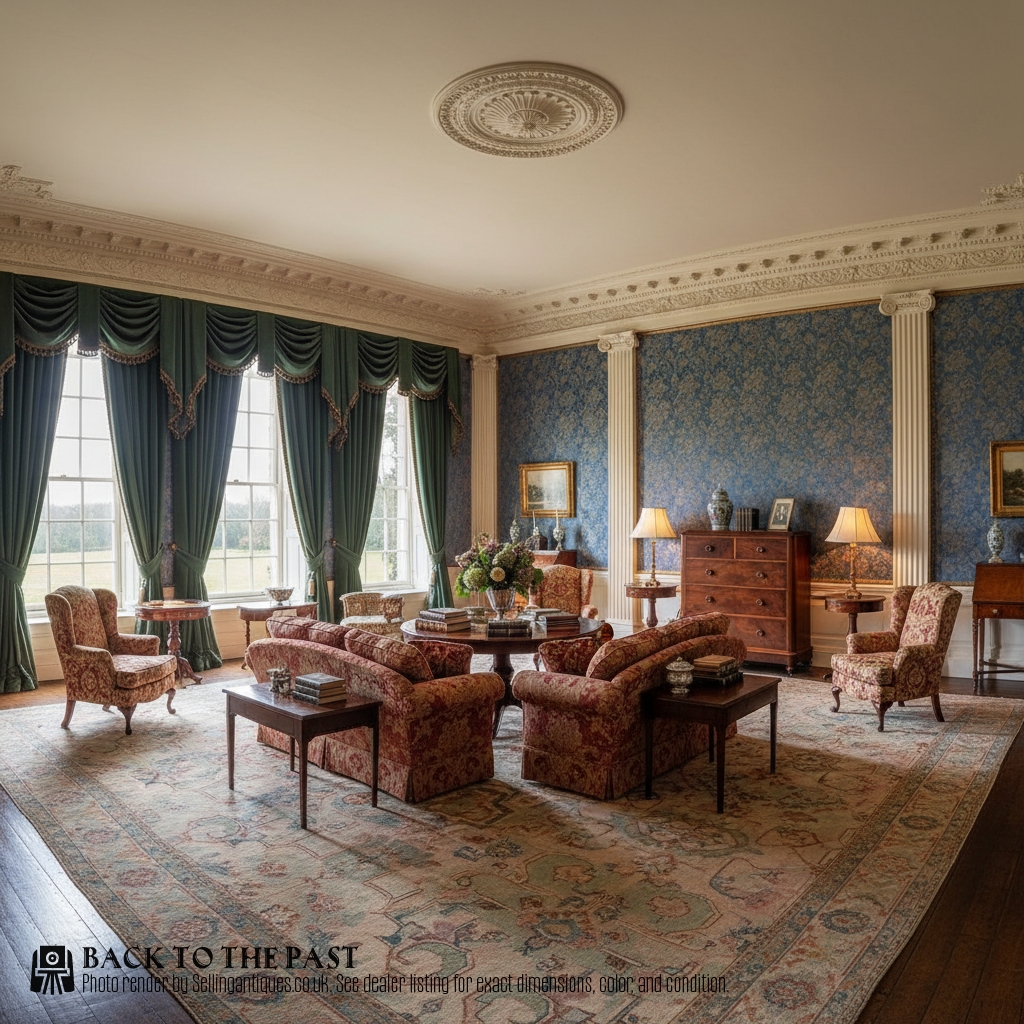
Deep Mahogany Drawers
When you search for deep mahogany drawers, you are looking at large case furniture designed primarily for practical bedroom storage during the nineteenth century. The items on this page span the Victorian and Regency eras, appearing as substantial chests of drawers, Scotch chests, and occasional tall storage configurations.
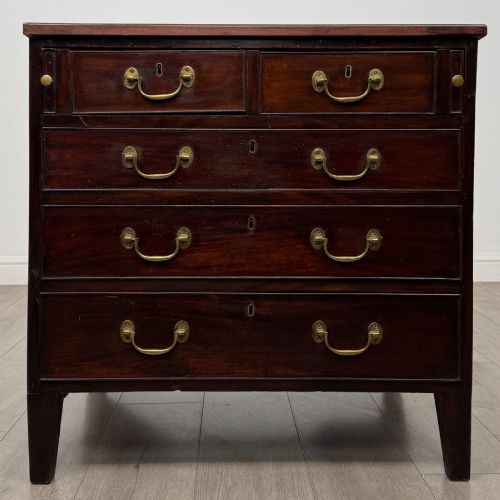
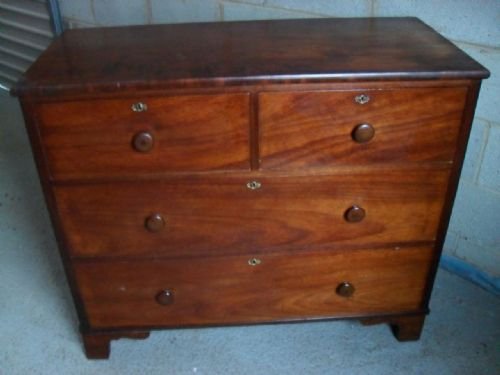
The version you are most likely to meet on this page is the Victorian chest featuring a two-over-two drawer arrangement, often incorporating significantly deepened lower compartments. These pieces frequently showcase impressive scale, standing as dominant focal points within period domestic interiors.
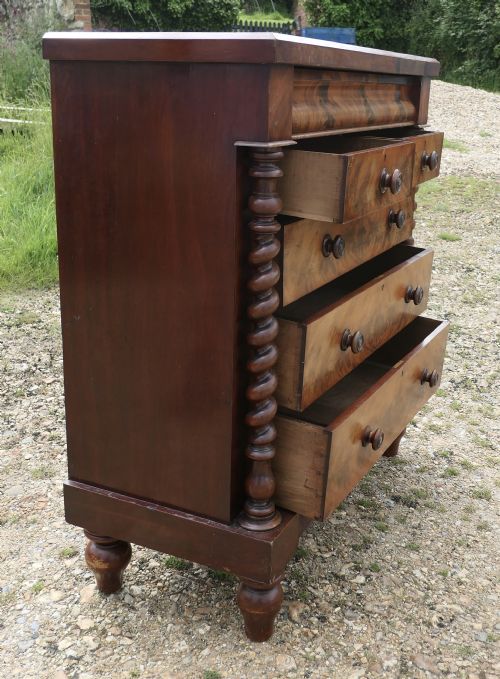
The evidence also reveals specialised forms including bow-fronted Scotch chests and large-proportion storage units built from solid timbers and veneered surfaces. These heavy items were engineered to anchor a bedroom and provide massive internal capacity for bulky garments and household linens.
How they were made
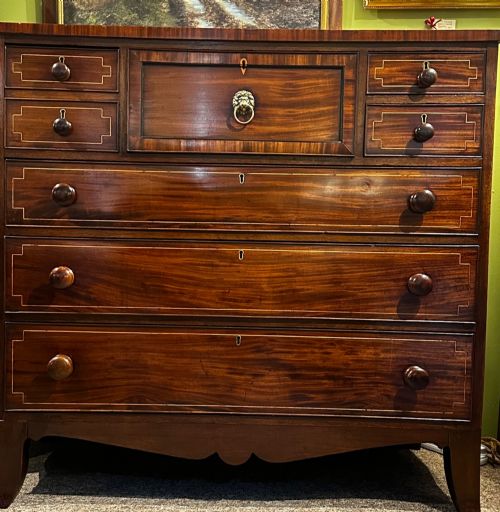
Cabinetmakers constructed these carcases using primary timbers of rich mahogany and pine, frequently applying figured flame mahogany veneer across the drawer fronts to create striking visual movement. Secondary construction woods such as pine appear on internal drawer linings and backboards.
Surface ornamentation relies on natural timber grain rather than applied carving, enhanced by contrasting boxwood stringing and brass hardware including knob handles or campaign-style fixtures. Drawers operate on side runners built directly into the heavy timber framework to support substantial weight.
Some nineteenth century Scotch chests concealed their top storage layer behind deep wooden fascias, keeping midnight reading material safe from curious household eyes.
What varies in quality
The distinction between tiers of quality rests in the selection of the timber veneers and the structural integrity of the heavy carcase. Pieces utilising highly figured flame mahogany across the primary facade demand greater cabinetmaking skill than plain mahogany surfaces.
Proportion and execution define the upper range, where balanced drawer arrangements and clean lines on large-scale Victorian and Regency pieces demonstrate superior workshop standards. Lesser examples show simpler construction and standard straight-grained timber without the decorative veneer work seen on finer variants.
The Deep Mahogany Drawers Glossary
- Flame Mahogany Veneer
- A thin slice of mahogany timber cut from the fork of the tree where the branch meets the trunk to create a distinctive flame-like pattern. This decorative surface elevates the visual presence of Victorian drawer fronts.
- Scotch Chest
- A tall regional chest of drawers typically featuring a concealed top drawer above smaller configuration drawers. These pieces are prominent among 19th-century mahogany storage items.
- Bow Front
- A convex curved cabinet front that projects outward in a smooth arc. This curved design softens the heavy visual weight of large Victorian drawer units.
- Pine
- A softwood commonly utilised for secondary structural elements such as drawer sides, carcase backs, and internal framing. It provides a stable and lightweight backing for dense mahogany facades.
- Boxwood
- A dense, pale wood frequently used for delicate inlay work and stringing lines on Regency and Victorian furniture. It creates sharp visual contrast against dark mahogany surfaces.
Deep Mahogany Drawers: Frequently Asked Questions
How do I spot a Scotch chest?
Scotch chests are identified by their tall proportions and a deep secret drawer positioned directly beneath the top surface moulding. They often incorporate columns or pilasters flanking the main drawer stack.
These regional chests appeared frequently in the nineteenth century to maximise vertical storage space in bedrooms without expanding the floor footprint.
What is a two over two arrangement?
A two over two arrangement refers to a chest featuring two smaller drawers positioned above two wider, deep drawers. This layout balances facade aesthetics with deep storage capacity for bulky clothing.
Cabinetmakers utilised this specific configuration widely during the Victorian period to accommodate the changing scale of domestic garments.
Are these drawers heavy to move?
These pieces are exceptionally heavy due to the solid mahogany timbers, dense pine carcases, and large overall dimensions. Moving them generally requires two people and careful handling to protect the polished veneer surfaces.
Historical pieces were designed as permanent bedroom architecture rather than modular furniture intended for frequent relocation.
How do I care for mahogany veneer?
Maintain mahogany veneer by keeping the timber away from direct heat sources and strong sunlight that can dry out and split the thin wood surface. Apply natural beeswax periodically to nourish the grain and preserve the deep reddish-brown tone.
Avoid excessive moisture during cleaning, using only a soft dry cloth to remove dust from the polished exterior.
How do I date a mahogany chest?
Dating relies on observing construction methods, timber choice, handle styles, and secondary woods like pine linings. Regency pieces exhibit neoclassical restraint, while Victorian examples often feature bolder proportions and flame veneer.
Hardware fixings and drawer construction techniques provide the clearest physical evidence for narrowing down the decade of manufacture.