


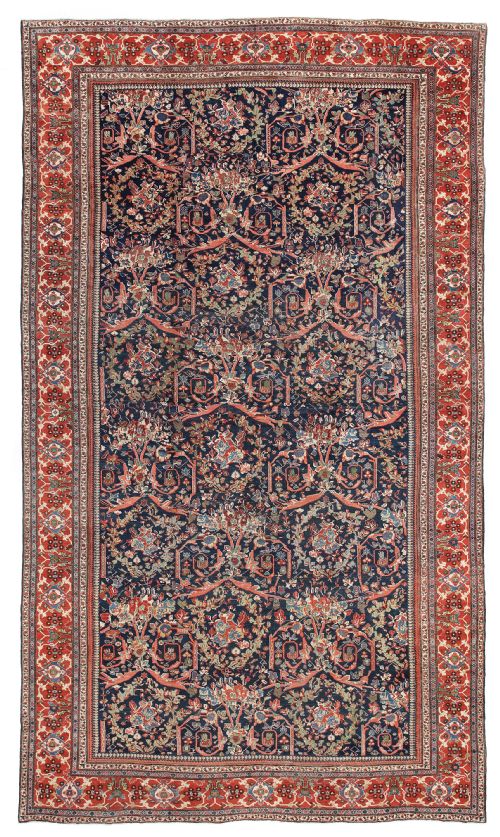
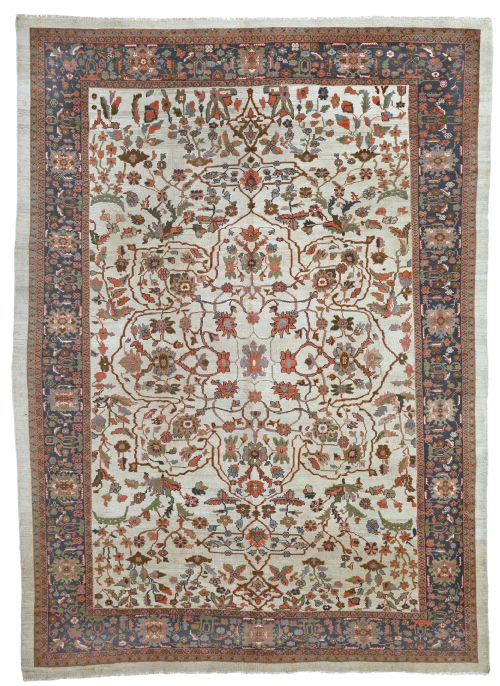

Decorative Mahal Carpet
A decorative mahal carpet brings large-scale Persian pattern and muted warmth to a grand room.
Decorative Mahal Carpet
A decorative mahal carpet is a large woven floor covering originating from Persia, valued for its room-filling scale and balanced design. You are most likely to meet room-sized examples dating from the late nineteenth century up to the early twentieth century.
The pieces on this page span several decades of weaving tradition, specifically from eighteen eighty through to nineteen ten. These floor coverings bridge the gap between formal court designs and more relaxed domestic interiors.
Many carry related stylistic tags such as Ziegler or Sultanabad, reflecting the commercial workshops operating in Western Persia during that period. Each rug displays the characteristic large-scale floral motifs and softened palettes that define the group.
How they were made
These carpets are constructed with a durable cotton foundation supporting a deep wool pile. The combination of these two materials provides the structural stability needed for large room-size formats.
Weavers hand-knotted the wool onto the cotton warps and wefts, a laborious technique that allowed for complex curvilinear patterns. Natural dyes provided the muted reds, blues, and soft neutrals characteristic of the region.
Decorative Mahal Carpet Retail Price Guide 2026
Typical asking prices for decorative mahal carpet among the pieces listed under this phrase on Sellingantiques today, from the lower quarter to the upper quarter. They describe what is for sale here now, not the wider market.
Some carpets stretch over four and a half metres, proving that nineteenth-century weavers took serious room dimensions in their stride.
What varies in quality
Quality in a decorative mahal carpet rests primarily on the handling of the scale and the subtlety of the colour palette. Stronger examples maintain balanced proportions across large expanses without the pattern feeling crowded.
The handling of the wool pile also dictates the tactile and visual depth of the piece. Better preserved surfaces retain crisper drawing within the floral motifs and a more even wear pattern across the field.
The Decorative Mahal Carpet Glossary
- Mahal
- A type of Persian carpet woven in the district around Sultanabad, known for large-scale patterns. These rugs often feature more relaxed designs than city-woven pieces.
- Ziegler
- A trade designation for nineteenth-century Persian carpets produced for the Western market. They typically feature softened palettes and expansive floral layouts.
- Sultanabad
- The West Persian city and manufacturing centre associated with large-format decorative carpets. It represents the broader regional tradition that includes mahal production.
- Warp
- The vertical threads stretched on the loom that form the foundational skeleton of the carpet. The visible fringes at either end of the rug are the extension of these threads.
- Weft
- The horizontal threads passed back and forth through the warp to lock the knots in place. Together with the warp, they create the sturdy cotton foundation of the weave.
Decorative Mahal Carpet: Frequently Asked Questions
What is a decorative mahal carpet?
A decorative mahal carpet is a nineteenth or early twentieth-century Persian floor covering designed with large-scale floral motifs. These pieces are particularly sought after for their room-filling dimensions and muted colour palettes.
They originate from the West Persian weaving traditions associated with Sultanabad. Collectors prize them for their ability to anchor large living spaces with traditional artistry.
How do you date these carpets?
Dating relies on stylistic markers, construction methods, and dye characteristics observed across nineteenth and early twentieth-century examples. Pieces on this page typically date between eighteen eighty and nineteen ten.
Changes in palette and wool texture help differentiate the decades. Examining the cotton foundation and knot structure provides further confirmation of the period.
Where were these rugs made?
These carpets were woven in Western Persia, specifically in and around the district of Sultanabad. This region became a major centre for carpet production geared towards Western tastes.
The local workshops developed distinctive large-scale floral designs using durable wool and cotton materials. This regional focus created the recognizable aesthetic seen in these pieces.
How should I live with one?
Living with a room-size carpet involves placing it in a low-traffic or moderate-traffic area to preserve the wool pile. Using a suitable underlay protects the cotton foundation and prevents slipping.
Regular gentle vacuuming without a beater bar keeps the wool clean. Professional cleaning should be undertaken sparingly by specialists familiar with antique Persian textiles.