


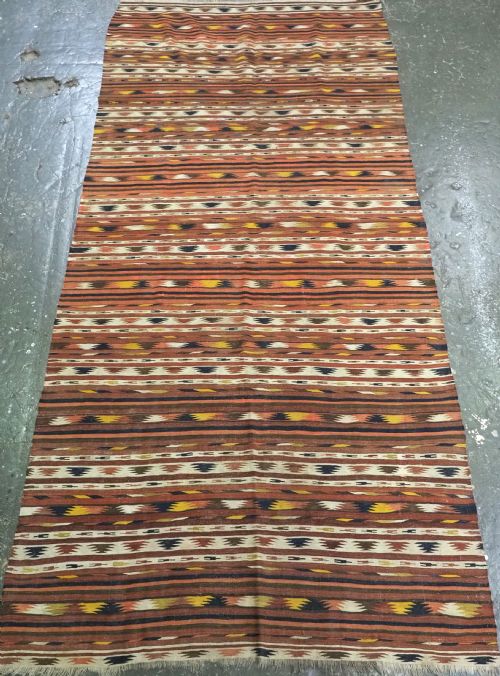
Decorative Flatweave Rug
A decorative flatweave rug brings warmth and historic textile art to a floor, prized for its graphic patterns and flat structure.
Decorative Flatweave Rug
A decorative flatweave rug encompasses flat-surfaced textile pieces made by nomadic and traditional weavers across regions such as Persia, Anatolia, Central Asia, and Eastern Europe. These items serve multiple utilitarian and decorative functions, spanning floor coverings, tent bands, storage bags, and wall hangings.
The decorative flatweave rug selections found here include traditional Bessarabian kilims, Turkmen dali kilims, Turkish Kayseri kilims, and utilitarian tribal pieces like bread sofreh cloths, salt bags, and saddlebags. Each object reflects the specific weaving heritage and regional motifs of its maker.
Dated examples on this page primarily span the late nineteenth century and the early twentieth century, specifically between 1880 and 1920. Buyers will frequently encounter Bessarabian kilims and tribal nomadic weavings among these listings.
How they were made
These textiles are constructed primarily from wool, cotton, and goat hair, utilising interlocking weft techniques to build geometric and floral designs without a piled surface. Natural dyes provide the underlying palette, creating rich colour variations across the woven surface.
Nomadic and traditional workshops employ specialised flatweaving methods, seen in structures ranging from very fine weaves on Turkmen dali kilims to large two-part formats in Kayseri kilims. The absence of pile creates a durable, flat textile well-suited for both wall display and floor placement.
Decorative Flatweave Rug Retail Price Guide 2026
Typical asking prices for decorative flatweave rug among the pieces listed under this phrase on Sellingantiques today, from the lower quarter to the upper quarter. They describe what is for sale here now, not the wider market.
Listings feature wool, cotton, and goat hair materials combined with natural dyes across pieces dated from 1880 to 1920.
What varies in quality
The standard of a flatweave depends upon the tightness and consistency of the weave structure, where finer density yields greater crispness in the geometric patterns. Expert handling of natural dyes ensures that colours age with harmony and depth.
Design integrity and the preservation of original tribal formats, such as complete pairs of saddlebags or intact tent bands, elevate the textile. Condition and structural completeness heavily influence the standing of an individual piece.
The Decorative Flatweave Rug Glossary
- Kilim
- A flatwoven textile produced without a pile, common throughout the Near East and Central Asia. These pieces function as floor coverings, wall hangings, and functional storage containers.
- Sofreh
- A spread or cloth traditionally used for eating, kneading dough, or serving bread in Persian households. These textiles often feature symbolic tribal motifs.
- Tent Band
- A long, narrow woven strip utilised in nomadic encampments to secure tent structures. They display dense geometric patterns wrought in wool or goat hair.
- Natural Dyes
- Colourants derived from plant, insect, and mineral sources rather than synthetic chemical equivalents. They produce nuanced tones that develop a rich patina over time.
- Bessarabian
- Pertaining to the historical region situated between the Black Sea and the Prut river, known for flatweaves featuring distinct floral compositions influenced by European design traditions.
Decorative Flatweave Rug: Frequently Asked Questions
What is a flatweave rug?
A flatweave rug is a textile constructed without knotted pile, created by interweaving warp and weft threads to form a completely flat surface. This category includes kilims, salt bags, and sofreh cloths.
Because they lack pile, these textiles lie flat on the floor or hang easily on walls, making them versatile additions to various interior spaces.
How do I care for a flatweave rug?
Care involves gentle vacuuming without a rotating brush roll and professional textile cleaning when necessary. Keeping the piece out of direct, prolonged sunlight protects the natural dyes.
Using a quality underlay prevents slipping and reduces friction between the flat textile and the floorboards.
Where were these textiles made?
These rugs and flatweaves originate from various weaving traditions across Central Asia, Anatolia, Persia, and Eastern Europe. Nomadic groups and regional workshops each developed distinct structural methods and visual motifs.
Examples range from Western Afghan tribal pieces to Bessarabian kilims influenced by European floral traditions.
How can I tell the age of a flatweave?
Age is indicated by the materials used, the character of the natural dyes, and the specific structural characteristics of the weave. Stylistic markers often align with late nineteenth or early twentieth-century production.
Comparing construction techniques with dated examples helps establish the likely period of origin.