


Decorative Desktop Box
These decorative desktop box examples offer refined storage for letters and trinkets, bringing period craftsmanship and tactile materials straight to your desk.
Decorative Desktop Box
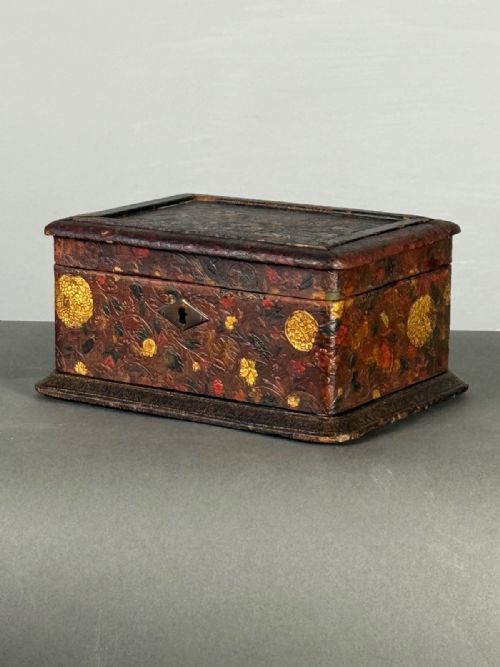
A decorative desktop box encompasses various forms designed to sit upon a surface, ranging from small stationery cabinets and tea caddies to keepsake caskets and writing storage. You encounter items primarily from the nineteenth century alongside earlier seventeenth-century pieces and later examples from the early decades of the twentieth century.
The selection includes specific regional work, such as Russian hand-painted pieces and Anglo-Indian sewing boxes alongside English and French productions. Styles vary considerably, incorporating Regency elegance, Victorian lacquer, Baroque richness, and Chinoiserie motifs.
Makers and workshops utilised diverse structural forms, including table cabinets and book box ink stands, ensuring that each decorative desktop box serves a functional role while displaying distinct period aesthetics.
Materials and construction
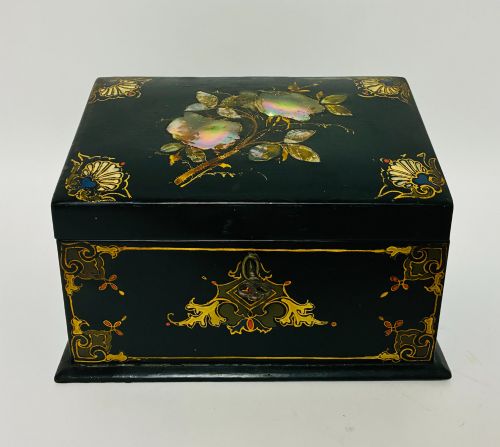
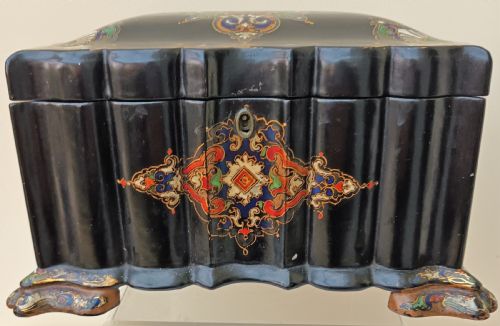
Papier-mâché serves as a primary base for many pieces, often finished with deep lacquer, gold leaf, and hand-painted polychrome details. Woodwork employs materials such as ebony, walnut, burr yew, oak, fruitwood, and sandalwood, sometimes enhanced with intricate marquetry.
Exotic materials appear on specialised pieces, incorporating horn, ivory, quill work, and leather coverings stamped or painted with metallic highlights. Glass and brass fittings complete the construction, providing structural hinges, clasps, and desk accessory mounts.
Some nineteenth-century boxes double as miniature libraries by disguising themselves as stacked leather-bound books.
Assessing quality and execution
Quality reveals itself in the intricacy of the surface decoration, from the precision of hand-painted lacquer scenes to the fine execution of marquetry patterns and quill work. Superior examples demonstrate careful selection of timber, such as well-figured burr yew or pollard oak.
The sophistication of the internal fittings and the integration of functional elements, like integrated clocks or stationery dividers, separate standard utilitarian storage from masterwork desk accessories.
Susse Freres Paris
The Decorative Desktop Box Glossary
- Papier-mâché
- A composite material made from paper pulp or reinforced paper layers, moulded and lacquered to provide a smooth, durable surface for painting.
- Marquetry
- The art of applying decorative veneer pieces to a structure to form geometric or pictorial designs.
- Tea caddy
- A box originally designed for storing loose tea leaves, often featuring internal compartments and secure lids.
- Table cabinet
- A small freestanding piece of furniture with doors or drawers, built to sit on a desk or table for document storage.
- Quill work
- A decorative technique utilising flattened porcupine quills arranged in geometric patterns, frequently found on Anglo-Indian pieces.
Decorative Desktop Box: Frequently Asked Questions
What is a decorative desktop box used for?
These boxes provided secure storage for precious keepsakes, letters, stationery, and tea on working desks and tables.
Today, they serve the exact same purpose while adding period character and texture to a modern home office or study.
How do I date a decorative desktop box?
Dating relies on identifying the prevailing style, such as Regency neoclassical lines or Victorian papier-mâché techniques, alongside the materials employed.
Examining construction methods and hinges also helps establish whether an item belongs to the seventeenth, nineteenth, or early twentieth century.
Are these boxes fragile?
Pieces finished with delicate lacquer, gold leaf, or organic elements like ivory and quill work require careful handling and stable humidity.
Keeping them away from direct sunlight and excessive moisture preserves the painted surfaces and structural integrity.
What materials are most common?
Wood is the most frequent material, utilising oaks, walnuts, and exotic timbers like sandalwood alongside decorative papier-mâché.
Leather, brass, and glass also appear regularly as primary coverings or functional hardware accents.