
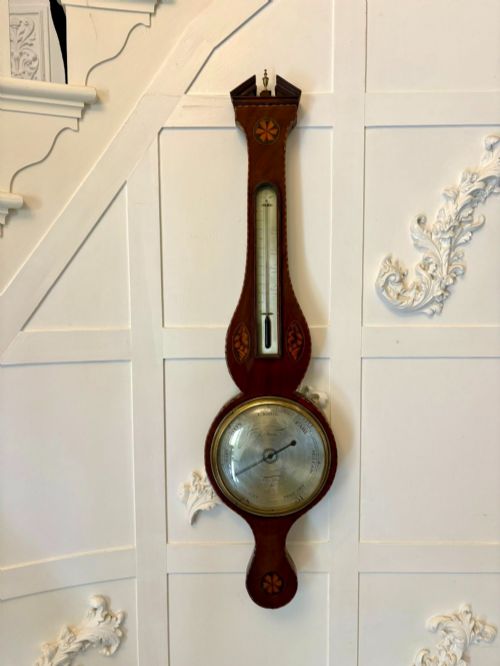


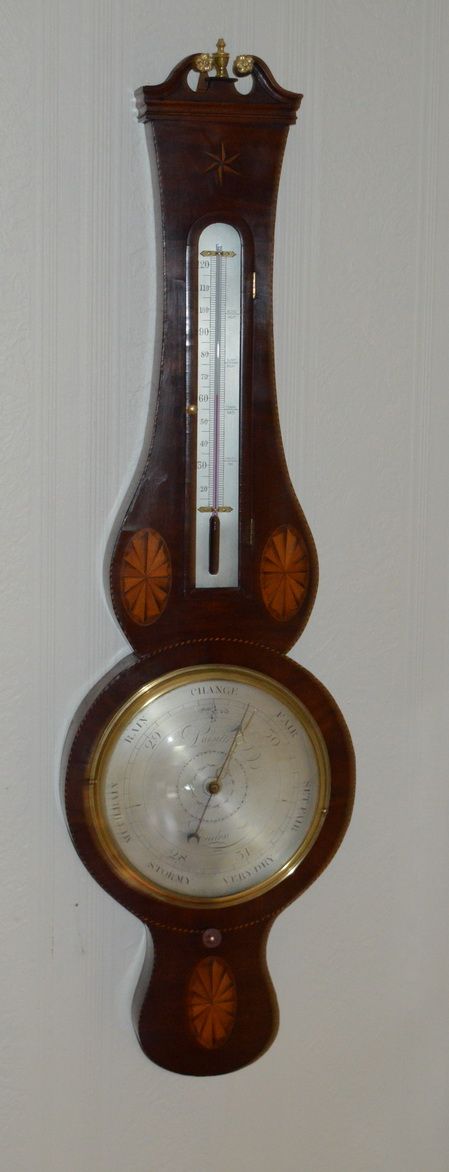
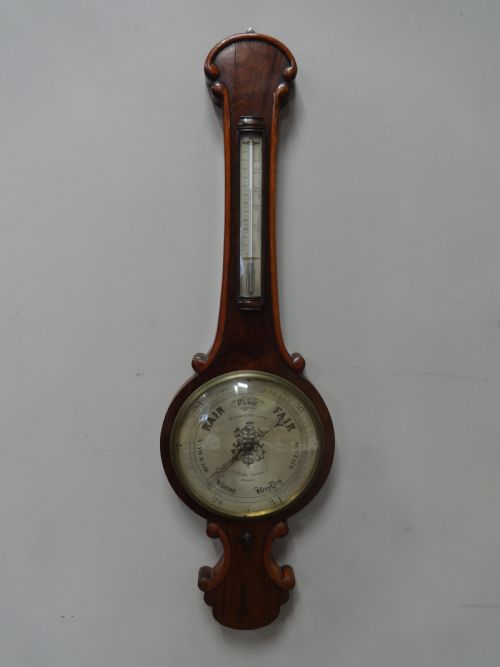
Dark Wood Wheel Barometer
When you want a dark wood wheel barometer, you are looking for a reliable weather glass housed in a decorative wall case.
Dark Wood Wheel Barometer
A dark wood wheel barometer combines practical atmospheric measurement with domestic decoration. These wall barometers span the Georgian, Regency, and Victorian periods, reflecting shifting tastes in interior display.
The most common form on this page is the banjo barometer, shaped with a rounded dial at the top and a long trunk below. Examples date from the eighteenth and nineteenth centuries, utilising rich timbers such as mahogany and rosewood.
Makers housed these precision instruments in cases embellished with shell inlay, mother of pearl, and marquetry. Wall barometers of this scale served as focal points in period hallways and reception rooms.
Materials and construction
Cabinets rely upon dense cabinet timbers including mahogany and rosewood, sometimes accented with satinwood stringing or walnut. These woods were selected for stability and polished to a deep lustre.
Dials and indicators incorporate engraved silvered metal plates protected beneath curved glass bezels. Brass fittings secure the components, while mercury tubes measure atmospheric pressure within the trunk.
Materials recorded across the selection include mahogany, rosewood, walnut, satinwood, brass, mother of pearl, and silvered metal.
Assessing quality and craftsmanship
Quality rests in the crispness of the cabinetwork and the delicacy of the inlaid decoration. Superior pieces display finely executed shell motifs and mother of pearl detail that remain intact within the timber.
The sophistication of the maker's signature engraved on the silvered dial elevates a piece. Better examples retain their original mercury tubes and brass hygrometer or thermometer attachments at the top.
Roncoroni·Luisetti of London·Joseph Somalvico and Co·J C Moretti of King's Lynn·Negretti and Zambra
The Dark Wood Wheel Barometer Glossary
- Wheel barometer
- An instrument that uses a pulley and weight system to translate mercury movement into the rotation of a visible hand on a dial. This layout defined domestic weather glasses throughout the Georgian and Victorian eras.
- Banjo barometer
- A common wall barometer shape resembling a banjo, featuring a circular dial head above a tapered wooden trunk. The lower body often houses a spirit thermometer or hygrometer.
- Silvered metal
- A brass or copper dial plate treated to achieve a bright, silvery finish before being engraved with weather scales and maker details. The fine lines catch the light for clear reading.
- Mercurial barometer
- A weather glass operating on the principle of balancing atmospheric pressure against a column of mercury. These form the traditional mechanism found in older instruments.
- Marquetry
- The art of applying small pieces of veneer to form decorative pictures and geometric patterns on furniture surfaces. It appears on select wall cases to frame the central glass.
Dark Wood Wheel Barometer: Frequently Asked Questions
How do wheel barometers work?
A sealed glass tube containing mercury responds to changes in outside air pressure. A float resting on the mercury connects to a silk thread and pulley system that turns the pointer on the dial.
As pressure rises or falls, the needle moves across engraved weather descriptions ranging from stormy to very dry. This mechanical linkage allowed households to monitor impending weather shifts at a glance.
Are these barometers still accurate?
Many surviving mercurial barometers maintain their mechanical precision if the internal tube remains unbroken. They continue to register genuine barometric pressure changes in the home.
Calibration can sometimes be adjusted via the screw on the back or front plate. However, many owners display them primarily as historical wall furniture rather than primary meteorological instruments.
Where should I hang a wall barometer?
Select an interior wall that avoids direct sunlight and heavy heat sources like radiators. Stable room temperatures protect the antique wood case and ensure the internal mechanism functions smoothly.
Ensure the wall fixing is secure, as these instruments possess significant weight due to dense timber and glass components. Hang them at eye level so the dial can be read easily.
How do I date a mahogany barometer?
Georgian examples from around eighteen hundred typically feature restrained mahogany cases with delicate shell marquetry. Victorian pieces from later decades often incorporate heavier walnut or rosewood with bolder carving.
Maker signatures and the style of the engraved silvered dial also provide clues to the decade of manufacture. Earlier dials tend to be simpler, while later Victorian versions include more complex scales.