
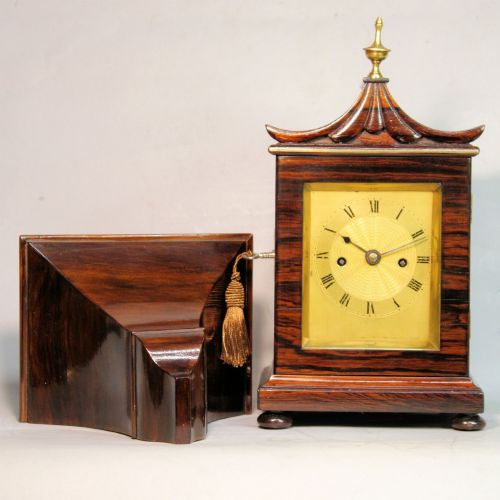


Dark Rosewood Wall Clock
These dark rosewood wall clocks are substantial timepieces built from rich timber, offering a striking focal point for any room.
Dark Rosewood Wall Clock
A dark rosewood wall clock combines heavy timber cases with reliable dial movements, originating across the nineteenth century during the Victorian, Regency, and Georgian periods. Most examples encountered here take the form of drop-dial wall clocks, featuring circular faces above lower wooden cases.
Makers utilised dark rosewood for its deep grain and substantial weight, frequently mounting these timepieces in octagonal or drop-dial configurations. The selection ranges from miniature fusee bracket clocks with optional wall mounts to large striking regulators.
Buyers will find that Victorian and late Victorian productions dominate the available selection, alongside pieces from the Regency and George IV eras. These timepieces served practical domestic functions while displaying the prominent timber work favoured in period interiors.
How they were made
Cases were constructed from solid rosewood, often housing fusee movements that drove the mechanism with a smooth, even force. Workshops incorporated brass details, glass dial covers, and mother-of-pearl inlay to adorn the heavy wooden frames.
Dial faces frequently featured painted numerals protected behind hinged glass bezels and cast brass surrounds. Master clockmakers fitted twin fusee or standard fusee movements capable of bell striking to regulate the time accurately.
Several clocks wear mother-of-pearl like tiny Sunday jewels.
What varies in quality
Quality rests upon the crispness of the rosewood case carving, the complexity of the internal fusee movement, and the presence of decorative inlays such as mother-of-pearl or brass. Simpler octagonal dial clocks offer plain timber surfaces, whereas high-end regulators and drop-dial pieces feature refined timber selection and superior bell-striking mechanisms.
The precision of the dial painting and the integrity of the heavy timber housing distinguish standard production from exceptional workshop creations. Finer examples retain original components throughout their cases and dial assemblies.
Halliday & Rich Bridgwater·James Bell Bath
The Dark Rosewood Wall Clock Glossary
- Fusee
- A conical pulley used in clock movements to maintain an even pull as the mainspring unwinds. This mechanism ensures consistent timekeeping accuracy throughout the running period.
- Drop-dial
- A clock design featuring a circular dial mounted above an extended wooden case. This lower section often houses a pendulum and allows for weight-driven or spring-driven mechanisms.
- Regulator
- A precision timepiece designed to maintain exceptional accuracy, frequently utilised as a standard for setting other clocks. These examples often incorporate sophisticated movements.
- Mother-of-pearl
- An iridescent inner layer of certain mollusc shells utilised for decorative inlay work on clock cases. Artisans cut this material into geometric or floral motifs.
- Bracket clock
- A portable timepiece originally designed to sit on a wall bracket or table surface. Some historic examples include matching wall brackets for secure mounting.
Dark Rosewood Wall Clock: Frequently Asked Questions
What is a fusee movement?
A fusee movement uses a conical pulley to equalise the declining power of the mainspring as it unwinds. This ensures the clock maintains steady force and accurate timekeeping.
Such mechanisms represent traditional British clockmaking skill and are commonly found in nineteenth-century wall timepieces.
How do I date a rosewood clock?
Dating relies on examining the case style, dial construction, and movement type recorded in the nineteenth-century periods. Victorian, Regency, and Georgian eras each display distinct proportions and decorative treatments.
Cabinet work and inlay styles also shift from the simpler Regency designs to the more ornate late Victorian examples.
Where were these clocks hung?
These timepieces hung in prominent domestic and public spaces where accurate timekeeping and striking bells were required. Hallways, parlours, and offices provided the necessary wall space for their heavy timber cases.
Their substantial drop-dial forms were specifically engineered for secure vertical mounting.
What maintenance do they need?
Mechanical clocks require professional servicing every few years to clean the gears and renew the lubricants. Winding must be performed regularly using the appropriate key.
Proper wall mounting into solid masonry or studwork is essential to support the heavy rosewood and glass construction.