



Dark Rosewood Table Clock
Dark rosewood table clock items are timepieces housed in rich timbers that bring warmth and mechanical precision to any interior.

Dark Rosewood Table Clock
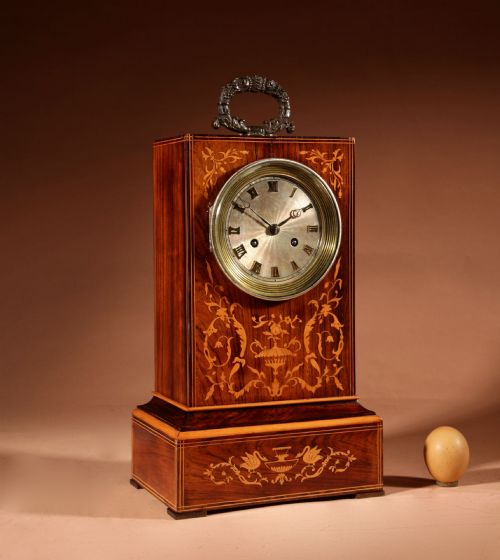
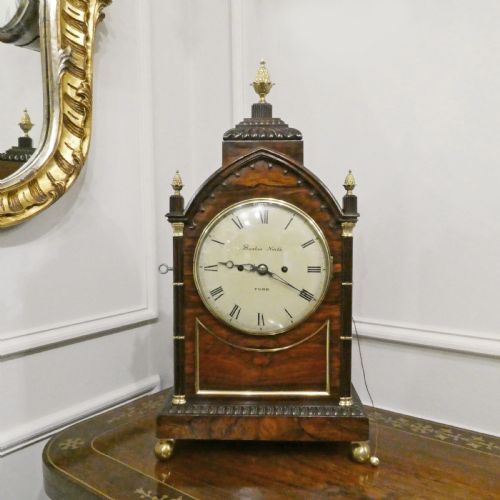
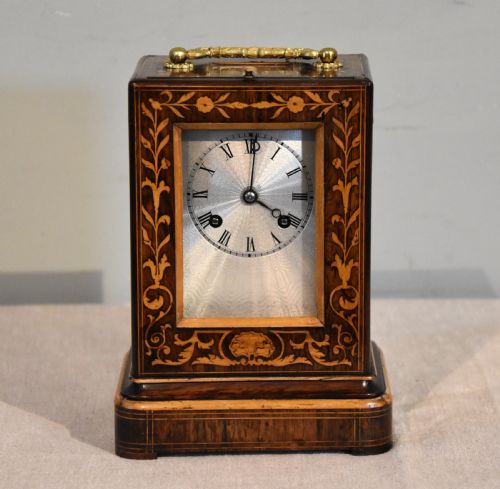
A dark rosewood table clock is typically encountered as a bracket clock, mantel clock, or carriage timepiece dating from the nineteenth century. These pieces range from substantial twin fusee bracket clocks to smaller French and English mantel designs.
The materials recorded in the evidence combine dark rosewood cases with brass, glass, enamel, and silvered metal dials, frequently decorated with satinwood or mother-of-pearl inlay.
Makers represented across the listings include English firms such as Barber & North of York, Seller of Reading, Plumbly & Tupman, and L.Donne, alongside French makers like Paul Garnier and Henry Marc.
Materials and construction
Cases are built from dense rosewood, sometimes ebonised or inlaid with contrasting satinwood and mother-of-pearl, enclosing complex mechanical movements driven by fusee or spring mechanisms.
Dials employ enamel, brass, or silvered metal to display the time, protected behind glazed bezels and housed within architectural styles that include Regency, Gothic Revival, and Victorian designs.
Dark Rosewood Table Clock Retail Price Guide 2026
Typical asking prices for dark rosewood table clock among the pieces listed under this phrase on Sellingantiques today, from the lower quarter to the upper quarter. They describe what is for sale here now, not the wider market.
Some miniature clocks come with an optional wall bracket for hanging.
Evaluating craftsmanship
Quality in these clocks rests upon the precision of the case inlay, the crispness of the brass mounts, and the complexity of the movement, such as quarter-striking or twin fusee configurations.
Finer examples demonstrate superior timber selection, intricate marquetry, and signed movements from established makers, distinguishing them from simpler timepieces.
Barber & North of York·Seller of Reading·Arnold and Frodsham·Paul Garnier·Henry Marc·Plumbly & Tupman·L.Donne Birchin Lane
The Dark Rosewood Table Clock Glossary
- Bracket clock
- A portable clock originally designed to sit on a wall bracket or table. These movements often feature fusee mechanisms.
- Fusee
- A conical pulley used in clock movements to maintain even driving power as the mainspring unwinds.
- Portico clock
- A mantel clock designed with architectural columns resembling a classical portico. These frequently incorporate rosewood and satinwood veneers.
- Marquetry
- Decorative patterns formed by fitting together thin pieces of wood veneer. This technique is often seen in French designs.
- Silvered metal
- A metal dial treated with a silver finish to provide high contrast for engraved numerals.
Dark Rosewood Table Clock: Frequently Asked Questions
What is a dark rosewood table clock?
A dark rosewood table clock is a mechanical timepiece housed in a rich wooden case, designed to sit on a mantel, table, or bracket.
These pieces span the nineteenth century and encompass various English and French styles.
How do I wind my clock?
Most mechanical clocks require a key to tension the mainspring through winding holes on the dial.
Care must be taken not to overwind the movement to ensure proper operation.
Where were these clocks made?
The pieces originate primarily from workshops in England and France during the nineteenth century.
Prominent makers operated in London, provincial towns, and Paris.
How do I identify the period?
Period identification relies on case architecture, dial materials, and stylistic traits such as Regency, Gothic Revival, or Victorian ornamentation.
Signatures on the movement or dial often provide further chronological context.
What maintenance do they need?
Mechanical clocks benefit from periodic professional servicing to clean the gears and maintain proper lubrication.
Placing the clock on a stable surface ensures the pendulum or balance wheel remains level.