
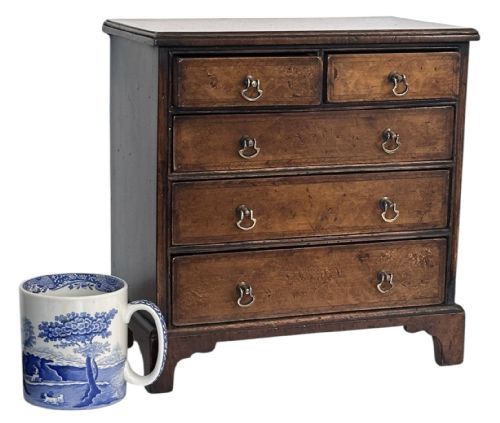


Dark Mahogany Jewellery Chest
A dark mahogany jewellery chest brings miniature craftsmanship into your daily routine, offering small-scale storage with the presence of larger antique furniture.
Dark Mahogany Jewellery Chest
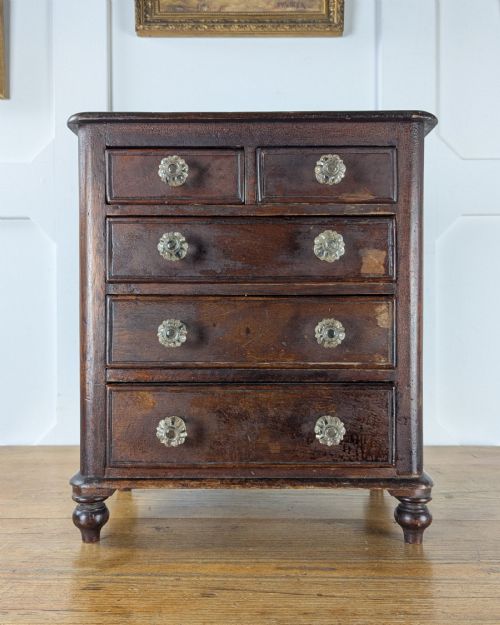
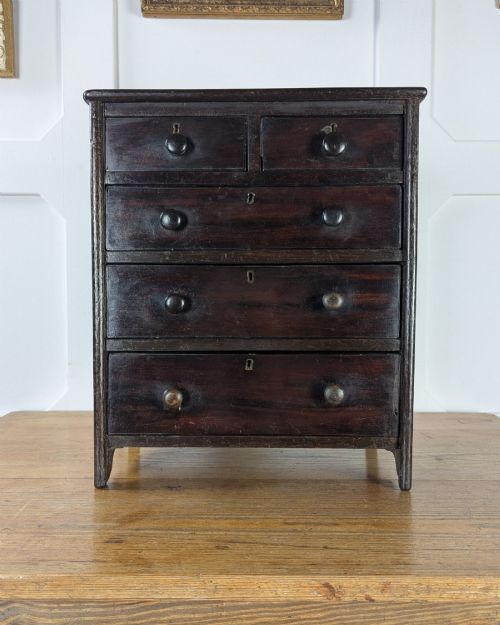
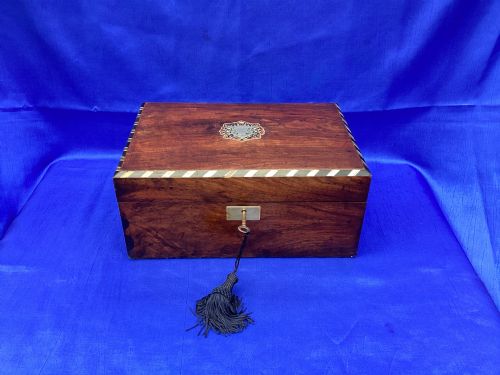
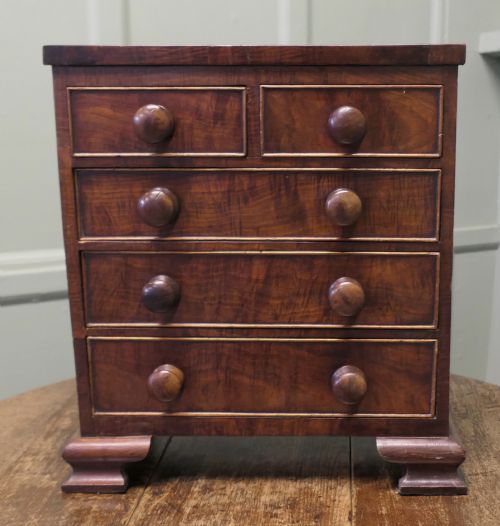
When you search for a dark mahogany jewellery chest, you encounter miniature chests of drawers, small cabinets, and specialised watch or jewellery boxes. These pieces often originate from the Georgian, Victorian, and Edwardian periods, frequently taking the form of apprentice pieces or scaled-down case furniture.
The selection on this page relies heavily on Victorian and 19th-century examples alongside 18th-century and Georgian pieces. Most take the shape of miniature chests of drawers or small table cabinets designed for personal valuables, watches, and trinkets.
Alongside traditional British forms, the listings include occasional international examples such as Chinese table cabinets and travelling boxes in contrasting woods. The core of what you meet remains the mahogany miniature chest, built with the proportions of full-size furniture.
How they were made
Cabinetmakers constructed these pieces primarily from solid and veneered mahogany, sometimes incorporating secondary timbers like oak. Surfaces often feature fine wood inlay, boxwood stringing, or contrasting mother-of-pearl details.
Hardware played a functional and decorative role, with makers fitting brass handles, escutcheons, and hinges. Turners shaped small wooden feet to support the miniature chests, while joiners utilised traditional drawer-making techniques on a reduced scale.
Listings span the Georgian, Victorian, and Edwardian eras, predominantly featuring mahogany alongside brass, glass, and mother-of-pearl.
What varies in quality
The standard of a piece depends largely on the fidelity of its scaling and the crispness of its joinery. Better examples maintain the exact proportions and architectural detailing of full-sized furniture rather than appearing clumsy or simplified.
Surface finish and material selection also set pieces apart. A deep, rich patina on the mahogany, combined with neat inlay work and well-fitted drawers, distinguishes finer workshop output from simpler utilitarian boxes.
The Dark Mahogany Jewellery Chest Glossary
- Apprentice piece
- A small-scale item demonstrating a craftsman's skill to gain master status. These often mirror full-size chests of drawers.
- Bowfront
- A convex, curved front elevation popular on Georgian and Victorian case furniture. It softens the silhouette of the piece.
- Escutcheon
- A protective plate surrounding a keyhole, usually fashioned from brass. It prevents the wood from wearing around the lock.
- Patina
- The surface sheen and deep colour developed by aged wood through handling and time. It indicates natural maturation.
- Stringing
- A narrow strip of contrasting wood inlaid into the surface of furniture. Boxwood is frequently used for this decorative banding.
Dark Mahogany Jewellery Chest: Frequently Asked Questions
What is an apprentice chest?
An apprentice chest is a small-scale model built by a trainee cabinetmaker to prove their proficiency in woodworking. These pieces replicate full-size furniture in every detail.
They served as practical demonstrations of skill rather than toys, which accounts for their robust construction and fine materials.
How were these small chests used?
Owners utilised them to store jewellery, watches, trinkets, and small personal documents. Their compartmented interiors suited high-value items requiring secure storage.
Over time, people also placed them on tables and desks simply as decorative ornamental furniture.
How do I date a mahogany chest?
Dating relies on observing construction methods, handle styles, foot types, and overall aesthetic traits. Georgian pieces tend to show clean architectural lines, while Victorian examples often feature turned feet or applied mouldings.
Comparing the secondary timbers and the character of the wood finish further clarifies the period of origin.
Can I store modern jewellery in them?
You can safely store modern rings, necklaces, and watches inside these velvet-lined or wood-partitioned compartments. The drawers protect pieces from dust and tangling.
Care should be taken with overfilling, as antique drawer stops are designed for lighter loads than heavy modern collections.