
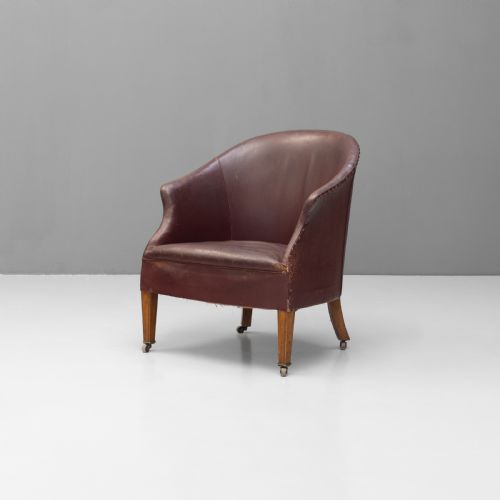


Curved Back Club Chair
A curved back club chair brings deep-seated comfort and architectural presence to a room, drawing on decades of confident design.
Curved Back Club Chair
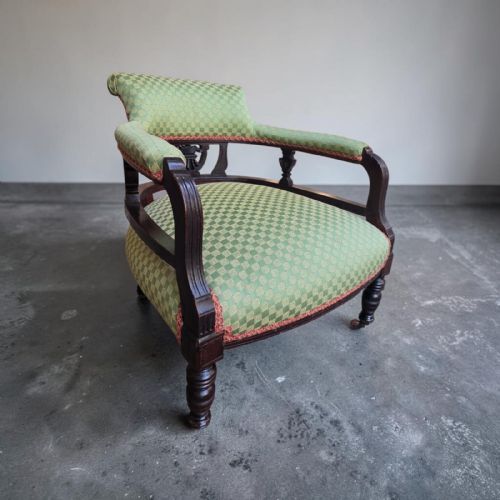
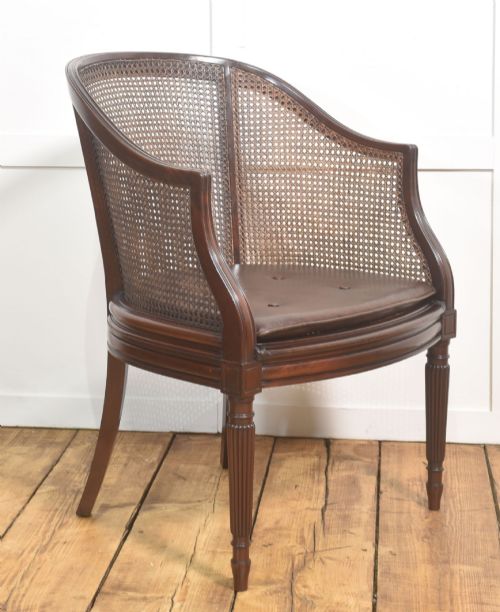
A curved back club chair offers a deep, enclosing seat designed for sustained relaxation, emerging in forms ranging from Victorian buttoned frames to streamlined mid-century silhouettes. When exploring a curved back club chair, buyers encounter low-slung profiles, barrel backs, and tub designs that wrap around the sitter.
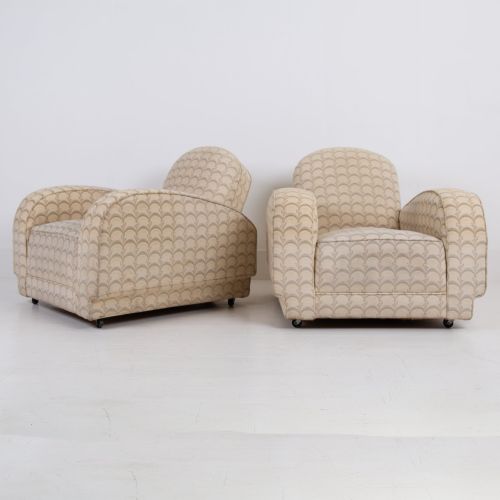
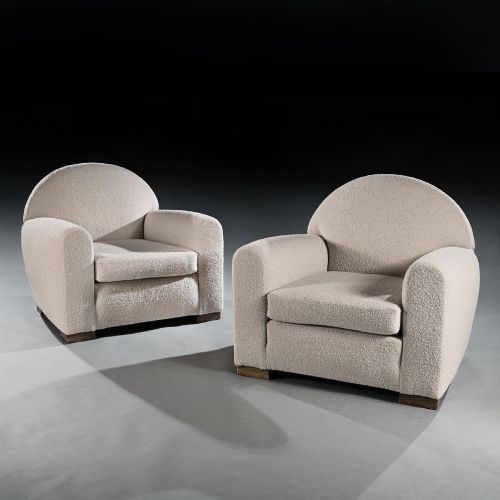
The pieces on this page span the nineteenth century through to the middle of the twentieth century, taking in Edwardian, Art Deco, and French mid-century iterations. Most commonly, these seating choices appear as upholstered armchairs, tub chairs, and cocktail chairs tailored for domestic reception rooms.
Makers often softened the rigid geometry of earlier decades by introducing rounded armrests and curved backrests that support an upright yet restful posture. These armchairs function as central seating elements in a library, study, or drawing room, balancing substantial proportions with inviting contours.
Materials and construction methods
Makers built these frames using sturdy timber carcasses, relying on mahogany and oak for structural integrity while incorporating cane panels to lighten the visual weight of the silhouette. Cabinetmakers shaped the curved wooden rails by hand or steam-bending, ensuring the continuous sweep characteristic of the barrel and tub forms.
Upholstery formed the core of the construction, employing heavy fabric, leather, and metal detailing such as brass tacks to secure the outer covering over deep internal padding. High-buttoned upholstery techniques, seen in nineteenth-century examples, demanded precise tension to create the characteristic tufted surface across the curved back.
Materials recorded across the selection include mahogany, oak, leather, cane, fabric, and brass hardware details.
Assessing quality in construction and finish
Quality rests in the integrity of the wooden frame's joinery and the resilience of the internal springing, which determines how cleanly the curved back holds its tension over decades of use. Superior examples display seamless transitions where the arms meet the curved backrest, showing meticulous hand-shaping of the timber.
The grade of the covering material and the precision of the stitching dictate the finish at the top of the range. Leather and heavy fabric selections show careful paring at the seams, whereas simpler pieces rely on standard textile stretches that lack the tailored finish of bespoke workshops.
Harry and Lou Epstein
The Curved Back Club Chair Glossary
- Tub chair
- An upholstered armchair with a continuous curved back and arms that form a single semi-circular enclosure. This form provides a snug and supportive sit.
- Barrel back
- A seating design featuring a high, fully curved backrest resembling the stave construction of a barrel. It wraps around the sitter to enclose the upper body.
- Cane
- Strips of woven rattan used to form decorative and breathable panels within wooden chair frames. It introduces textural contrast to the heavy timber structure.
- Buttoning
- A traditional upholstery method where deep depressions are secured with twine and covered buttons across the backrest. This technique creates a tufted pattern that holds internal stuffing firmly in place.
Curved Back Club Chair: Frequently Asked Questions
What defines a club chair?
A club chair is a deep, comfortable armchair designed for lounging, typically featuring low arms and a padded seat. The curved back variation wraps around the user for additional support and an enveloping feel.
These pieces originated as heavy, leather-upholstered seating in gentlemen's clubs before transitioning into domestic living spaces in various stylistic forms throughout the nineteenth and twentieth centuries.
How do I date a curved back chair?
Dating relies on examining the underlying timber, the style of the upholstery, and the specific silhouette. Victorian examples often feature high buttoning and exposed mahogany or walnut frames, while Edwardian versions frequently incorporate cane panels.
Later Art Deco and mid-century pieces discard ornate woodwork in favour of streamlined, continuous upholstery lines and low-slung proportions that reflect the design priorities of the nineteen-thirties and forties.
Where should I place a tub chair?
A tub chair suits smaller corners, bedrooms, or paired arrangements opposite a sofa due to its compact yet enveloping footprint. The curved back allows the piece to sit comfortably away from walls as a freestanding sculptural element.
In studies and libraries, these chairs provide a compact reading seat that occupies less visual space than a standard wingback while maintaining deep-seated comfort.
Are these chairs suitable for daily use?
These antique and vintage frames are constructed from solid hardwoods like oak and mahogany, making them structurally robust for everyday seating. Many retain their original internal support or have received updated foundations to handle regular domestic life.
Choosing a piece with durable leather or tightly woven fabric ensures the exterior withstands frequent use while developing a natural patina over time.