


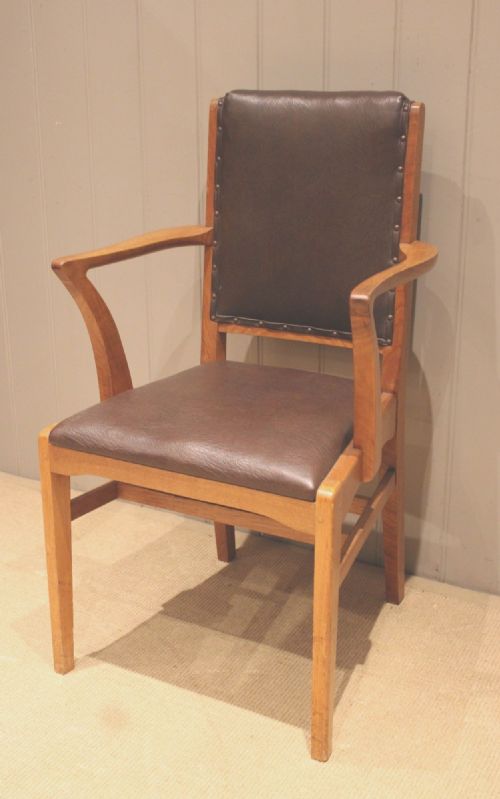


Curved Arm Leather Chairs
Curved arm leather chairs bring immediate warmth and functional comfort to a room, offering robust seating shaped from enduring timber and hide.
Curved Arm Leather Chairs
These curved arm leather chairs encompass sturdy seating designed across the nineteenth and twentieth centuries, spanning periods from the Victorian era through Edwardian times to Art Deco designs. Buyers encounter forms ranging from functional desk chairs to low armchairs and club armchairs.
The materials and styles represented include mahogany, oak, birch, walnut, and teak, styled with influences from Queen Anne, Biedermeier, Sheraton revival, and Art Deco movements. Many examples feature integrated leather upholstery alongside brass and textile details.
Desk chairs and open armchairs dominate the offerings, providing practical workspaces or conversational seating. Their overarching characteristic remains the curved armrest configuration paired with leather coverings.
Construction and materials
Makers built the foundational frames of these chairs from solid hardwoods such as mahogany, oak, walnut, teak, and birch, sometimes employing ebonised finishes or brass inlay for decorative emphasis.
Upholstery relies upon traditional hide and leather, occasionally paired with textile elements and secured to frames shaped with bentwood techniques or classical revival joinery.
The listings here span the nineteenth century, Victorian era, Edwardian period, and 1930s Art Deco.
Judging quality in construction and finish
The calibre of timber selection and the integrity of the joinery set higher grades apart from simpler utilitarian seating, visible in the depth of the mahogany, walnut, or oak used for the frame.
The treatment of the leather upholstery and the crispness of revival detailing, such as Sheraton or Queen Anne influences, determine the distinction between standard workshop production and finer examples.
The Curved Arm Leather Chairs Glossary
- Biedermeier
- A Central European style from the nineteenth century focusing on utilitarian comfort and clean lines without excessive ornamentation. Birchwood was frequently utilised during this period.
- Sheraton Revival
- A late nineteenth and early twentieth century design movement drawing upon the neoclassical furniture forms of eighteenth century designer Thomas Sheraton. These pieces often utilise mahogany.
- Bentwood
- A technique where wood is heated and bent into curved structural forms rather than carved from a single block. Thonet famously perfected this method.
- Plantation Chair
- A deep-seated colonial chair often featuring extended arms designed for lounging in warmer climates. Teak and leather are common materials in these forms.
Curved Arm Leather Chairs: Frequently Asked Questions
Are these chairs suitable for daily desk work?
Many of these pieces are specifically formed as desk chairs and armchairs, offering practical seating for working environments.
Their robust timber frames and supportive leather seats accommodate regular daily use.
How do I identify an Art Deco chair?
Art Deco pieces typically date from the 1930s and display streamlined forms and smooth leather surfaces.
They often prioritise comfort and bold geometric presence over historical revival ornamentation.
What woods were commonly used for these chairs?
Makers predominantly utilised solid hardwoods including mahogany, oak, walnut, and birch.
Some examples also incorporate exotic timbers like teak alongside brass and textile accents.
How do I care for the leather upholstery?
Leather upholstery benefits from regular dusting and occasional conditioning to maintain the suppleness of the hide.
Keeping the chairs away from direct heat sources prevents the leather from drying out over time.