
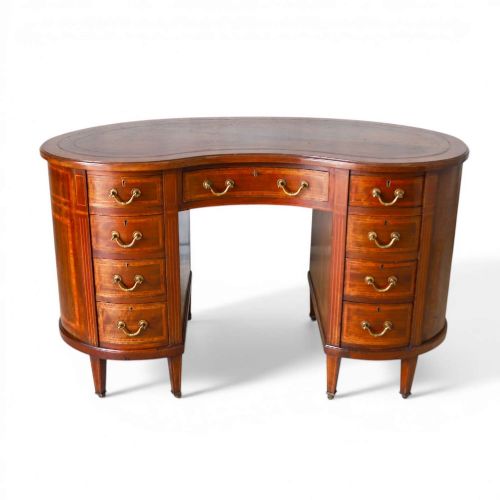
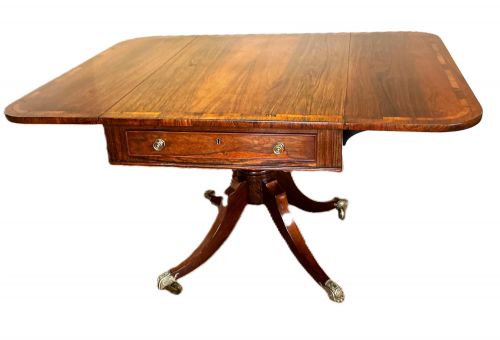


Crossbanded Pedestal Desk
A crossbanded pedestal desk is a substantial writing furniture piece defined by a border veneer framing the timber, sought after for formal studies and libraries.
Crossbanded Pedestal Desk
When you search for a crossbanded pedestal desk, you are looking at substantial writing furniture constructed with a distinct border veneer framing the main timber of the top or drawers. The pieces available span periods from the Georgian and Regency eras through the Victorian and Edwardian periods up to the early twentieth century.
You are most likely to meet mahogany versions featuring satinwood or walnut crossbanding, alongside occasional examples in oak or burr walnut with tulipwood or kingswood borders. These items take the form of twin pedestal desks, partner desks, kidney desks, and Davenport desks designed for practical use in a study or library.
The construction typically incorporates multiple banks of drawers flanking a central kneehole, often retaining original leather writing surfaces, brass hardware, and oak linings. Stylistic influences range from classic Georgian proportions to Sheraton Revival interpretations and Victorian refinements.
What varies in quality
Quality varies according to the precision of the timber matching and the execution of the crossbanding and inlay work across the top and drawer fronts. Superior examples demonstrate careful grain selection in flame mahogany, satinwood, or burr walnut.
Construction standards differ in the joinery of the internal drawers, such as the use of oak linings and traditional dovetailing, as well as the retention of original brass hardware and leather tops. The refinement of proportions and edge details distinguishes finer pieces.
Listings feature items spanning the Georgian, Regency, Victorian, and Edwardian periods, constructed in mahogany, satinwood, oak, walnut, and rosewood.
The Crossbanded Pedestal Desk Glossary
- Crossbanding
- A border veneer applied to the edges of a surface, arranged so the grain runs perpendicularly to the central panel. This technique frames the primary timber and provides a decorative contrast.
- Pedestal desk
- A freestanding writing table comprising two separate drawer pedestals supporting a wide top with a central kneehole space. It offers substantial storage capacity and a finished rear for placement in the middle of a room.
- Satinwood
- A light yellowish timber native to India and Ceylon, frequently used for fine veneers and inlay work during the eighteenth and nineteenth centuries. It brings a bright visual accent to mahogany furniture.
- Partners desk
- A large double-sided pedestal desk designed for two people to work opposite one another, featuring drawers and cupboards on both sides. These pieces represent the larger scale of nineteenth-century office furniture.
Crossbanded Pedestal Desk: Frequently Asked Questions
What is a crossbanded pedestal desk?
A crossbanded pedestal desk is a large writing table featuring two supporting stacks of drawers and a distinct border veneer framing the top or drawer fronts. These pieces were built for studies and libraries to provide both workspace and extensive storage.
They appear in various timber combinations such as mahogany with satinwood or walnut with tulipwood, reflecting stylistic shifts from the Georgian period through the Edwardian era.
How do I date a pedestal desk?
Dating a pedestal desk involves examining the primary woods, secondary timbers used for drawer linings, hardware types, and overall construction methods. Georgian and Regency pieces show different proportions and joinery compared to later Victorian or Edwardian interpretations.
Details like oak-lined drawers, original brass swan neck handles or ring pulls, and the style of crossbanding help narrow down the period of manufacture.
What is a partners desk?
A partners desk is an expanded version of the standard pedestal desk designed with working space and drawer access on both sides. This allows two individuals to sit opposite each other while using the furniture.
They are typically substantial in scale and were utilised in large libraries, administrative offices, and stately homes.
Are writing surfaces original?
Many desks retain their original tooled leather or hide writing inserts, though some have been replaced over time due to wear. The presence of period-appropriate leather with blind tooling adds to the historical integrity of the piece.
Examining the edges of the leather and the surrounding crossbanded timber reveals whether the insert has been modernised or remains undisturbed.
How do I care for a wood desk?
Caring for an antique wood desk involves keeping it away from direct sunlight and maintaining stable humidity levels to protect the delicate crossbanding and veneers. Regular dusting with a soft, dry cloth preserves the polished finish.
Leather writing surfaces benefit from occasional specialist conditioning to prevent the material from drying out or cracking.