

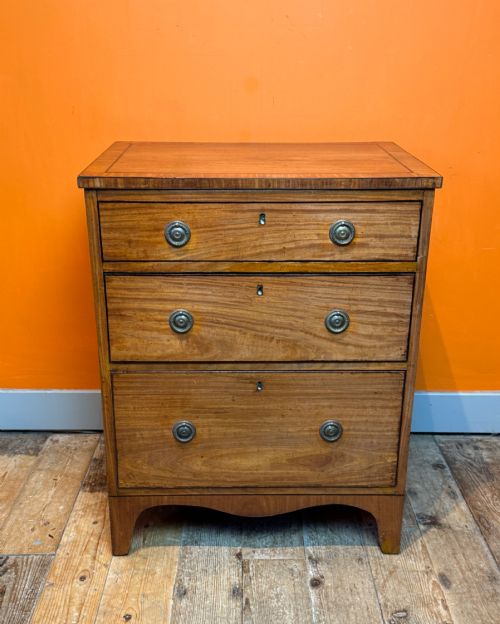
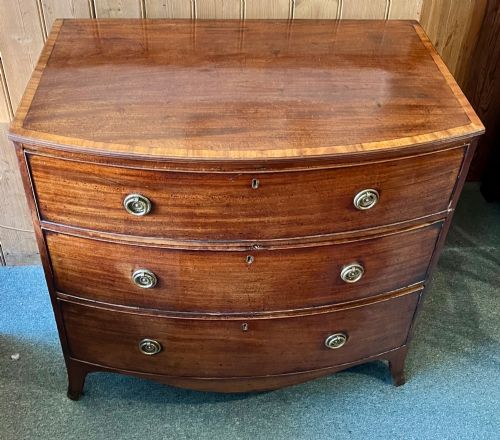
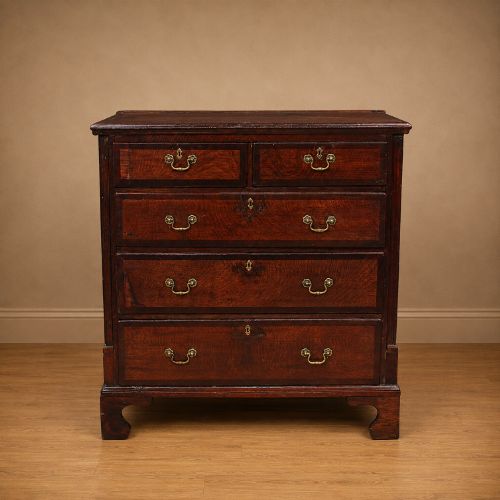
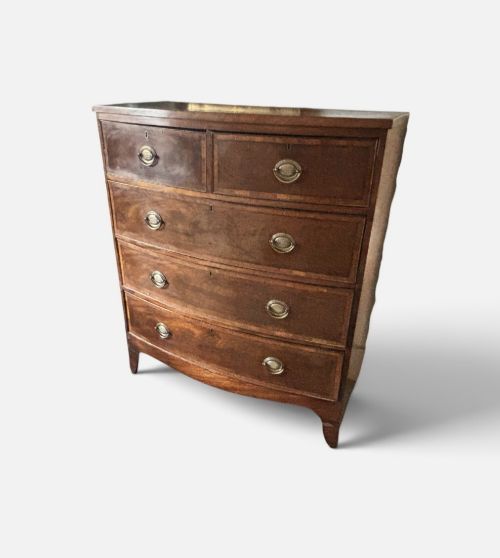



Crossbanded Mahogany Commode
A crossbanded mahogany commode is a timber chest of drawers framed in contrasting veneer that brings warmth and line to a room.
Crossbanded Mahogany Commode
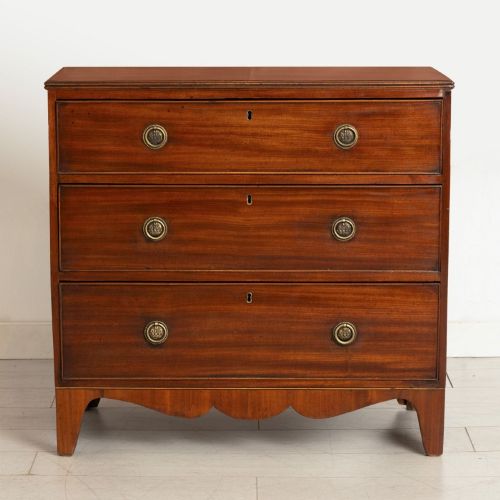
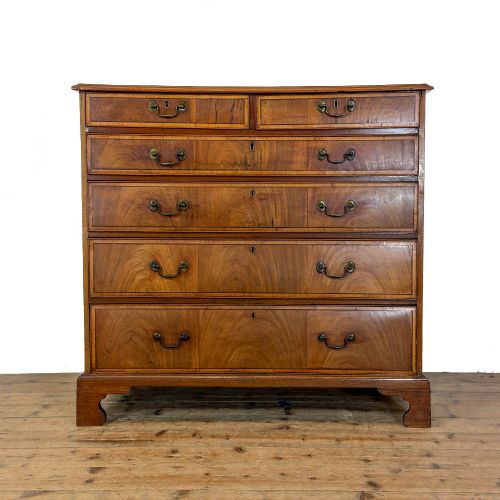
A crossbanded mahogany commode is a case piece designed for storage, most frequently taking the form of a bow front or straight front chest of drawers. These items emerge across the Georgian, Regency, and Victorian periods, alongside Edwardian interpretations.
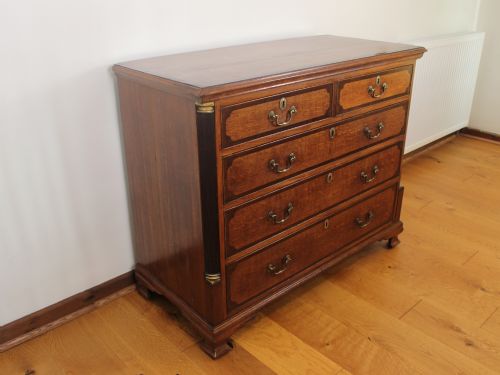
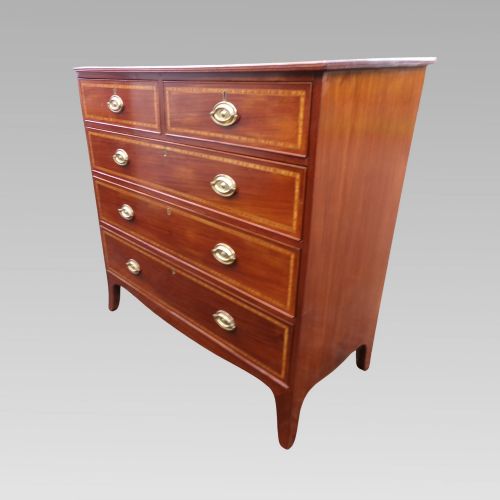
The dominant version on this page is the bow front chest in rich mahogany, often detailed with satinwood or boxwood inlay running along the perimeter of the top surface. Examples range from compact small proportions to larger Georgian oak pieces banded in mahogany.
Origins span British workshops of the eighteenth and nineteenth centuries, alongside colonial revival production. Buyers encounter both fitted interiors from the eighteenth century and simpler graduated drawer configurations from the Regency era.
Construction and materials
Cabinetmakers built these pieces using solid mahogany and oak for the primary carcass and drawer linings, applying thin veneers to the exterior surfaces. Boxwood and satinwood provide the contrasting borders known as crossbanding, set perpendicular to the grain of the main top.
Hardware consists principally of brass handles secured to dovetailed drawer boxes. Timber selection relies on the natural figure of the wood, polished to emphasise the grain patterns across the front and top.
Crossbanded Mahogany Commode Retail Price Guide 2026
Typical asking prices for crossbanded mahogany commode among the pieces listed under this phrase on Sellingantiques today, from the lower quarter to the upper quarter. They describe what is for sale here now, not the wider market.
Listings feature pieces spanning the Georgian, Regency, and Victorian periods, constructed from mahogany, oak, and satinwood.
Distinguishing quality
The refinement of the timber and the precision of the crossbanding separate standard output from finer examples. Subtle details such as graduated drawer depths and clean execution of the bow front contour indicate greater skill in the workshop.
Secondary timbers like oak inside the drawer construction reflect the structural integrity of the piece. The crispness of the inlay work and the preservation of the original brass handles dictate the overall standard.
The Crossbanded Mahogany Commode Glossary
- Crossbanding
- A border veneer applied to the edges of a surface where the grain runs at right angles to the central panel. This technique frames the top of a chest with a neat geometric border.
- Bow front
- A convex curved cabinet front that projects outward in the centre. This shape softens the profile of a heavy case piece.
- Graduated drawers
- A set of drawers that decrease in depth from bottom to top. This arrangement creates visual balance on the facade.
- Satinwood
- A pale, dense timber used for contrasting inlay work and banding. Its luminous quality catches the light against darker mahogany.
Crossbanded Mahogany Commode: Frequently Asked Questions
What is a crossbanded mahogany commode?
A crossbanded mahogany commode is a chest of drawers constructed primarily from mahogany with a decorative border veneer around the edges of the top or drawers.
These pieces function as storage furniture for bedrooms and living spaces, combining practical capacity with decorative cabinetwork.
How do I date a mahogany chest?
Dating relies on observing construction methods, timber choices, and overall proportions across periods like the Georgian and Regency eras.
Examining the drawer linings, handle styles, and secondary woods such as oak provides clear indicators of the decade of manufacture.
Where were these chests placed?
These chests were traditionally utilised in bedrooms, parlours, and hallways for storing clothing and household linens.
Their finished top surfaces also served as display areas for decorative objects, mirrors, and lighting.
What does bow front mean?
A bow front describes a cabinet facade that curves outward in a gentle sweep rather than sitting flat.
This stylistic choice softens the corners of the furniture and was widely favoured during the Regency period.