
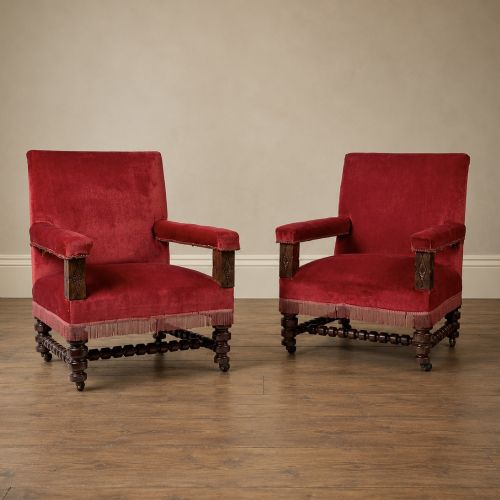


Crimson Velvet Armchair
A crimson velvet armchair brings rich texture and traditional seating into a room, offering deep comfort combined with historic character.
Crimson Velvet Armchair
A crimson velvet armchair is a substantial seat upholstered in red pile fabric, appearing across periods from the nineteenth century into the twentieth century. These chairs combine rich textile surfaces with structural timber frames designed for domestic comfort and reception spaces.
The versions most commonly met on this page span Victorian, Edwardian, and Regency eras, taking forms such as open armchairs, button-backed parlour seating, and low slipper chairs. They include singular reading seats, paired library chairs, and larger matched suites.
Makers and workshops of the nineteenth and early twentieth centuries produced these pieces using hardwood, walnut, mahogany, and oak frames. The enduring appeal lies in the contrast between warm timber supports and deep red textile upholstery.
Materials and construction
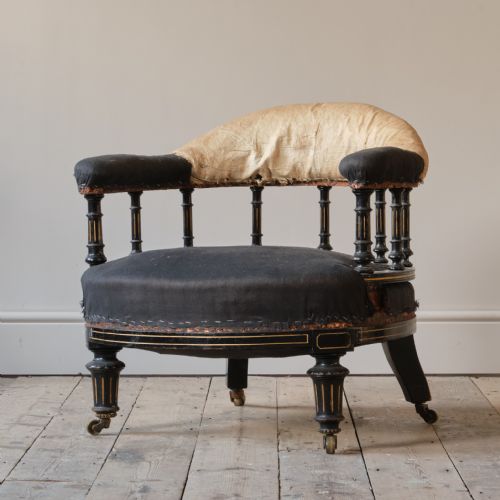
Timbers such as mahogany, walnut, oak, and ebonised wood form the structural skeletons of these seats, providing durable support beneath the upholstery. Brass castors and iron framing occasionally appear to assist mobility and reinforce the heavier Victorian designs.
Velvet provides the defining tactile surface for the upholstery, stretched over sprung or stuffed interiors depending on the period of manufacture. Frames display carved wooden details, exposed open arms, and traditional joinery appropriate to each specific stylistic revival.
Listings feature frames constructed from mahogany, walnut, oak, and ebonised timber.
Assessing quality and craftsmanship
Quality rests in the integrity of the timber frame and the precision of the joinery hidden beneath the textile covers. Substantial proportions and well-executed carved details on walnut or mahogany differentiate finer workshops from standard production.
The execution of the upholstery work, from button-backed tension to the neatness of the bordering, distinguishes exceptional seating from simpler domestic items. Heavier frames with integrated brass hardware and robust internal construction represent the upper tier of surviving examples.
Gillows·Howard and Sons
The Crimson Velvet Armchair Glossary
- Slipper chair
- A low-seated upholstered chair traditionally used in bedrooms for dressing. These pieces sit close to the floor and usually lack arms.
- Button back
- An upholstery technique where depressions are formed in the padding by stitching through to secure buttons in a geometric pattern. This method creates structured tufting across the backrest.
- Open armchair
- A seat featuring exposed wooden arms without upholstered padding along the grip. This style highlights the carved timber framework of the maker.
- Wing back
- An armchair with side panels attached to the backrest designed to shield the sitter from drafts. These high-backed seats often incorporate deep upholstery.
- Ebonised wood
- Timber treated with a finish to resemble ebony, producing a dark, polished black surface. This technique was frequently utilised during the nineteenth century.
Crimson Velvet Armchair: Frequently Asked Questions
What periods do these armchairs date from?
The listings span from the Regency and William IV periods through Victorian production into Edwardian and later twentieth-century examples.
Specific stylistic influences include the Aesthetic Movement, French Consulate styles, and Queen Anne revivals alongside standard Victorian and Edwardian manufacturing.
How do I identify a Victorian armchair?
Victorian examples often feature substantial walnut, mahogany, or oak frames, sometimes incorporating iron framing or button-backed upholstery.
They appear in various forms including parlour chairs, large open armchairs, and paired seating with deep red textile coverings.
What woods were used for the frames?
Makers utilised a variety of timbers including mahogany, walnut, oak, and ebonised wood to construct the structural supports.
These hardwoods were chosen for their strength and ability to take detailed carving or smooth polishing.
Are these chairs sold in pairs?
Several listings feature matched pairs of armchairs, particularly from the Victorian period, alongside larger suites and individual seating options.
Single chairs also appear, including low slipper chairs and wing-backed fireside designs suited for specific interior spaces.