



Cream Upholstered Suite
A cream upholstered suite brings enduring elegance to a room, offering matched seating crafted across periods from the Victorian era to Art Deco.
Cream Upholstered Suite
A cream upholstered suite encompasses matched sets of seating including salon suites, parlour suites, and lounge suites designed to coordinate seating arrangements within a reception or drawing room. When searching for a cream upholstered suite, buyers encounter various configurations ranging from large multi-piece drawing room sets with sofas and armchairs to compact three-piece arrangements.
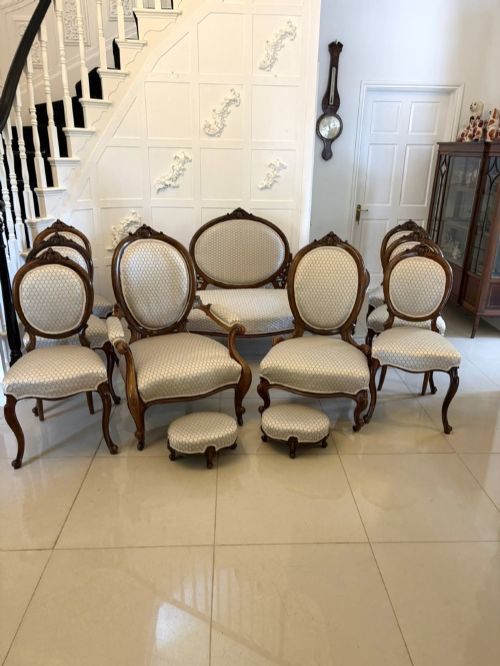
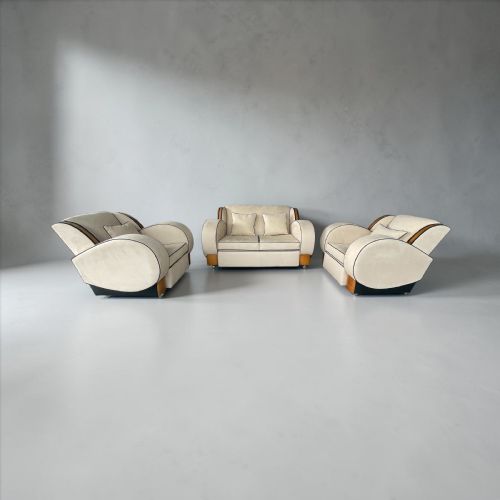
The evidence shows these groupings originate across the nineteenth and twentieth centuries, taking distinct forms such as Victorian carved walnut settings, Edwardian carved mahogany groupings, and nineteen-thirties Art Deco tank suites. Surviving examples demonstrate how period makers produced cohesive suites combining sofas, armchairs, and side chairs upholstered in damask and fabric.
Buyers frequently find matching chairs and sofas spanning French Empire, Louis XVI style gilt-wood, and satinwood constructions. Each grouping reflects the prevailing domestic seating requirements of its specific period, uniting functional comfort with decorative woodwork.
Materials and construction
Makers utilised solid timbers such as mahogany, walnut, oak, and satinwood for the structural frames of these seating sets, frequently applying walnut veneer and gilt-wood finishes. Carved details such as lion paw feet and ornate woodwork demonstrate traditional carpentry techniques employed during the Victorian and Edwardian periods.
Upholstery fabrics including damask and standard textile coverings were applied over interior padding, complemented in certain designs by brass hardware components. These materials were shaped to match specific stylistic movements, from the sweeping curves of Louis XVI revival pieces to the geometric lines of Art Deco design.
Cream Upholstered Suite Retail Price Guide 2026
Typical asking prices for cream upholstered suite among the pieces listed under this phrase on Sellingantiques today, from the lower quarter to the upper quarter. They describe what is for sale here now, not the wider market.
Some Victorian suites come equipped with matching footstools, ensuring that nineteenth-century relaxation remained entirely supported from head to toe.
Assessing quality in period seating
Quality in these suites rests on the integrity of the timber frame and the precision of the carved embellishments. Suites featuring substantial carved walnut or gilt-wood elements demonstrate superior craftsmanship compared to simpler frameworks.
The degree of preservation in the original woodwork and the sophistication of the stylistic execution, whether French Empire or Victorian, determine the distinction between standard room settings and exceptional surviving examples.
The Cream Upholstered Suite Glossary
- Salon suite
- A matching set of seating furniture intended for a formal drawing room or reception space. It typically includes a sofa and multiple armchairs or side chairs.
- Damask
- A reversible figured fabric traditionally used for upholstery and heavy drapery. This material appears frequently on period furniture pieces.
- Gilt-wood
- Wood that has been treated with gold leaf or a gold-coloured finish. This technique highlights carved details on decorative frames.
- Walnut veneer
- A thin layer of walnut timber applied over a secondary wood base to provide a decorative surface. It allows makers to display rich grain patterns on large panels.
Cream Upholstered Suite: Frequently Asked Questions
What pieces come in a salon suite?
A salon suite typically includes a central sofa paired with matching armchairs and side chairs, designed to furnish a formal reception room.
Larger configurations may also incorporate footstools or additional seating to accommodate multiple guests in a unified decorative scheme.
How do I identify a Victorian suite?
Victorian suites often feature heavy timber frames made from walnut or mahogany, detailed with elaborate hand carvings and deep upholstery.
Look for period characteristics such as balloon backs, carved cabriole legs, or decorative elements like lion paw feet.
Where were these suites used?
These matched seating arrangements were designed for the principal entertaining spaces of nineteenth and early twentieth-century homes.
They furnished drawing rooms, parlours, and salons where hosts received visitors and family members gathered for conversation.
How do Art Deco suites differ?
Art Deco suites from the nineteen-thirties abandon ornate Victorian carvings in favour of streamlined silhouettes and geometric forms.
They utilise materials like black walnut and feature upholstery styles suited to modern twentieth-century interiors.