
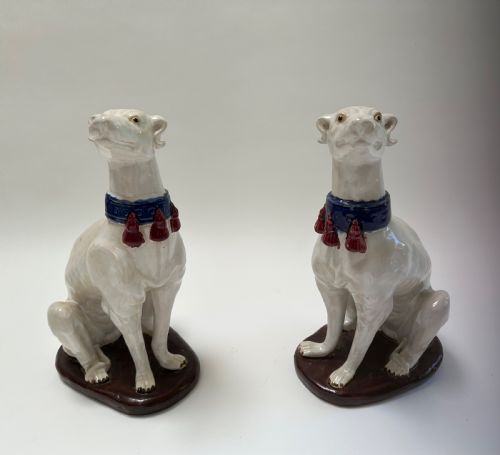


Cream Ceramic Dog Figurine
These cream ceramic dog figurine pieces bring sculptural canine charm to a room, spanning Victorian Staffordshire pairs and early twentieth century continental groups.
Cream Ceramic Dog Figurine
A cream ceramic dog figurine brings sculptural canine charm to a room, spanning Victorian Staffordshire pairs and early twentieth century continental groups. These figures range from mantelpiece spans and greyhounds to seated setters and hunting groups with game.
The version most commonly met on this page is the traditional pair of Staffordshire figures, often modelled as poodles, spaniels, or hounds from the nineteenth century. Alongside these, buyers find larger Bohemian works and figural groups produced in porcelain and earthenware.
Materials and construction methods
Makers utilised ceramic materials including earthenware, porcelain, and biscuit porcelain, alongside tin-glazed earthenware and parian ware. These bodies were shaped into decorative sculptures and figures, then finished with glaze and enamel details.
Moulding and casting techniques allowed workshops to produce both individual animal figures and complex figure groups involving human subjects and game. Surfaces were treated with smooth glazes or left unglazed in the manner of parian ware to highlight sculptural form.
Listings feature pieces spanning the nineteenth century, the Victorian and Edwardian eras, up to the 1940s, utilising earthenware, porcelain, and parian ware.
Distinctions in quality
Quality in these figures rests upon the crispness of the moulding and the sensitivity of the modelling, particularly in the rendering of the animal's expression and coat. Superior pieces display careful attention to anatomical detail rather than flat or generalised shaping.
The application of glaze and enamel decoration further separates standard production from finer work, with subtle tonal variations and precise hand-painting enhancing the visual depth of the ceramic surface.
Royal Dux·Royal Dolton
The Cream Ceramic Dog Figurine Glossary
- Staffordshire
- A term denoting pottery produced in the Staffordshire region of England, famous for utilitarian and decorative figures including mantle dogs. These pieces typically date from the nineteenth century and often appear in pairs.
- Parian Ware
- A fine-grained biscuit porcelain resembling marble, developed in the nineteenth century for sculptural figures. It was frequently utilised for classical subjects and detailed animal sculptures.
- Majolica
- A type of tin-glazed earthenware featuring colourful, opaque glazes over a modelled body. It gained popularity during the nineteenth century revival periods.
- Biscuit Porcelain
- Unglazed porcelain fired once to a hard, matte state that resembles white marble. This finish accentuates fine sculptural details without the distraction of a glossy surface.
Cream Ceramic Dog Figurine: Frequently Asked Questions
What are cream ceramic dog figurines?
These pieces are sculptural representations of dogs modelled in ceramic materials like earthenware, porcelain, and parian ware. They include decorative figures, pairs for mantelpieces, and larger sculptural groups.
The styles range from Victorian Staffordshire work to Italian Renaissance Revival and Art Nouveau pieces, capturing various canine breeds such as poodles, spaniels, greyhounds, and setters.
How were these dog figures used?
Historically, ceramic dog figures served as decorative ornaments within domestic interiors, frequently arranged as matching pairs upon mantelpieces or side tables. Staffordshire spaniels and poodles were staple ornaments in Victorian parlours.
Larger continental groups and figural sculptures functioned primarily as display pieces, showcasing the technical skill of the pottery and adding domestic warmth to a room.
How do I date a ceramic dog?
Dating relies on stylistic markers, manufacturing materials, and recorded periods such as Victorian, Edwardian, or specific decades from the nineteenth and twentieth centuries. Staffordshire pairs often point to mid-nineteenth century production.
Changes in ceramic bodies, from heavy earthenware to refined parian ware and porcelain, alongside specific aesthetic movements like Art Nouveau, help establish the era of manufacture.
How do I care for ceramic dog figures?
Care involves gentle dusting with a soft, dry cloth to prevent the accumulation of dirt on glazed or unglazed surfaces. Avoid harsh cleaning agents that might damage enamel details or delicate biscuit porcelain.
Display the pieces away from areas prone to heavy vibrations or extreme temperature fluctuations to protect the ceramic body and any historic glaze.