



Cranberry Crystal Glasses
These cranberry crystal glasses bring rich hues and cut brilliance to the table, spanning Victorian and Edwardian dining rooms.
Cranberry Crystal Glasses
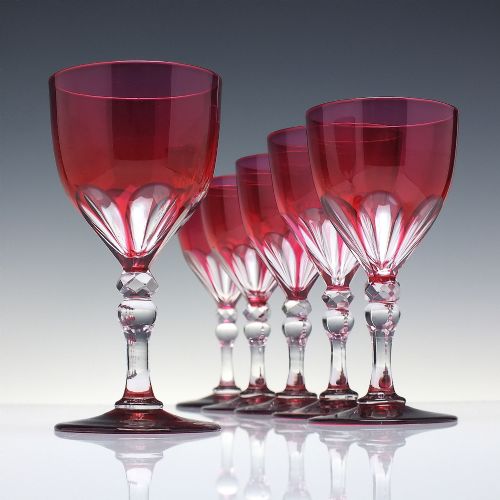
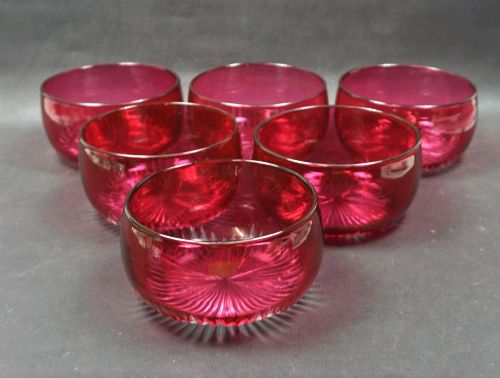
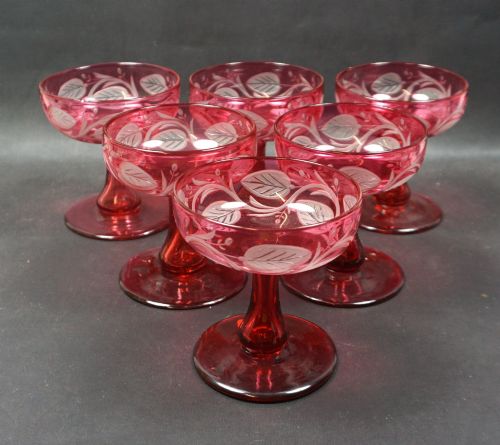
When you search for cranberry crystal glasses, you encounter a vibrant range of Victorian and Edwardian tablewares, scent bottles, and decorative vessels. The selection encompasses champagne coupes, wine jugs, decanters, and mantel lustres fashioned from richly coloured glass.
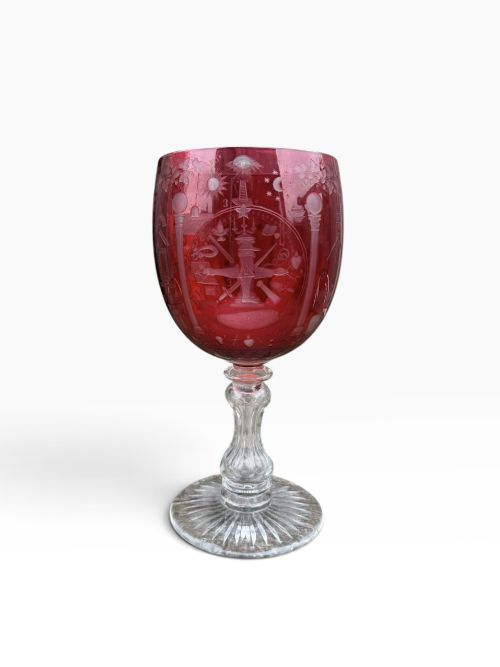
Most examples date from the nineteenth century, including pieces attributed to English and Bohemian makers around eighteen eighty. You will find items featuring layered colour over clear crystal, often enriched with wheel-engraved motifs like fruiting vines or convolvulus.
Forms vary from practical drinking vessels like hock decanters and tumblers to ornamental mantle lustres hung with glass prisms. Certain items incorporate sterling silver mounts, pairing deep red hues with polished metalwork.
How they were made
The distinctive pink and red tones of cranberry glass are achieved by adding gold chloride to the molten glass batch. Artisans often employed an overlay technique, casing a layer of coloured glass over clear crystal before cutting away sections to reveal the transparent base beneath.
Surface decoration frequently involved wheel-engraving, where craftsmen carved botanical patterns such as vines and flowers directly into the glass. Pieces with silver mounts utilise sterling elements hallmarked in centres like Birmingham during the late Victorian and Edwardian eras.
Cranberry Crystal Glasses Retail Price Guide 2026
Typical asking prices for cranberry crystal glasses among the pieces listed under this phrase on Sellingantiques today, from the lower quarter to the upper quarter. They describe what is for sale here now, not the wider market.
Listings feature Victorian and Edwardian periods, utilising cranberry glass, ruby glass, cut crystal, and sterling silver across various decorative and functional forms.
What varies in quality
Depth of colour and precision of the overlay technique dictate the visual weight of each piece. Crisp, deep cutting through the coloured layer to the clear crystal reveals superior handcrafting and definition in motifs like fruiting vines.
The integration of secondary materials, such as heavy sterling silver mounts or finely cast lustres with matched prisms, elevates the distinction of individual items. Balance in proportion and clarity in the underlying lead crystal complete the measure of quality.
Harold Bushell & Co
The Cranberry Crystal Glasses Glossary
- Cranberry glass
- A transparent glass coloured with gold, yielding shades from pale pink to deep crimson. It forms the primary medium for Victorian tablewares and decorative objects.
- Overlay
- A technique where a layer of coloured glass is fused over clear crystal. Subsequent cutting removes parts of the top layer to create contrasting patterns.
- Mantel lustre
- An ornamental vase hung with cut glass prisms, designed to refract candlelight. These pieces were popular on Victorian mantelpieces.
- Hock decanter
- A tall bottle specifically shaped for serving hock or white wine. They frequently appear in colour over crystal forms from the nineteenth century.
- Champagne coupe
- A shallow, broad-bowled stemmed glass used for sparkling wine. Victorian versions often feature engraved botanical decoration around the bowl.
Cranberry Crystal Glasses: Frequently Asked Questions
How do I date cranberry glass?
Dating relies on stylistic markers, manufacturing techniques, and occasional hallmarked silver mounts. Victorian pieces often display rich colour saturation and heavy cutting typical of the nineteenth century.
Later Edwardian items show shifts in form and mounting styles. Comparing the depth of the overlay and the sharpness of wheel-engraved motifs helps place an object within its proper decade.
What were mantel lustres used for?
Mantel lustres served as decorative garnitures on nineteenth-century fireplaces. The hanging glass prisms were intended to catch and reflect the light of candles placed nearby.
While largely ornamental, they demonstrated the owner's taste and the maker's skill in glass cutting and prism assembly.
Are silver mounts common on these pieces?
Sterling silver mounts appear on select scent bottles and perfume containers from the late Victorian period. These mounts often bear hallmarks indicating the assay office and year of manufacture.
Such additions transformed simple glass vessels into luxury dressing table accessories.
How do I care for antique glass?
Antique glassware requires gentle hand washing in lukewarm water using mild detergent. Avoid sudden temperature changes to protect the material from thermal shock.
Items with silver mounts or delicate engraving should be dried promptly with a soft linen cloth to preserve the finish.