
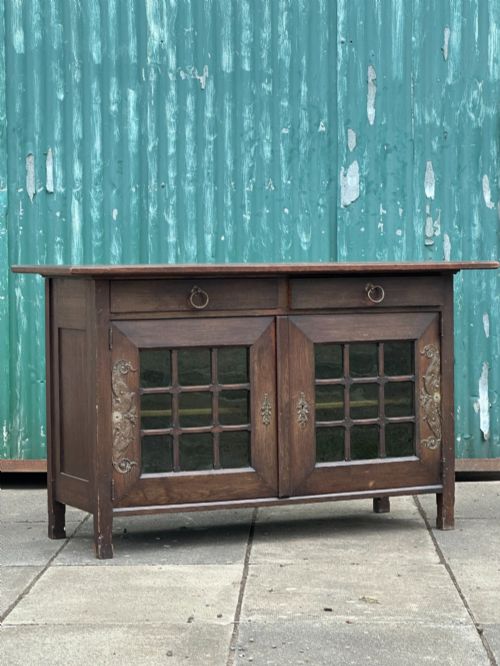


Craftsman Style Sideboard
These craftsman style sideboard examples bring honest oak construction and deliberate utility into the modern dining room.
Craftsman Style Sideboard
A craftsman style sideboard provides sturdy storage for dining rooms through heavy timber construction and linear forms. These pieces belong to the Arts and Crafts movement, emerging across the late nineteenth and early twentieth centuries from periods including the Edwardian era.
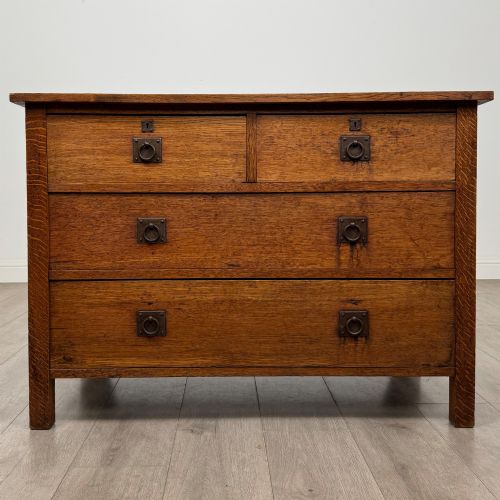
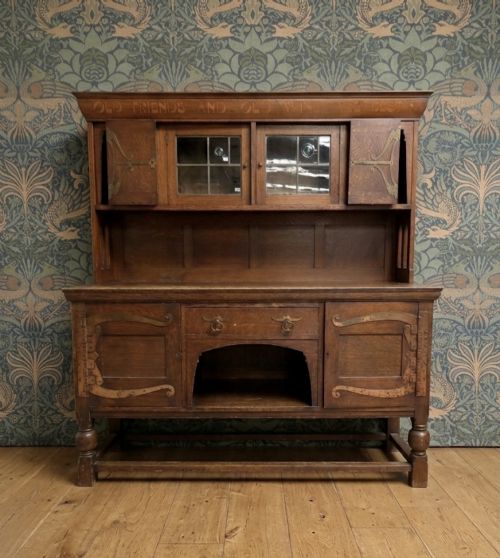
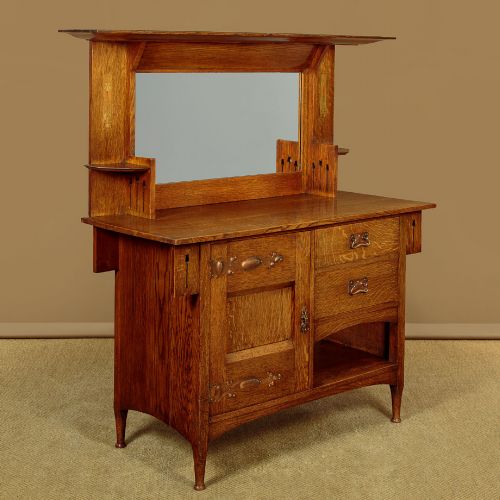
Makers shaped these sideboards and dressers using solid oak as a primary timber, alongside variations like mahogany. Forms range from low side cabinets and chests of drawers to tall dressers fitted with glass and mirror elements.
Examples on this page span the 1880s through the 1920s, showing regional British output including pieces linked to the Cotswold School and major London firms.
How they were made
Carpenters constructed these sideboards predominantly in solid oak, occasionally selecting mahogany for alternative colour tones. Timber selection focused on visible grain patterns rather than hidden structural uniformity.
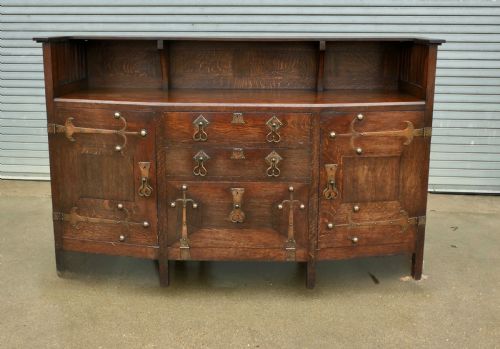
Decoration relied on structural joinery and subtle surface embellishment rather than heavy carving. Makers incorporated wood inlay, marquetry, and exposed iron, copper, or brass hardware as functional highlights.
Makers hid hammered copper strap hinges and iron drop handles in plain sight, turning simple drawer pulls into miniature metallic sculptures.
What varies in quality
Quality rests in the architectural proportion and the restraint of the decorative elements. The finest examples show purposeful hand-planed timber surfaces and carefully balanced proportions between cupboard doors, drawers, and open plate racks.
Maker attribution separates standard workshop output from documented pieces produced by leading firms and designers. Pieces carrying verified provenance or distinctive regional characteristics hold greater interest for collectors.
Ambrose Heal for Heal & Son·Leonard Wyburd·Liberty & Co.·Shapland and Petter
The Craftsman Style Sideboard Glossary
- Arts & Crafts
- A design movement prioritising traditional craftsmanship, simple forms, and visible construction methods over mass-produced ornamentation. It developed as a reaction against industrial manufacturing standards of the nineteenth century.
- Marquetry Inlay
- The art of applying small pieces of veneer to a structure to form decorative patterns. Craftsmen utilised different timber shades to create pictorial or geometric designs on drawer fronts and cabinet doors.
- Side Cabinet
- A low storage unit designed for dining spaces, often preceding or accompanying larger sideboard forms. These items provided enclosed shelving for tableware and linens.
Craftsman Style Sideboard: Frequently Asked Questions
How do I date a craftsman style sideboard?
Dating relies on identifying construction markers, timber choices, and stylistic cues recorded across the 1880 to 1920 periods. Edwardian and earlier pieces often display hand-cut joinery and specific hardware styles.
Examining secondary timbers inside drawers and the presence of maker stamps or attributed design traits helps narrow the production decade.
Are these sideboards practical for daily dining room storage?
These sideboards offer deep drawers, shelved cupboards, and surface tops well suited for holding modern tableware and linens. Their robust oak construction handles heavy daily use without issue.
Consider overall room dimensions before selection, as variations range from compact side cabinets to tall dressers with upper shelving.
How do I care for the oak surfaces?
Maintain the timber by dusting regularly with a dry cloth and applying natural beeswax periodically to nourish the grain. Avoid placing furniture in direct sunlight or near heat sources to prevent timber splitting.
Protect surfaces from moisture by using coasters and trivets beneath hot dishes and wet glassware.
What defines the Cotswold School style?
Cotswold School pieces emphasise plain, unadorned surfaces that highlight the natural figure of solid oak. The aesthetic rejects industrial excess in favor of visible hand-finished details.
Such items represent a specific twentieth-century strand of the broader Arts and Crafts tradition.