


Craftsman Style Oak Chairs
Craftsman style oak chairs bring honest construction and sturdy timber into everyday rooms, offering a tactile connection to the early twentieth century.
Craftsman Style Oak Chairs
Craftsman style oak chairs encompass sturdy seating designed during the early twentieth century, drawing heavily on the principles of the Arts and Crafts movement. Buyers searching this phrase encounter practical forms meant for daily use, ranging from single side chairs to sets intended for dining spaces.
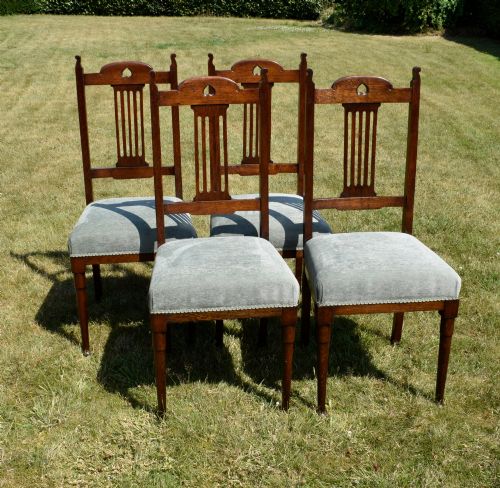
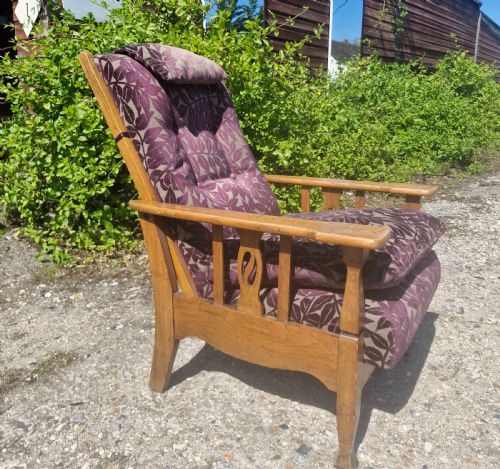
The most common versions met on this page include armchairs and side chairs framed in solid oak, often featuring low ladder backs or reclining mechanisms. Stools and low seating also appear, reflecting the functional domestic output of the period.
Originating largely from the Edwardian era up to the 1910s and 1920s, these pieces rely on visible construction methods rather than applied surface ornament. The emphasis rests squarely on the natural grain of the timber and the straightforward utility of the form.
Materials and construction
Oak forms the structural foundation of these chairs, frequently specified as English oak, providing the dense grain and rigid framework required for heavy domestic use. Workshops utilised this timber for its strength and ability to take a clean, honest joint without elaborate veneer.
Seating areas incorporate woven rush or supportive upholstery finished in materials such as leather, fabric, linen, and standard upholstery. Metal components like brass fastenings and structural metal elements appear alongside timber frames to secure reclining mechanisms and joints.
The documented periods span from 1900 through the Edwardian era up to 1940, capturing decades of Arts and Crafts output.
Assessing quality and origin
Quality in these chairs is distinguished by the integrity of the timber selection and the precision of the joinery rather than surface embellishment. Pieces attributed to notable workshops or retailers demonstrate a higher level of hand-finishing in the exposed wooden frame and tighter tolerances in the joints.
The choice of seating material also marks a distinction in grade, with hand-woven rush seats and high-grade leather upholstery representing a more involved artisan process than standard fabric coverings. Shapland & Petter, Liberty & Co, and Goodyers of London represent the maker attribution level that elevates a piece above anonymous production.
Goodyers of London·Liberty and Co·Robert Mouseman Thompson·Shapland and Petter
The Craftsman Style Oak Chairs Glossary
- Arts and Crafts
- A design movement spanning the late nineteenth and early twentieth centuries that prioritised traditional craftsmanship and natural materials. It rejected mass production in favour of visible construction and simple utility.
- Ladder back
- A chair back featuring multiple horizontal wooden slats resembling the rungs of a ladder. This form provides back support through simple structural arrangement.
- Reclining armchair
- An adjustable chair designed for relaxation where the back angle can be altered. These items utilise mechanical adjustments housed within a sturdy wooden frame.
- Rush seat
- A seating surface woven from dried marsh rushes around a wooden frame. This traditional technique creates a durable, textured matting.
- Edwardian
- The period spanning the reign of King Edward VII from 1901 to 1910. Furniture from this era often lighter in scale while retaining stylistic links to earlier Victorian movements.
Craftsman Style Oak Chairs: Frequently Asked Questions
What defines craftsman style oak chairs?
These chairs are defined by their solid oak construction, straightforward joinery, and functional design rooted in the early twentieth century. They reject ornate carving in favour of exposed structural elements and natural timber grain.
Most examples date from the Edwardian era through the 1910s, aligning closely with the principles of the Arts and Crafts movement. Their forms prioritise utility, ranging from simple dining seats to adjustable reclining armchairs.
How do I identify a maker?
Maker identification relies on stamped marks, paper labels, or distinct structural characteristics associated with specific workshops or retailers of the period. Pieces originating from prominent retailers or named makers often feature signature joinery details.
Documentation or branded stamps on the wooden frame help confirm attribution to workshops such as Liberty or specific cabinet makers. Without these marks, pieces are typically categorised by general style and period.
Were these chairs used for dining?
Many of these chairs were specifically produced as sets for dining rooms, alongside single armchairs intended for living spaces. Dining variants usually feature side chair proportions without arms to fit neatly beneath tables.
Sets of four demonstrate the domestic production scale of the era, designed to furnish middle-class homes with durable, matching seating. Their sturdy oak frames ensured they withstood daily family meals.
How do I care for oak frames?
Caring for oak frames involves maintaining consistent indoor humidity levels to prevent the timber from drying out or splitting. Regular dusting with a soft, dry cloth preserves the natural finish of the wood without chemical buildup.
Leather and fabric upholstery require cleaning methods appropriate to the specific material specified in the construction. Avoiding direct sunlight protects both the timber colour and the integrity of the original upholstery.