


Country Path Painting
These country path painting examples capture quiet rural lanes and wooded tracks, offering a tranquil window into earlier pastoral life.
Country Path Painting
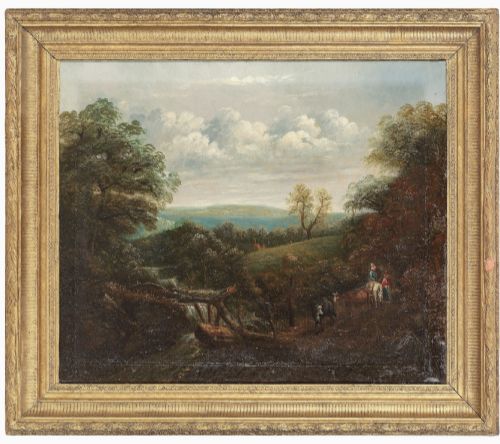
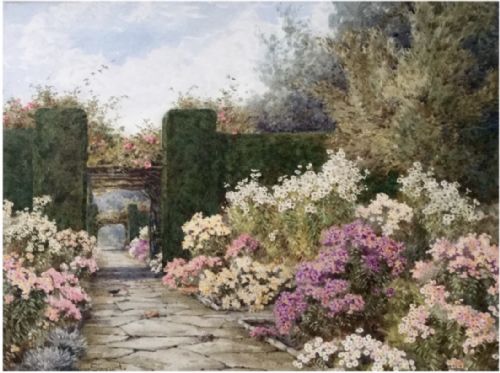
A country path painting depicts rural routes, woodland tracks, and village lanes through the mediums of oil and watercolour. The examples on this page span the Victorian and Edwardian eras, alongside the Norwich School, Barbizon School, and Post-Impressionism.
Most pieces date from the nineteenth and early twentieth centuries, recorded across periods such as nineteen ten, nineteen twenty, and nineteen thirty. These works range in form from oil on canvas to framed watercolours on paper.
Buyers encounter subjects like figures walking along country tracks, leafy lanes, and wooded scenes. The styles represented include Impressionism and traditional British landscape traditions.
Materials and Techniques
Artists painted primarily with oil paint on canvas or watercolour on paper, capturing light and foliage along rural routes. Frames often incorporate wood, gesso, gilt wood, and gold leaf to complement the painted surface.
Techniques vary from the textured brushwork seen in Impressionist and Post-Impressionist canvases to the delicate washes of nineteenth-century watercolours. Makers mounted these works within traditional timber and gilded frames.
Listings feature canvases and watercolours spanning the Victorian and Edwardian eras, alongside Norwich School and Post-Impressionist works.
Evaluating Quality
Quality rests in the handling of light, depth of perspective, and the deftness of brushwork along the depicted lane or track. Stronger works convey atmosphere through confident application of oil or watercolour.
The sophistication of the composition and the condition of the original canvas or paper influence the standing of a piece. Period frames finished in gold leaf or gesso also contribute to the completeness of the object.
Henri Joseph Harpignies·Abraham Hulk Jnr·John Abernethy Lynas-Gray·Joseph Thors·Walter Emsley·William Greaves·Lilian Stannard·Kershaw Schofield
The Country Path Painting Glossary
- Oil on Canvas
- Pigment mixed with drying oil applied to a woven fabric support stretched over a wooden frame. This medium allows for rich textures and deep colour blending.
- Watercolour
- Pigments suspended in a water-soluble vehicle, applied to paper to create transparent washes of colour. It offers a luminous quality particularly suited to atmospheric skies and foliage.
- Gesso
- A plaster-like mixture applied to wood frames before gilding or painting, providing a smooth base. It is often moulded to create decorative relief patterns.
- Norwich School
- A regional group of artists inspired by the Norfolk landscape, active from the early to mid-nineteenth century. They focused on local rural scenery and naturalistic lighting.
- Barbizon School
- A French movement centred on landscape painting, emphasising direct observation of nature. Painters worked outdoors to capture realistic rural views.
Country Path Painting: Frequently Asked Questions
How should I hang a country path painting?
Position the painting at eye level on a wall with balanced ambient lighting to highlight the texture of the oil or watercolour.
Avoid direct sunlight to protect the pigments and any original gilt wood frames from fading over time.
What periods do these paintings come from?
The works primarily date from the nineteenth and early twentieth centuries, encompassing Victorian, Edwardian, and later modernist movements.
Specific dates recorded include the late eighteenth century, nineteen ten, nineteen twenty, and nineteen thirty.
How do I care for an oil on canvas?
Keep the canvas away from extreme temperature fluctuations and excessive moisture to prevent warping of the wood stretcher.
Dust the surface gently with a soft, dry brush without applying pressure to the painted layers.