


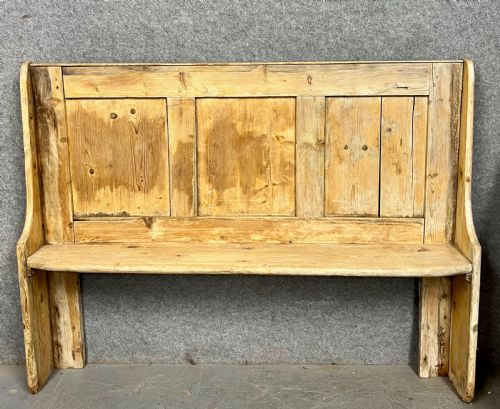


Country House Hall Bench
A country house hall bench brings architectural presence and utilitarian warmth to an entrance, grounding the space with historic timber and enduring purpose.
Country House Hall Bench
When searching for a country house hall bench, you encounter robust seating designed for draughty corridors, grand vestibules, and domestic service areas. The selection on this page spans simple pine boards, substantial oak frameworks, and painted finishes originating from various regional traditions.
Forms range from high-backed settle benches that block cold drafts to long dining benches and window seats. You are most likely to meet 19th-century examples in pine and oak, alongside earlier 18th-century settles and Regency mahogany variations.
These items served practical domestic roles, from storing provisions in high-backed settles to providing sturdy perches in grand halls and country house utility spaces.
How they were made
Construction relies heavily on native timbers such as oak, pine, elm, and mahogany, chosen for structural stability and local availability. Joinery techniques prioritize utilitarian durability, utilising peg joints, heavy planking, and robust framing to withstand daily domestic use.
Surface treatments vary from natural waxed finishes highlighting the grain of limed oak to layered painted surfaces and brass or iron hardware additions. Structural elements often incorporate panelled backs, storage compartments beneath hinged seats, and turned or chamfered supports.
Country House Hall Bench Retail Price Guide 2026
Typical asking prices for country house hall bench among the pieces listed under this phrase on Sellingantiques today, from the lower quarter to the upper quarter. They describe what is for sale here now, not the wider market.
Several benches retain the distinct aroma of old beeswax and hearth smoke, carrying the quiet atmosphere of rural sitting rooms straight into the hallway.
What varies in quality
Quality rests upon the integrity of the timber, the proportion of the piece, and the honesty of the construction. Superior examples display mature timber selection with well-balanced proportions that suit domestic interiors.
The degree of original surface preservation also dictates standing, where undisturbed paint or aged patination on oak and pine commands greater appreciation than over-restored or stripped surfaces.
The Country House Hall Bench Glossary
- Settle
- A wooden bench with a high back, solid arms, and frequently a box compartment beneath the seat for storage. This form shielded occupants from drafts in large halls.
- Patina
- The surface sheen and colour developed by timber and paint over decades of handling, exposure, and polishing. It serves as an indicator of age and continuous use.
- Truss
- A structural framework of beams welded or pegged together to support weight. In benches and workbenches, this ensures rigid stability across long spans.
- Chamfer
- A symmetrical sloping cut made on the sharp edge of a wooden post or beam. This technique lightens the visual bulk of heavy structural timbers.
Country House Hall Bench: Frequently Asked Questions
Where should I place a hall bench?
These pieces suit entrance halls, boot rooms, and wide corridors where their linear footprint and storage capabilities function practically.
They also work well against plain walls in large living spaces to anchor freestanding furniture groupings.
How do I care for antique timber benches?
Maintain the wood by applying traditional beeswax periodically to nourish dry surfaces and preserve the natural patination.
Keep timber furniture away from direct heat sources and sudden temperature shifts to prevent warping or splitting.
What is a bacon settle?
A traditional regional settle featuring a high panelled back traditionally used for hanging cured meats to dry away from household pests.
These pieces represent specialised vernacular furniture from agricultural districts.
Are painted finishes original?
Painted surfaces on country furniture may be original, historic overpaint, or later decorative additions applied to suit domestic tastes.
Examining the wear patterns and pigment layering helps determine the age of the surface.