


Corridor Accent Chairs
Corridor accent chairs are rigid timber hall chairs designed for narrow spaces, offering clean classical lines and sculptural backs.
Corridor Accent Chairs
When you search for corridor accent chairs, you are looking at hall chairs originating mainly from the Georgian, Regency and Victorian periods. These pieces function as narrow occasional seating or decorative focal points in hallways and landings.
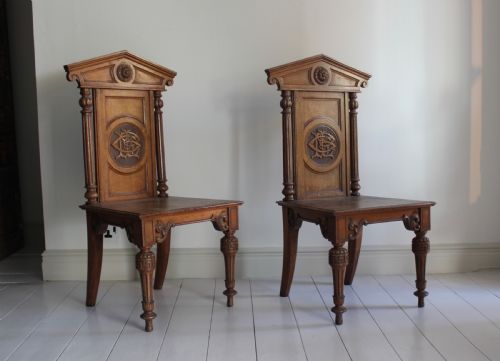
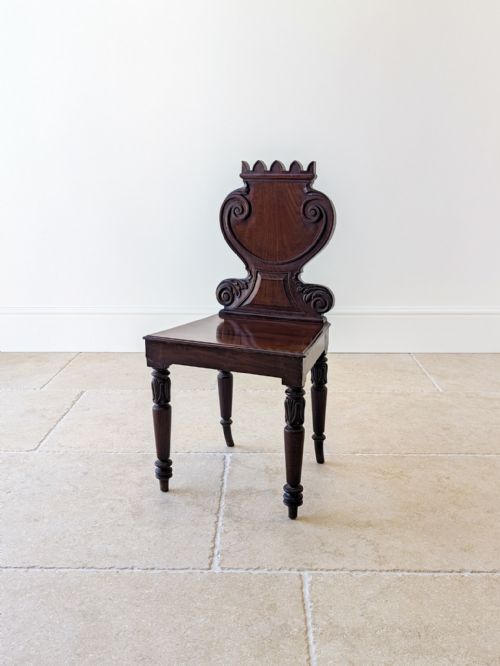
The versions you are most likely to meet on this page are mahogany or oak examples featuring solid wood seats and elaborate carved backs, often found in pairs. Their compact footprint and upright posture suit transitional spaces where bulkier seating fails.
How they were made
Cabinet makers utilised dense hardwoods like mahogany, walnut and oak to construct these robust items, ensuring the timber could withstand constant use in communal areas. Solid wood construction forms the basis of both the frames and the sculpted seats.
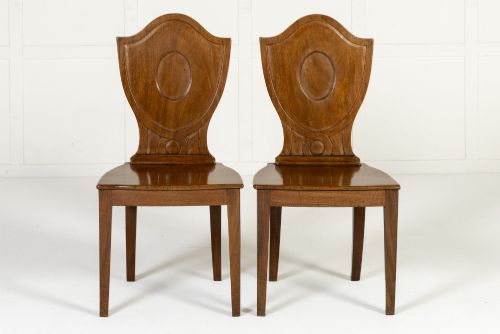
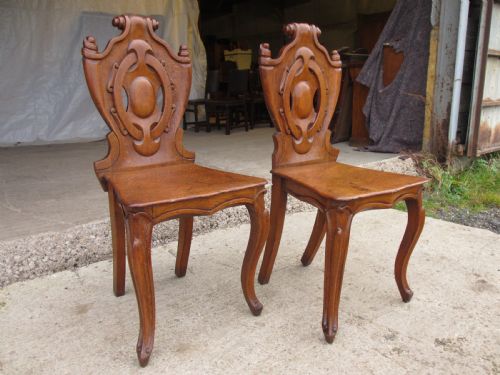
Carving techniques defined the decorative vocabulary, with shield backs, Prince of Wales feathers and Gothic revival motifs rendered directly into the solid timber. Legs range from simpler turned supports to cabriole configurations depending on the prevailing style of the decade.
Some Victorian oak chairs feature carved Prince of Wales feathers, bringing royal flair directly to the hallway.
What varies in quality
The depth and crispness of the timber carving separate standard examples from finer commissions, particularly in the execution of heraldic motifs and shield backs. Sharper chisel work and symmetrical grain selection indicate superior workshop output.
Material choice and structural integrity also dictate worth, with well-figured walnut and substantial mahogany commanding attention over plain timber. The weight and stability of the solid wood seat reflect the original maker's investment of time and material.
The Corridor Accent Chairs Glossary
- Hall chair
- A rigid wooden seat intended for occasional use in entrance halls rather than long periods of sitting. These pieces frequently display carved family crests or decorative shields on the backrest.
- Shield back
- A chair back shaped like a heraldic shield, popular during the Georgian and Victorian eras. This form often incorporates carved details such as feathers or foliage.
- Cabriole leg
- A furniture leg that curves outward and then tapers inward, inspired by the shape of an animal's leg. This feature appears on select Victorian iterations.
- Regency
- A British design period spanning the early nineteenth century characterised by classical revival motifs and clean architectural lines. Pieces from this era often draw inspiration from ancient Roman and Greek forms.
- William IV
- A transitional design style bridging the late Regency and early Victorian periods. Furniture from this time typically exhibits heavier proportions and bold carved ornamentation.
Corridor Accent Chairs: Frequently Asked Questions
Where do I put a corridor accent chair?
These chairs suit narrow hallways, landings and entrance spaces where floor space is limited. Their shallow depth allows them to sit flat against a wall without obstructing movement.
They function primarily as visual accents or occasional perches rather than comfortable lounge seating. Pairing them near a console table creates a balanced focal point in an otherwise plain corridor.
Are these chairs comfortable to sit on?
Most hall chairs feature solid wood seats without upholstery, designed for short periods of waiting. Their upright posture encourages proper posture rather than relaxed lounging.
If you require soft seating for daily use, these pieces are better utilised for their sculptural appearance. Adding a loose cushion can increase comfort while preserving the timber seat underneath.
How do I identify a Georgian hall chair?
Georgian examples generally date from the eighteenth or early nineteenth century, displaying restrained classical proportions. Look for finely figured mahogany and subtle carved details on the backrest.
Earlier pieces often feature simpler geometry compared to the exuberant ornamentation of later Victorian revivals. Construction methods like hand-cut joints help confirm an older origin.
Why are many of these chairs sold in pairs?
Original hall chairs were frequently commissioned in matching sets to flank a hallway or echo architectural symmetry. Many survive today as pairs because they remained together in domestic settings over the centuries.
Finding a matching pair offers greater decorating flexibility for framing a doorway or console table. Single examples still work well as standalone statement pieces in tighter corners.