

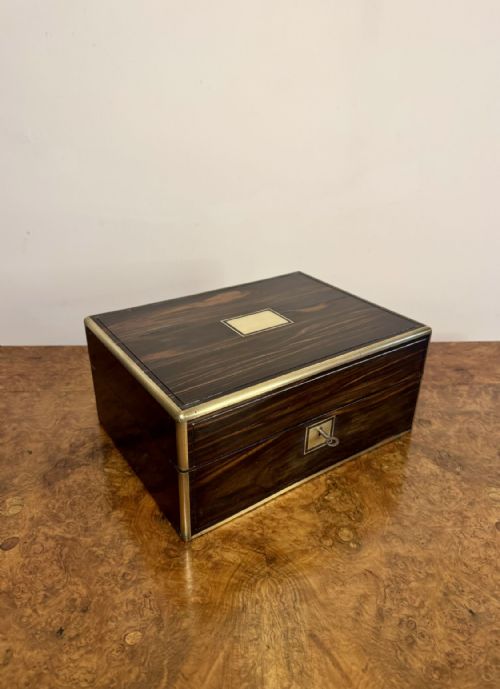
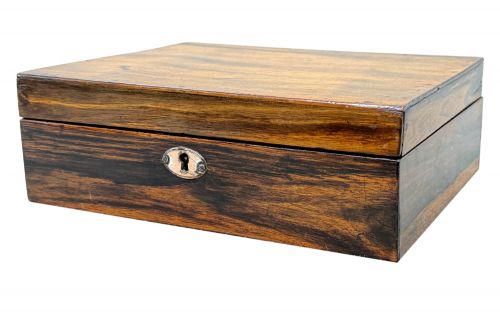


Coromandel Wood Vanity Box
These coromandel wood vanity boxes are substantial nineteenth-century travelling cases lined for jewellery, scent bottles and writing equipment.
Coromandel Wood Vanity Box
A coromandel wood vanity box is a heavy portable chest designed for personal grooming, jewellery storage and correspondence during the Victorian period. Buyers encounter rectangular forms dating from the early Victorian era through to the Aesthetic Movement, spanning roughly the mid to late nineteenth century.
The most common formats on this page are fitted dressing boxes and travelling vanity cases equipped with internal trays, compartments and glass scent bottles. Examples frequently double as sewing boxes or jewellery caskets, reflecting the multi-purpose nature of high-end nineteenth-century dressing cases.
How they were made
Craftsmen built these cases using dense, dark coromandel wood as a primary substrate, often reinforcing the carcass and edges with substantial brass mounts. Mother-of-pearl inlay appears across several examples, providing pale geometric contrast to the rich grain of the exotic timber.
Interiors rely on precision joinery to create removable trays and secret compartments, lined in velvet or silk to protect fragile glass and metal contents. Cut glass and crystal bottles with matching collars sit neatly inside dedicated internal partitions.
Coromandel Wood Vanity Box Retail Price Guide 2026
Typical asking prices for coromandel wood vanity box among the pieces listed under this phrase on Sellingantiques today, from the lower quarter to the upper quarter. They describe what is for sale here now, not the wider market.
The selection spans from early Victorian mother-of-pearl inlaid pieces to later Aesthetic Movement examples.
What varies in quality
Quality rests primarily on the complexity of the internal fitments and the sophistication of the brass and mother-of-pearl inlay work. Superior examples include fully integrated sets of cut-glass crystal bottles, working locks with original keys, and complex secret drawer mechanisms.
The choice of coromandel timber also dictates grade, with deeply figured grain patterns commanding greater visual presence than plain cuts. Maker attribution adds distinction, particularly when pieces bear signatures from established London retailers and luxury makers.
H Mitchell of 168 Oxford Street London·Asprey·Edwards
The Coromandel Wood Vanity Box Glossary
- Coromandel
- A dense, heavily figured tropical hardwood imported from Asia and used extensively for luxury Victorian boxes. Its dark brown colour and striking grain make it highly prized.
- Tantalus
- A locking wooden stand or box that secures decanters or scent bottles behind a metal bar to prevent unauthorized access. The bottles remain visible while locked away.
- Aesthetic Period
- A late nineteenth-century design movement focused on beauty and art for art's sake, moving away from heavy Victorian historicism. Pieces from this era often feature refined, minimalist decorative schemes.
- Dressing Box
- A portable container fitted with compartments for cosmetics, brushes, jewellery and writing implements. These were essential travel companions for wealthy Victorians.
- Mother-of-Pearl
- The iridescent inner layer of certain mollusc shells, used extensively for decorative inlay in nineteenth-century woodwork. It provides a luminous contrast against dark timbers.
Coromandel Wood Vanity Box: Frequently Asked Questions
What is inside a coromandel wood vanity box?
These boxes typically contain a fitted interior with velvet or silk linings, removable trays for jewellery, and compartments for writing equipment. Many also house cut glass or crystal scent bottles with matching metal collars.
More elaborate models feature secret drawers, mirror panels set into the lid, and specialised slots for small grooming tools.
How do I date a coromandel vanity box?
Dating relies on the overall style, construction methods, and any maker's marks or brass plates found inside the case. Early Victorian examples from around eighteen-fifty often feature mother-of-pearl inlay, while later Aesthetic Period pieces from the eighteen-eighties display simpler, more restrained lines.
Lock manufacturers' stamps and street addresses inscribed on the fitted furniture also help narrow down the decade of production.
Were these boxes meant for travel?
Yes, they were designed as portable dressing cases for wealthy Victorians undertaking extended journeys by train or carriage. The robust coromandel construction and heavy brass mounts protected personal valuables during transit.
Despite their travel function, their weight and luxurious silk linings suggest they belonged to affluent owners who moved within well-appointed social circles.
How do I care for coromandel wood?
Coromandel wood requires stable environmental conditions with moderate humidity to prevent the timber from splitting or warping. Keep the boxes away from direct sunlight and heat sources to preserve the rich dark colour and polished finish.
Gentle dusting with a dry, soft cloth is sufficient for routine maintenance, avoiding modern chemical polishes that can damage historic varnish or silk linings.