

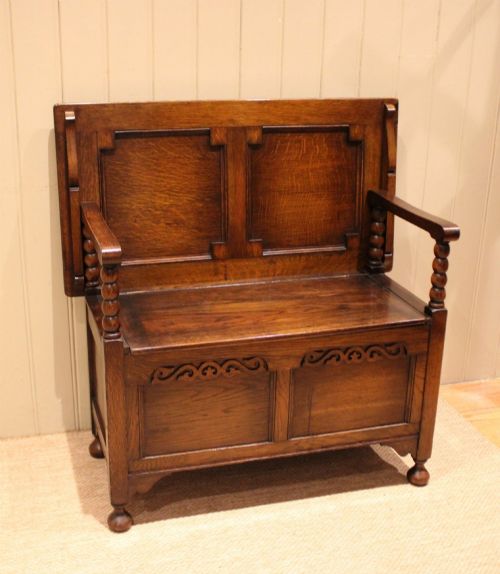




Convertible Settle Table
These convertible settle table pieces transform from bench to table in a single motion, offering compact utility for daily living.
Convertible Settle Table
A convertible settle table serves as both a bench seat and a table, operating through a hinged top that pivots forward over the arms. This dual-purpose furniture category includes monks benches, hall seats, and chair tables designed for smaller domestic spaces.
The selections span from late seventeenth century examples to later revivals from the Victorian era, nineteen-hundreds, and nineteen-twenties. Oak dominates the offerings, alongside occasional pine and mixed timber construction.
Regional vernacular pieces such as Catalan shepherd benches and painted country lambing chairs also appear within this group. Buyers frequently encounter carved oak variants from the early twentieth century featuring lift-up storage compartments beneath the seat.
How they were made
Joinery relies on solid timber construction using oak, pine, and mixed timber planks assembled with pegged mortise and tenon joints. Panels are often fielded or decoratively carved in Jacobean and Gothic revival styles.
Iron and metal hardware secures the pivoting mechanism that allows the backrest to transform into a table top. Storage boxes incorporate panelled floors and sides fixed beneath the seat base, sometimes including integrated drawers.
Convertible Settle Table Retail Price Guide 2026
Typical asking prices for convertible settle table among the pieces listed under this phrase on Sellingantiques today, from the lower quarter to the upper quarter. They describe what is for sale here now, not the wider market.
Listings span multiple centuries, ranging from seventeenth century oak examples to nineteenth century Victorian Gothic pieces and nineteen-twenties revival items.
What varies in quality
The depth and crispness of carved ornamentation distinguish standard production from finer work, particularly on the back panels and arm supports. Heavy relief carving from the Victorian revival period contrasts with simpler seventeenth century surfaces.
The structural integrity of the pivoting mechanism and the condition of the original timber pins affect usability and proportion. Well-proportioned examples maintain balance in both the bench and table configurations without excessive play in the joints.
The Convertible Settle Table Glossary
- Monks bench
- A form of dual-purpose seating featuring a hinged back that folds down onto the arms to create a table surface. This type often includes a storage chest beneath the seat.
- Settle
- A wooden bench with a high back, solid arms, and a closed base designed to block drafts in older interiors. Convertible variants incorporate the pivoting top mechanism.
- Jacobean Revival
- A nineteenth and twentieth century design style copying seventeenth century English oak furniture motifs. Characteristic details include geometric panel moulding and deep strapwork carving.
- Vernacular
- Furniture built by local tradesmen using regional traditions and available woods rather than following strict metropolitan design patterns. These pieces often utilise plain pine or local oak.
- Mortise and tenon
- A traditional joint where a projecting tongue fits tightly into a matching cavity to lock two pieces of timber together at a right angle.
Convertible Settle Table: Frequently Asked Questions
What is a convertible settle table?
A convertible settle table is a dual-purpose item of furniture that functions as a high-backed seat or a chair with storage below, and transforms into a table when the backrest is pivoted forward over the arms.
These pieces were historically used in domestic spaces where floor area was at a premium, allowing a single item to serve both dining and seating needs.
How do you operate the table top?
The upper section acts as both the backrest for the bench and the surface of the table. Pivoting pins or wooden dowels set into the arms allow the entire back to swing forward and rest horizontally.
Users simply lift and tilt the upper panel until it rests flat upon the armrests, creating a stable surface supported by the arms and back frame.
Where were these pieces used?
These items were placed in halls, parlours, and living spaces where multi-functional furniture saved valuable floor space. The enclosed base beneath the seat also served as storage for blankets or household goods.
In modern settings, they function effectively in hallways, kitchens, or compact dining areas as seating with hidden storage capability.
How do I care for oak furniture?
Solid oak surfaces require minimal maintenance beyond regular dusting with a dry or slightly damp cloth. Avoiding placement near direct heat sources prevents the timber from splitting or warping over time.
Application of traditional wax polish helps maintain the lustre of the timber finish without building up heavy chemical layers.