

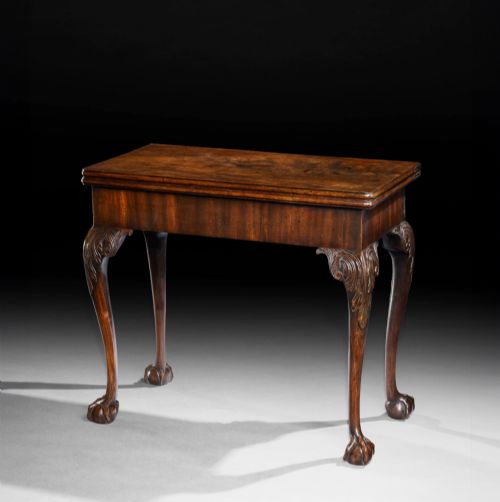
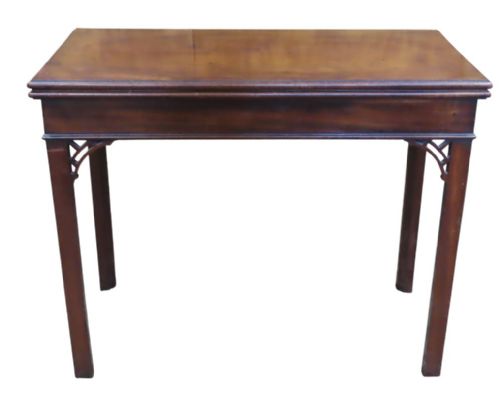
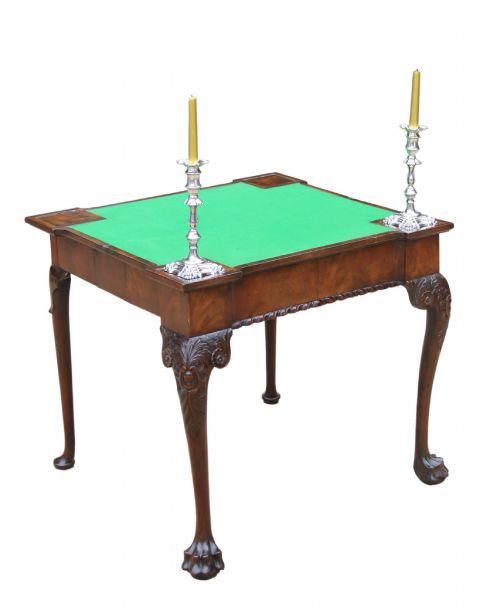


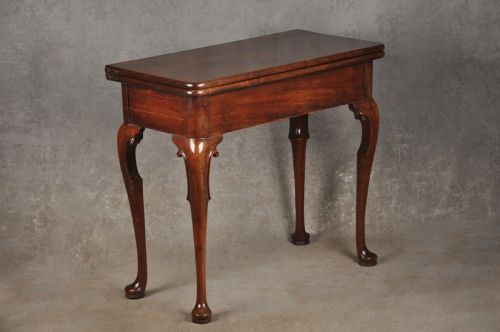
Concertina Card Table
These concertina card tables open fully on a clever expanding frame to give four firm corners for play without a central leg in the way.
Concertina Card Table
A concertina card table is a specialist piece of antique furniture designed for card playing and social entertaining. When closed, it serves as a side or tea table against the wall, but the top unfolds and the hinged frame expands outwards to support the extended surface.
You will most commonly encounter eighteenth-century examples on this page, spanning the George II and Chippendale periods through to the Regency era. Mahogany is the dominant timber, often paired with green baize surfaces for playing cards.
The form exists in several closely related variants, including dedicated games tables, tea tables, and occasional tables with concertina action frames. Irish variations also appear among these listings, alongside pieces executed in the manner of notable cabinet makers.
How they were made
Cabinet makers constructed these tables primarily from solid mahogany and wood veneers, utilising brass hinges and internal pivots for the folding mechanism. The defining feature is the concertina action, which allows the rear legs and frame to extend outwards in a bellows-like motion to bear the weight of the unfolded leaf.
Surfaces were lined with baize for card playing, and timber was shaped into plain or carved forms depending on the prevailing style of the period. Georgian and Chippendale workshops employed skilled joinery to ensure the folding frame aligned flush when closed and remained stable when fully open.
Listings feature eighteenth-century and Regency pieces constructed from mahogany, brass, and wood veneer, styled in Georgian, Chippendale, and George II designs.
What varies in quality
Quality in a concertina card table lies in the precision of the concertina mechanism and the crispness of the timber carving. Superior examples maintain a seamless fit when the leaves are closed, with hinges and wooden joints that operate smoothly without sagging.
The choice of mahogany grain, the depth of carving on the legs, and the integration of drawers or tea table tops all distinguish standard pieces from finer works. The integrity of the expanding frame determines how securely the table stands under weight.
Giles Grendey·Howard And Sons
The Concertina Card Table Glossary
- Concertina action
- A hinged frame that expands like a bellows to support a folding table top. This design allows all four legs to move outward, providing stability without a central swinging leg.
- Baize
- A coarse woollen fabric, traditionally green, used to line the playing surfaces of card tables. It provides a flat, soft texture that prevents cards from sliding.
- Chippendale
- An eighteenth-century English furniture style named after Thomas Chippendale. It is characterised by elaborate mahogany carving, cabriole legs, and ball-and-claw feet.
Concertina Card Table: Frequently Asked Questions
What is a concertina card table?
A concertina card table is a folding table designed with an expanding frame that pulls out from the rear when the top leaf is opened. This clever mechanism allows all four legs to support the corners during card games.
When closed, the table sits compactly against a wall as a side or tea table. The design solves the problem of needing stable leg support without cluttering the floor space beneath.
How do you use a concertina card table?
You use these tables by lifting the hinged top leaf and pulling the frame outward so the concertina joints expand fully. The folded leaf then rests flat on the newly widened wooden structure.
Many examples feature a baize-lined interior surface specifically intended for card games or social pastimes. When finished playing, you simply fold the top back over and push the frame closed.
How do I tell different periods apart?
You tell periods apart by examining the overall style, timber selection, and decorative details like leg carving and edge mouldings. Mid-eighteenth-century George II and Chippendale pieces often display robust mahogany and carved cabriole legs.
Later Regency examples shift towards cleaner lines and different proportions influenced by classical revival styles. Comparing the structure and joinery helps confirm the era of manufacture.
How do I live with an antique card table?
Living with these tables involves placing them in rooms where their dual function as a console and a game surface can be appreciated. They work well against living room or hallway walls when closed.
Care for them by keeping them away from direct heat sources and sudden humidity changes to protect the mahogany and baize. Treat the folding mechanism with care when opening and closing the top.