


Commercial Oak Storage
Commercial oak storage brings robust utility into a room, offering hardwearing drawers and cabinets built for heavy daily business.
Commercial Oak Storage
When you search for commercial oak storage, you encounter functional business furniture built to organise documents, small goods and office supplies. These pieces stem from the nineteenth century up through the nineteen-thirties, spanning Victorian, Edwardian and interwar commercial eras.
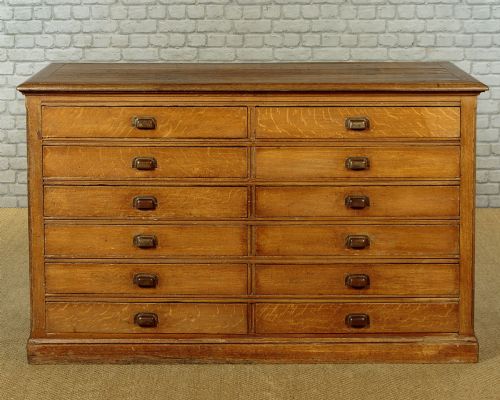
You are most likely to meet filing cabinets, banks of drawers and haberdashery or watchmaker cabinets on this page. These items range from tambour front file cabinets and draper's countertop needle drawer units to large banks of twelve drawers and desktop cabinets.
The objects originate from working environments such as offices, draperies and workshops where durable storage was essential. Their construction reflects a purely utilitarian purpose designed to withstand decades of continuous use.
How they were made
The primary material across these pieces is solid oak, selected for its strength and heavy weight. Cabinetmakers paired this dense timber with brass and metal hardware to reinforce structural joints and drawer pulls.
Functional mechanisms define the construction of many pieces, notably flexible tambour fronts and specialised drawer arrangements. Glass panels also appear in display elements, allowing visibility into countertop and tabletop cabinets.
The inventory spans the nineteenth century, Edwardian era, and the nineteen-twenties and thirties, constructed primarily from oak with brass, metal and glass components.
What varies in quality
Quality rests in the precision of the mechanics, such as the smooth running of tambour slats and the tight tolerances of multi-drawer banks. Pieces equipped with patented systems or specialised trade fittings represent higher manufacturing ambition.
The selection of timber grain and the integrity of the original brass or metal hardware distinguish standard utilitarian boxes from finer workshop items.
Amberg·Manoah Rhodes and Sons Ltd
The Commercial Oak Storage Glossary
- Tambour front
- A flexible door made of narrow wooden slats glued to a canvas backing, sliding in a track to conceal interior compartments. This mechanism saves exterior space in tight office environments.
- Haberdashery cabinet
- A set of shallow drawers originally used in shops to organise small sewing items, ribbons and notions. They feature multiple small pulls for rapid access.
- Bank of drawers
- A multi-tiered stack of storage compartments designed for systematic filing or parts storage. These units prioritize vertical capacity and sorting efficiency.
- Countertop cabinet
- A compact storage unit designed to sit on top of a shop counter or desk for immediate customer service. They bring contents to eye level.
Commercial Oak Storage: Frequently Asked Questions
What are commercial oak storage pieces?
These pieces are heavy-duty furniture items constructed from oak during the late nineteenth and early twentieth centuries for business environments. They include filing cabinets, shop counters and multi-drawer storage units.
Designed strictly for utility, they served offices, drapers and watchmakers who required secure organisation for documents, tools and small merchandise.
How do I date an oak filing cabinet?
Dating relies on stylistic clues and hardware conventions visible across Victorian, Edwardian and nineteen-twenties or thirties interwar commercial designs. Patent labels and mechanical systems like tambour fronts also point to specific eras of manufacture.
Examine the construction methods and the style of the brass and metal fittings to determine whether a piece originates from the nineteenth century or the interwar period.
Where were these cabinets used?
Original locations included merchant shops, corporate offices and specialised workshops requiring systematic organisation. Watchmakers, drapers and administrative clerks relied on these cabinets daily.
Today, these pieces transition easily into domestic spaces as functional storage for modern stationery, craft supplies or kitchen items.
How do tambour doors work?
Tambour doors consist of vertical wooden strips attached to a flexible fabric backing that runs inside grooved tracks along the cabinet frame. Pulling the handle slides the entire curtain around a curve to open the cabinet.
This clever mechanism eliminates the need for swinging doors, making it ideal for compact office desks and filing cabinets.