

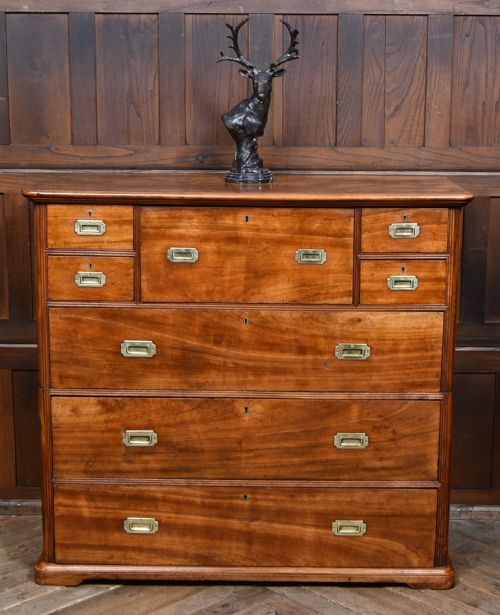

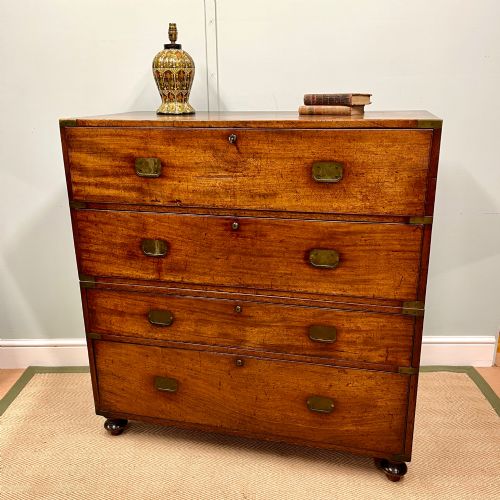


Colonial Secretaire Chest
A colonial secretaire chest combines brass-mounted travel utility with a fitted writing drawer, built to move across empires.
Colonial Secretaire Chest
A colonial secretaire chest functions as a robust chest of drawers incorporating a drop-front desk drawer for correspondence on the move. These items emerge from the nineteenth century, spanning Victorian, 1850, 1860, 1870, 1890, and 1920 production periods.
Most examples found here appear in two-part configurations designed for military campaigns and colonial travel. The forms integrate brass corners, recessed handles, and carrying hardware alongside fitted pigeonholes and small drawers behind the secretaire flap.
Makers utilised resilient tropical timbers and sturdy construction methods to withstand long journeys at sea and overland transport. The selections on this page unite British Colonial, Victorian Military, Anglo-Indian, and Anglo-Chinese styles into practical campaign furniture.
How they were made
Joiners constructed these chests primarily from dense timbers such as teak, camphorwood, rosewood, mahogany, and walnut to resist tropical humidity and rough handling. These woods provide a stable carcase capable of splitting into two distinct sections for lifting.
Brass strapping, corner brackets, and flush-fitting iron or cast iron carrying handles reinforce every vulnerable edge and joint. Internal writing surfaces frequently feature lined leather inserts to provide a smooth platform for pen and paper.
Colonial Secretaire Chest Retail Price Guide 2026
Typical asking prices for colonial secretaire chest among the pieces listed under this phrase on Sellingantiques today, from the lower quarter to the upper quarter. They describe what is for sale here now, not the wider market.
One listed chest carries the name Captain Fairbrother, preserving the personal identity of an officer who once travelled with his desk.
What varies in quality
The sophistication of the internal stationery fitments dictates much of the distinction between standard campaign pieces and finer commissioned works. Secret compartments, pigeonhole layouts, and small maple or mahogany drawers show the care taken by the cabinetmaker.
The weight and finish of the brass hardware, from flush handles to locking mechanisms, separate utilitarian transport trunks from more elaborate officer furniture. Timber selection also plays a role, with choice grains of rosewood or figured camphorwood elevating the appearance.
The Colonial Secretaire Chest Glossary
- Campaign chest
- A piece of furniture built in two sections with recessed hardware and carrying handles designed for military transport. It breaks down easily for movement on horseback or ship.
- Secretaire
- A desk drawer featuring a drop-front flap that conceals small drawers and pigeonholes for writing. This compartment folds down to form a flat writing surface.
- Camphorwood
- An aromatic tropical timber chosen for campaign furniture because its natural scent repels insects. It provides a durable and fragrant carcase for chests.
- Anglo-Indian
- A style of furniture produced in India during the British colonial period using local timbers and traditional British forms. It often combines European function with intricate regional carving.
Colonial Secretaire Chest: Frequently Asked Questions
What is a colonial secretaire chest?
A colonial secretaire chest is a portable set of drawers featuring a pull-down writing drawer designed for use during nineteenth-century military campaigns and travel.
These chests divide into separate stacking sections held together by brass fittings and carrying handles for ease of transit.
How were these chests used?
Officers and administrators utilised them as both clothing storage and portable desks while stationed across the British Empire.
The drop-front drawer allowed officials to write letters and manage documents in temporary quarters.
What woods were used?
Cabinetmakers built these chests from durable hardwoods like teak, camphorwood, mahogany, and rosewood.
These dense materials withstood the rigours of sea voyages and tropical climates better than standard domestic timbers.
How do I date a campaign chest?
Dating relies on timber choices, construction methods, brass hardware styles, and documented periods like the Victorian era or specific decades.
Makers' marks or inscriptions, such as officer names, also help establish the exact era of manufacture.