





Coastal Cliff Painting
A coastal cliff painting brings the dramatic meeting of land and sea straight to an interior, offering a window onto shores from Victorian Britain to the French Riviera.
Coastal Cliff Painting
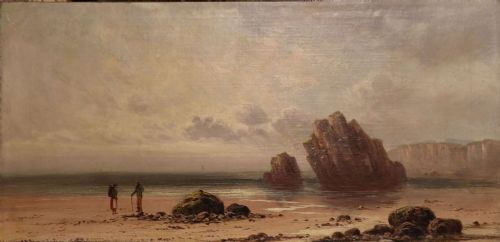
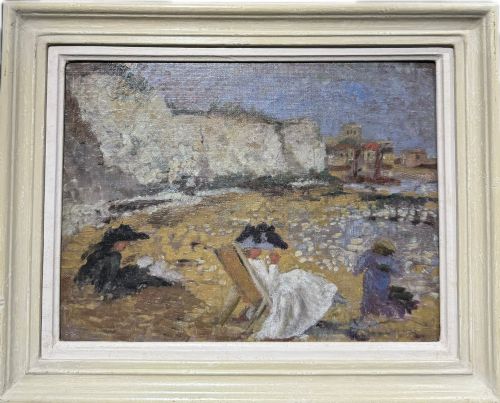
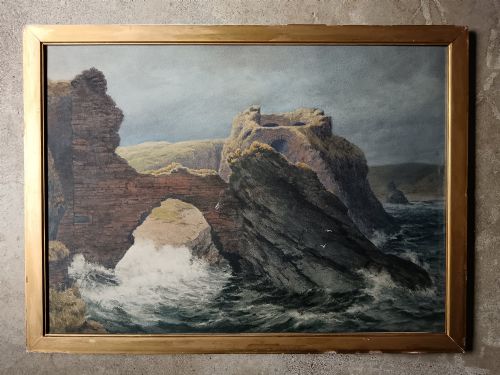
A coastal cliff painting captures shorelines, headlands, and beaches through various historic lenses, ranging from 19th Century Realism to British Impressionism and Post-Impressionism. These works frequently depict specific locations such as Runswick Bay, Cromer, or the Alabaster Coast, anchoring the artwork in real topography.
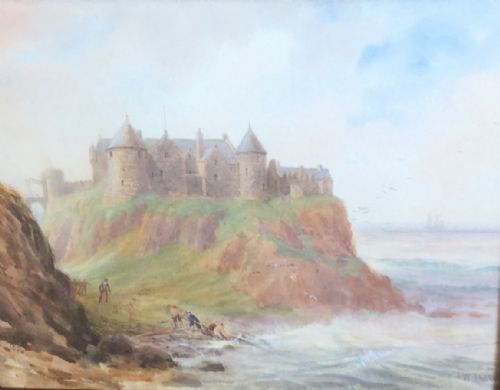
The pieces appearing on this page span several decades from the Victorian era through the 1950s, showing how artists recorded dramatic sea stacks, castles perched on headlands, and figures on beaches. Buyers encounter both intimate watercolours on paper and large-scale oil paintings on canvas or wood panels.
Watercolour paintings and oil paintings form the core of these offerings, capturing subjects like chalk cliffs at Beer, fishing boats below cliffs, and figures sunbathing on French shores. These works range from tightly detailed topographical watercolours to looser impressionist interpretations of light on water and stone.
Materials and technique
Artists executed these works primarily using oil paint on canvas, board, or wood, alongside watercolour pigment applied to paper. Oil paint allowed creators to build rich textures representing crashing waves and rugged cliff faces, while watercolour offered fluid transparency for atmospheric skies and coastal mists.
Support materials varied according to scale and period, with larger exhibition pieces demanding sturdy canvas stretched over wooden frames, and portable watercolours utilising heavy paper suited to outdoor sketching. Framed presentations often accompanied these works to protect the delicate paint surfaces and paper edges.
Coastal Cliff Painting Retail Price Guide 2026
Typical asking prices for coastal cliff painting among the pieces listed under this phrase on Sellingantiques today, from the lower quarter to the upper quarter. They describe what is for sale here now, not the wider market.
Several sheep manage to photobomb multiple dramatic Victorian cliff tops.
Factors of quality
Quality in a coastal cliff painting rests upon the artist's command of light, atmosphere, and spatial depth in rendering the meeting of land and sea. Works that successfully convey the atmospheric weight of salt air and the solidity of rock strata stand apart from routine topographical illustration.
The handling of medium distinguishes finer examples, whether through the confident, fluid washes of a watercolourist capturing Dunbar Castle or the deliberate, textured brushwork of an oil painter depicting chalk cliffs. Provenance and attribution to documented artists further elevate the standing of individual pieces.
John Moxon·Raymond Moritz·Norman Lloyd·Sir Thomas Newenham Dean·Stephen John Batchelder·Thomas Rose Miles·Joseph Newington Carter·Herbert James·William Savage Cooper·James Watson·William Edward Webb·Rowland Henry Hill·Edward T Jones·Fred Stead·Charles Jones·Joseph William Carey·George Marks·Alfred Egerton Cooper·Henry Valter
The Coastal Cliff Painting Glossary
- Watercolour
- A painting method where the pigments are suspended in a water-based solution. Artists apply these transparent washes to paper to achieve luminous effects.
- Oil paint
- A slow-drying medium composed of pigments suspended in a drying oil, typically linseed oil. This medium allows for deep colour saturation and textured impasto application.
- Canvas
- A closely woven heavy fabric utilised as a surface for oil painting. It is typically stretched across a wooden frame before work begins.
- Impressionism
- An art style focused on capturing the visual impression of the moment, particularly regarding shifting light and colour. Practitioners often utilise visible brushstrokes and unblended pigments.
Coastal Cliff Painting: Frequently Asked Questions
How do I hang a heavy oil painting?
Heavy oil paintings on canvas require secure fixings screwed directly into wall studs or heavy-duty wall anchors suited to the weight of the frame. Utilising sturdy picture wire attached to robust D-rings ensures the piece hangs safely.
Positioning the painting at eye level allows viewers to properly engage with the perspective of the coastline and the texture of the brushwork.
Where should I display watercolours?
Watercolours on paper need protection from direct sunlight to prevent the pigments from fading over time. Placing them on interior walls away from windows preserves the delicate tones of the sky and sea.
Framing under glass with acid-free mounts further safeguards the paper from environmental moisture and atmospheric pollutants.
How do I identify the period of a painting?
Dating a coastal work involves examining the clothing of any figures, the style of the brushwork, and the framing materials. Victorian pieces often feature detailed realism and ornate gilt frames, while 1920s and 1930s works may display looser, modernist tendencies.
Artist signatures, dates inscribed on the reverse, and historical exhibition labels provide definitive clues to the exact era of creation.
What is the difference between oil and watercolour?
Oil paint provides a thick, tactile surface with deep colour saturation that suits dramatic, stormy seas and heavy cliff textures. Watercolour relies on paper supports and translucent washes, creating lighter, more luminous atmospheric effects.
Both mediums offer distinct ways of recording the British and European coastline, depending on the artist's intent.