
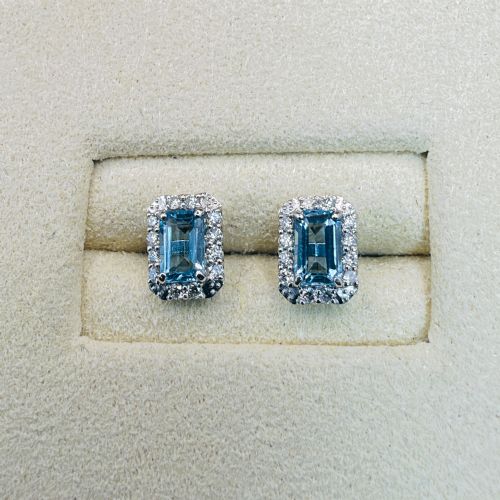
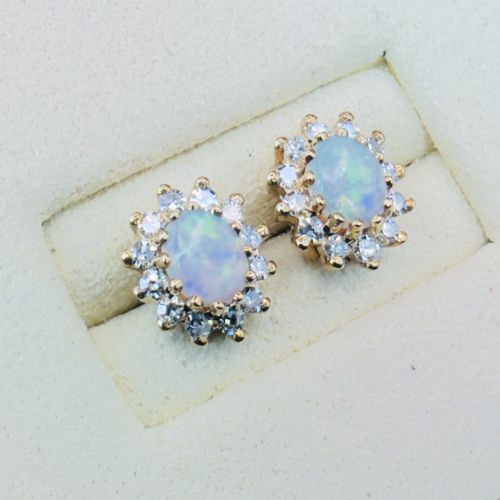


Cluster Style Stud Earrings
Cluster style stud earrings bring together a central gemstone surrounded by smaller stones, offering a secure fit close to the ear.
Cluster Style Stud Earrings
Cluster style stud earrings centre on a prominent main stone encircled by smaller accents, creating a compact silhouette that sits directly on the earlobe. The pieces on this page span several distinct periods, including the Edwardian era, the 1920s, 1930s, 1950s, and 1960s.
Designs on show include traditional floral arrangements, geometric Art Deco patterns, and daisy motifs. Stones range from diamonds and pearls to sapphires, garnets, opals, aquamarines, and peridots.
Mountings utilise various metals such as platinum, 18ct white gold, 9ct yellow gold, and standard 9ct gold. While most examples function as traditional studs, variations incorporate drop elements or screw and clip fittings.
How They Were Made
Goldsmiths constructed these mountings predominantly in white gold, yellow gold, platinum, and silver-topped gold, securing the stones with precise claw or bezel settings. Metals like 18ct white gold and platinum provided a durable yet bright framework that enhanced the sparkle of diamonds and coloured gems alike.
Gemstones such as diamonds, sapphires, garnets, and opals were cut into brilliant, emerald, oval cabochon, rose, and single cuts to maximise their individual visual impact within the clustered arrangement. Setting techniques required careful hand-placement of the surrounding stones to form uniform halos and floral shapes.
Some mid-century daisy clusters hide tiny brilliant-cut diamonds so tightly packed they practically buzz with floral enthusiasm.
What Varies in Quality
The choice of precious metals and the selection of gemstones dictate the distinction between standard and finer examples. High-grade mountings in platinum or 18ct white gold paired with clean diamonds and vivid sapphires represent a superior grade compared to lighter 9ct gold settings holding paste or faux pearls.
Precision in the arrangement of the cluster reveals the skill of the maker, where uniform stone spacing and secure, flush settings elevate the overall finish. Heavier metal weight and well-balanced stone proportions ensure the piece sits correctly on the ear without drooping.
The Cluster Style Stud Earrings Glossary
- Cluster
- An arrangement where a central gemstone is completely surrounded by a border of smaller stones. This design style creates a bold visual appearance from a compact footprint.
- Stud
- An earring design featuring a post that pierces the earlobe, holding the decorative element flush against the skin without dangling. Butterfly backs or alternative fastenings secure the post in place.
- Cabochon
- A gemstone cut with a smooth, rounded, convex upper surface and a flat base rather than faceted planes. This style is frequently used for opals and certain sapphires to showcase internal optical properties.
- Single Cut
- A simple diamond cut typically featuring seventeen facets, common in earlier twentieth-century jewellery. It produces a distinct, crisp sparkle compared to modern brilliant cuts.
Cluster Style Stud Earrings: Frequently Asked Questions
How do I wear cluster style stud earrings?
These earrings sit close to the lobe, making them suitable for both daily wear and formal occasions. Their compact profile ensures they do not catch on clothing.
Pair them with simple necklaces or bracelets to let the clustered stones remain the focal point of your outfit.
Are all cluster style stud earrings for pierced ears?
While the majority utilise standard posts for pierced ears, historical examples occasionally employ alternative fixings. Some vintage and antique variants use screw or clip-on mechanisms.
Check the specific listing details to confirm whether a pair requires pierced lobes or uses non-pierced fastenings.
How do I identify the period of an earring?
Dating relies on stylistic markers, metal choices, and gemstone cutting techniques characteristic of specific decades. Edwardian and 1920s pieces often display delicate millegrain work and platinum settings, whereas 1950s and 1960s items frequently showcase bolder floral or daisy cluster designs in yellow or white gold.
Comparing the stone cuts, such as single cut diamonds versus brilliant cuts, provides further clues to the era of manufacture.