
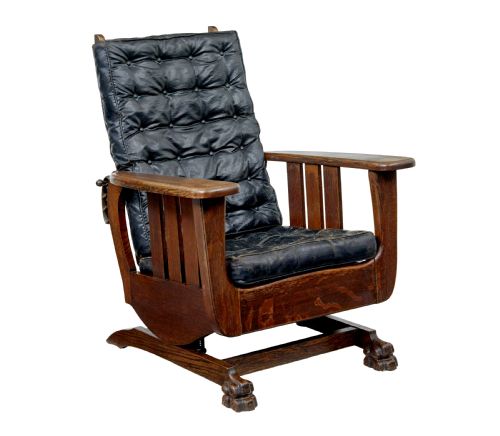


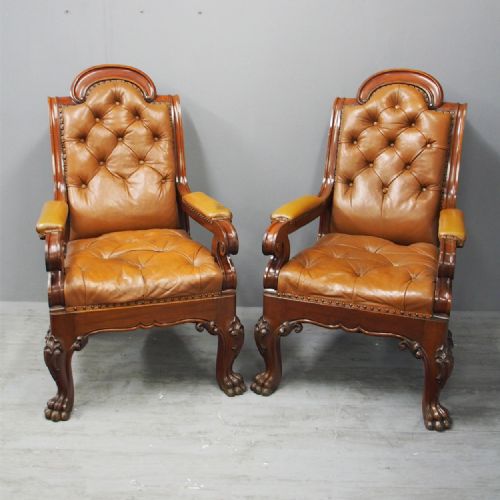
Claw Foot Leather Armchair
These claw foot leather armchair examples combine robust mahogany, walnut, and supple leather upholstery across various historic revivals.
Claw Foot Leather Armchair
A claw foot leather armchair offers a sturdy seating option characterised by prominent carved feet and traditional upholstery. These library chairs, club armchairs, and lounge suites appear in formats ranging from grand pairs to individual gentleman's seats.
The pieces represented span the nineteenth century through the early twentieth century, incorporating Victorian, Regency, and French Empire aesthetics. Buyers frequently encounter revival styles such as Chippendale and Georgian, alongside relaxed country house interpretations.
Makers and designers of the period adapted classic forms for domestic studies, libraries, and drawing rooms. The physical presence of carved claw and ball feet unites these diverse nineteenth-century and early twentieth-century seating options.
Materials and construction
Frames rely on dense hardwoods like mahogany, walnut, and general timber to support heavy use. Joinery techniques from the nineteenth and early twentieth centuries ensure structural longevity for these substantial frames.
Upholstery employs durable leather in shades of green, brown, and tan, secured over padded interiors. Metal elements such as brass occasionally appear in detailing, while wooden feet are meticulously carved into animalistic claw shapes.
Several armchairs are described as ladies and gentlemen pairs, ensuring no single seat has to read alone.
Assessing quality in leather seating
The distinction between standard examples and superior pieces rests on the precision of the wood carving on the feet and the richness of the timber grain. Finer library chairs exhibit crisper detail in the claw and ball motifs.
Upholstery execution and leather grading also dictate the tier of the piece, with thicker, supple hides elevating the overall manufacture. The harmony of revival proportions, whether French Empire or Georgian Chippendale, marks out the superior workshops.
Howard And Sons·George Bullock
The Claw Foot Leather Armchair Glossary
- Claw and ball
- A decorative foot carved to resemble an animal's claw grasping a spherical object. This motif appears frequently on eighteenth-century revival furniture legs.
- Library chair
- A heavy, comfortable armchair designed for reading rooms and studies. These typically feature upholstered arms and deep seating.
- Mahogany
- A durable tropical hardwood valued for its reddish-brown colour and fine grain. Makers utilised this material extensively for high-status frames.
- French Empire
- A neoclassical design style popular in the nineteenth century, characterised by military motifs and classical restraint. Pieces in this aesthetic often display bold forms.
- George IV
- A period of British design spanning the early nineteenth century. Furniture from this era often bridges Regency elegance and early Victorian mass.
Claw Foot Leather Armchair: Frequently Asked Questions
What is a claw foot leather armchair?
A claw foot leather armchair is a substantial seat featuring carved animalistic feet and leather upholstery. These chairs were built for libraries, studies, and formal drawing rooms.
They combine heavy timber frames with padded seating designed for long periods of reading or entertaining. The presence of carved claw and ball feet defines their distinct visual appearance.
How do I date a leather armchair?
Dating relies on examining the underlying wood, the style of the carved feet, and the construction methods used in the frame. Victorian and nineteenth-century pieces often display heavier proportions than later twentieth-century iterations.
Revival styles such as Georgian Chippendale or French Empire provide additional clues regarding the era of manufacture. Comparing the upholstery techniques and timber types helps narrow down the decade.
Are these chairs comfortable for daily use?
These library and club armchairs were originally constructed to offer substantial support and comfort for daily use. Their deep seats and upholstered arms make them practical for modern living spaces.
Condition varies depending on the preservation of the internal padding and the leather surface. Proper maintenance ensures these historic seats remain functional in contemporary homes.
What wood types were used?
Framing materials primarily consist of mahogany and walnut, alongside general hardwoods. These timbers provided the necessary strength to support heavy leather upholstery and carved elements.
Mahogany was favoured for its rich grain and durability in high-status library chairs. Walnut also appears frequently in nineteenth-century club armchairs.