

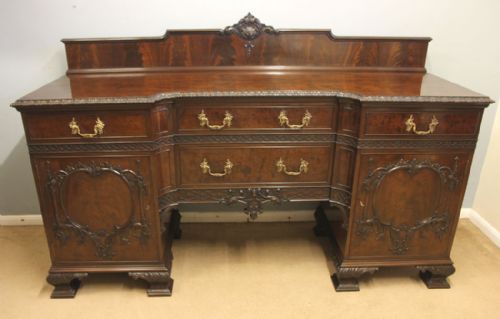


Claw and Ball Credenza
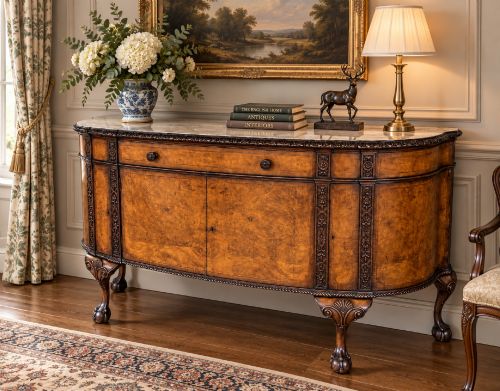
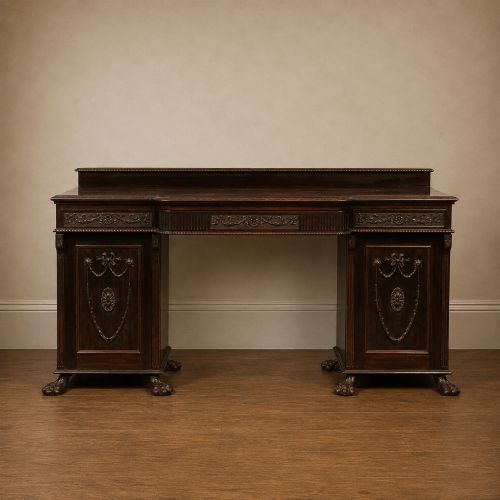
A claw and ball credenza brings grand revival proportions and distinct carved footwork into a formal dining room or hallway.
Claw and Ball Credenza
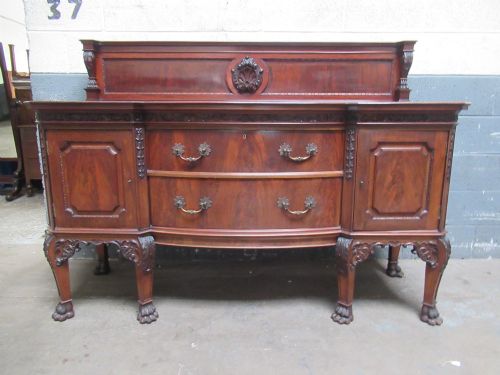
A claw and ball credenza encompasses a range of substantial sideboards, side cabinets, and display pieces linked by revival styles and heavy carved footwork. You are most likely to encounter Edwardian and early twentieth century mahogany or burr walnut pieces carrying Chippendale and Queen Anne revival influences.
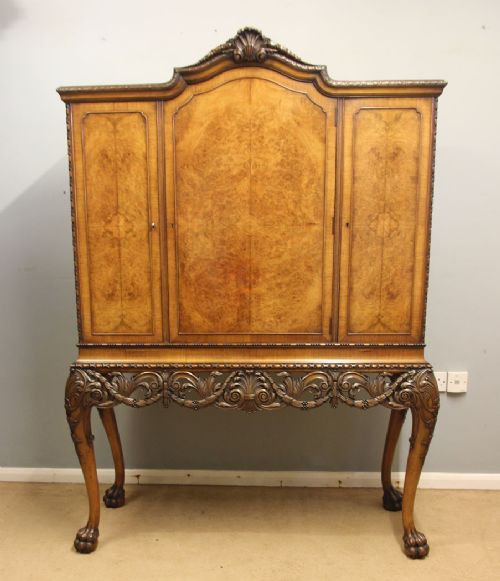
Forms on this page span straightforward servers and sideboards to breakfront cabinets, display cases, and dedicated cocktail units. These large storage items provide deep cupboards and drawer space while anchoring a room with dark wood presence and traditional motifs.
How they were made
Cabinet makers built these pieces using solid mahogany or hardwood frames combined with decorative veneers such as flame mahogany and burr walnut. Surfaces often feature carved details, serpentine or breakfront contours, and glass panels for display sections.
Hardware includes brass fittings, while the defining feet are carved directly from the timber to mimic the classic bird or beast talon gripping a sphere.
Claw and Ball Credenza Retail Price Guide 2026
Typical asking prices for claw and ball credenza among the pieces listed under this phrase on Sellingantiques today, from the lower quarter to the upper quarter. They describe what is for sale here now, not the wider market.
Some cocktail cabinets hide their evening provisions behind dignified walnut doors that pretend to be a serious bookcase.
What varies in quality
Quality reveals itself in the crispness of the timber carving, particularly around the intricate claw and ball feet and any applied mouldings. Heavier reliance on select burr walnut or flame mahogany veneers indicates higher ambition in the original workshop.
Structural complexity also separates standard servers from grand breakfront bookcases and cocktail cabinets with fitted interiors. Proportion, timber selection, and depth of carving dictate where a piece sits within the revival hierarchy.
The Claw and Ball Credenza Glossary
- Claw and ball
- A decorative foot carved to represent a talon grasping a ball, heavily favored in eighteenth century furniture and revived in later eras. This motif adds substantial visual weight to the base of large cabinets.
- Breakfront
- A piece of furniture whose central section projects forward from the flanking outer sections. This architectural arrangement creates dynamic shadow lines across large sideboards.
- Serpentine front
- A cabinet front featuring a curved profile that undulates outward in the centre and inward at the sides. It requires skilled woodworking to shape timber smoothly.
- Burr walnut
- Wood taken from the gnarled growth of a walnut tree, prized for its swirling, highly figured grain pattern. Cabinet makers used it as a veneer on statement doors and drawer fronts.
- Demi-lune
- A half-moon shape used for console tables and small side cabinets designed to sit flush against a wall. This format suits narrow hallways and smaller drawing rooms.
Claw and Ball Credenza: Frequently Asked Questions
What is a claw and ball credenza?
A claw and ball credenza is a large storage piece, typically a sideboard or display cabinet, featuring distinct carved footwork and revival styling from the early twentieth century.
These items combine deep cupboard capacity with decorative display functions, utilising rich hardwoods and veneers to anchor traditional interiors.
How do I date these cabinets?
Dating relies on stylistic markers, construction methods, and timber treatments that point toward Edwardian workshops or the decades immediately following.
Revival pieces often blend eighteenth century aesthetic rules with twentieth century interior requirements, distinguishing them from original antique items.
Where should I place one?
These substantial pieces demand adequate floor space and wall clearance to display their carved proportions and curved fronts properly.
Dining rooms, spacious hallways, and formal living areas suit the scale of breakfront sideboards, cocktail cabinets, and long display units.
What woods were used?
Makers relied heavily on mahogany as a primary solid timber, alongside durable hardwoods for structural stability and framing.
Decorative surfaces frequently showcase burr walnut and flame mahogany veneers to provide striking grain patterns across large doors and drawer fronts.