



Classical Ring
A classical ring brings centuries of ancient art to the hand through carved intaglios and cameos set in gold.
Classical Ring
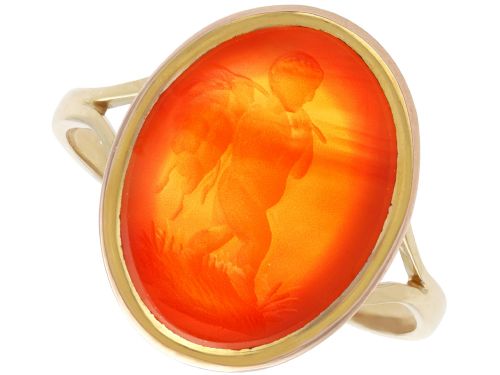
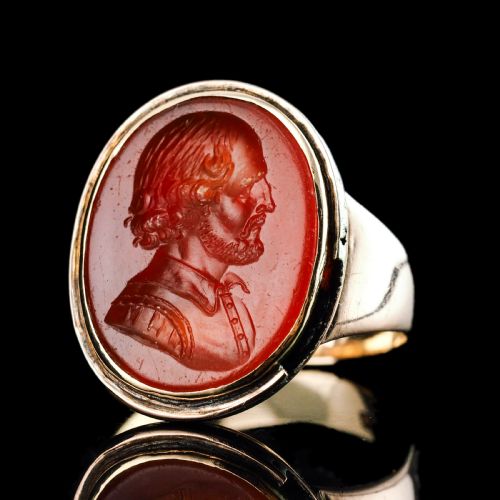
A classical ring is a piece of jewellery that uses ancient motifs or antique carved stones to evoke classical antiquity. These pieces predominantly take the form of intaglio rings and cameo rings featuring carved hardstones, agates, and carnelians.
Most examples encountered here date from the Georgian, Victorian, and Edwardian eras, spanning the eighteenth, nineteenth, and early twentieth centuries. They combine historical subjects such as classical female portraits, gentlemen, Zeus, and allegorical figures with enduring gold settings.
How they were made
The manufacture of these rings relies upon the skilled glyptic art of carving hardstones, specifically agate and carnelian, to produce recessed intaglios or raised cameos. Craftsmen utilise the natural colour banding of the stones to create contrast against the background.
The stones are then mounted securely into settings forged from various purities of gold, including nine-carat yellow gold, nine-carat rose gold, and eighteen-carat gold. This metalwork reflects the prevailing styles of the Georgian, Victorian, and Edwardian periods.
Classical Ring Retail Price Guide 2026
Typical asking prices for classical ring among the pieces listed under this phrase on Sellingantiques today, from the lower quarter to the upper quarter. They describe what is for sale here now, not the wider market.
Listings feature items spanning the eighteenth, nineteenth, and twentieth centuries, predominantly utilising agate, carnelian, and various purities of gold.
What varies in quality
Quality in these rings is determined by the precision and depth of the stone carving itself, where finer handwork yields sharper detail in the portrait or allegorical figure. The anatomical accuracy and expression of the subject distinguish superior examples from simpler productions.
The choice of materials also dictates the standing of the piece, with heavier gold weights and well-matched, high-grade hardstones or agates marking out the upper echelon of the range.
The Classical Ring Glossary
- Intaglio
- A gemstone or hardstone carved with a sunken design so that an impression can be made in wax. This technique was widely utilised in the Georgian and Victorian eras for signet rings and classical subjects.
- Cameo
- A method of carving where the design is raised in relief against a contrasting background colour. This style is frequently seen in Victorian hardstone and agate rings.
- Hardstone
- A semi-precious stone such as agate or carnelian used by lapidaries for carving detailed portraits and mythological scenes. These durable materials ensure the survival of the design over centuries.
- Carnelian
- A brownish-red variety of quartz crystal that is commonly used for intaglios. Its warm tone provides a striking contrast when set in yellow or rose gold.
Classical Ring: Frequently Asked Questions
What periods do these rings come from?
These rings mainly originate from the Georgian, Victorian, and Edwardian eras, spanning from the late eighteenth century through to the early twentieth century.
Makers of these periods drew heavily upon Classical Revival and Renaissance Revival aesthetics, reinterpreting ancient motifs for contemporary wearers.
What materials were used in their creation?
The stones chosen are typically natural hardstones, including carnelian and banded agate, which lend themselves well to minute carving.
These carved gems are set in various grades of gold, predominantly nine-carat yellow gold, nine-carat rose gold, and eighteen-carat gold.
How do I care for an antique gold ring?
Antique gold and hardstone rings require gentle handling to preserve the integrity of the antique metal settings and the delicate carved stones.
Avoid exposing them to harsh chemicals or ultrasonic cleaners, storing them separately to prevent scratches on softer gems like agate.